Wuzhen
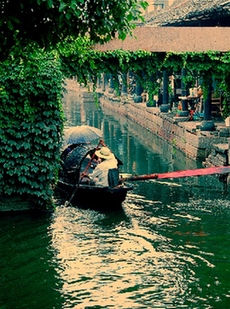
Wuzhen, about one hour from Suzhou and Hangzhou, and two hours from Shanghai, prides itself on its native son Mao Dun, one of the biggest names in 20th century Chinese literature. But Mao Dun was just one of a long list of literary luminaries from this area. Others include the titan of martial arts fiction, Jin Yong (Louis Cha), and romantic poet Xu Zhimo.
There is an innate connection between this canal-woven landscape and the abundance of literary genius. But you don't need to be aware of it to enjoy this town where black is so dominant you wonder whether Wuzhen (literally 'black town') is named after its color scheme or whether it was modeled on a black-and white brush painting.
Along its slightly curved street are some households open to the public. They serve as small museums to showcase wine brewing, cloth dyeing, old furniture and the traditional lifestyle that has been preserved over centuries. A town plaza, somewhat rare in this area, puts on shows with a local flavor for the throngs of tourists.
Mudu
The most famous folk tale involving Suzhou and its vicinity happened 2,500 years ago when what is now Zhejiang and southern Jiangzhou was divided into two kingdoms, Yue and Wu respectively. The king of Yue, after a humiliating defeat by Wu, lay low and hatched a scheme. He trained a local girl and sent her to the king of Wu as a concubine. The girl, using her beauty as bait, distracted the Wu king into neglecting his defense and paved the way for Yue to get his revenge and conquer Wu.
The girl, named Xi Shi, was one of the four ancient beauties of China. While the Wu king was madly in love with her, he commissioned a palatial resort at the top of a mountain near Suzhou. So many logs were transported through the rivers that the place at the foot of the mountain was totally blocked.
That place grew to be Mudu, literally 'clogged by wood'. It is difficult to distinguish legend from history, but the town was so prosperous and beautiful by the time of the Ming and Qing dynasties that it was a must-see for all six of Emperor Qianlong's tours of southern China. A court painter drew a 1,225-cm long scroll of scenes of Suzhou, half of which depicted suburban Mudu.
Now only half an hour from Suzhou, Mudu is known for its many private gardens. Step into one of them and you'll realize why even the Emperor was fascinated. Of course, you can venture up the nearby mountain. The original palace no longer exists but there are monuments in memory of the love and treachery from a love-blind king and a girl driven by patriotism.
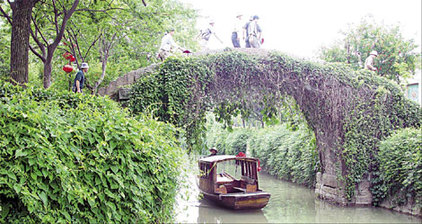
Small bridges like this are scattered around the rivers in Mudu. Xu Jianhua
(China Daily August 24, 2008)