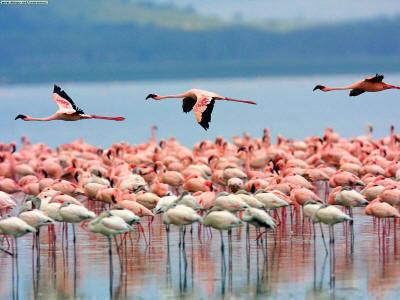
Eduardo Rodriguez Ramirez, Biologist, said, "Out of the six flamingo species in the world, the most threatened is the Flamingo Andino. There are only around 40-thousand counted individuals and the reproduction sites are very limited."
According to Ramirez, Flamingo Andino only reproduces in two places in Chile.
One of them is the Salt Lake of Atacama.
Here, dozens of indigenous people are temporarily employed every year guarding the restricted area where flamingos lay their eggs. They are there to prevent people from gathering and eating the eggs.
Some of them, like Maria Mondaca Cruz, work as guides for visiting tourists.
She explains to visiting tourists how the fees they pay to enter the park benefit local indigenous communities.
Maria Mondaca Cruz, Tourist Guide, said, "This is because this land use to belong to our ancestors, our grandfathers, they have always been here. For this reason we asked the National Forest Corporation if we could collaborate with them in this place".
The cooperation seems to be a win-win solution.
Indigenous people can earn money protecting the breeding sites of the endangered species.
Still, that doesn't solve the problem of a lack of water, the biggest threat facing flamingo Andino.
Water is key in the Atacama desert, commonly considered as one of the driest places on earth.
It mainly comes from surrounding high mountains, which get snow at certain times of the year that partly melts to supply the salt lake.