155 killed in Baghdad twin bombs
 0
0 


During his visit, Maliki said that the attacks would not affect the political process or the parliamentary elections due on Jan. 16, 2010 and pledged to punish those who are behind the bombings.
Maliki reiterated his accusation to the "remnants of the dismantled regime and Qaida militants," referring to Saddam Hussein's Baath party members and Qaida organizations in Iraq.
Maj. Gen. Qassim Atta, spokesman of Baghdad operations command, said that investigations are still underway as the devastation is enormous and the vehicles used in the bombings have turned into small pieces.
"Our experts are active to find out more details about the brutal attacks," Atta told reporters.
"The terrorists are targeting the government and the political process in the country," he said.
 |
|
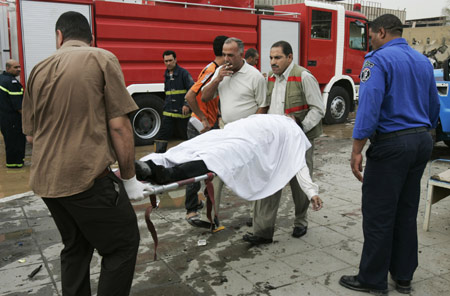
Security officials take a dead man to the morgue after two car bombs targeting the Ministry of Justice and the Baghdad Provincial Council exploded in central Baghdad October 25, 2009. [Xinhua] |
Jawad al-Bolani, Minister of Interior, told local media that the attacks are similar to the August 19 deadly attacks that targeted two Iraqi ministries, killing and wounding some 1,300 Iraqis.
"The attacks bear the same finger prints of the bloody Wednesday (August 19 attacks)," Bolani said.
Hassan al-Janabi, 35, angrily told Xinhua that "every time there is political disagreement or a new stage of the political process like the coming elections, we have deadly bombings."
Sunday's deadly bombings came as Iraqi political leaders were to meet in the evening to find a way out of the deadlock over the proposed election bill which threatens to delay the country's national elections due in next January.
Ali al-Dabagh, the Iraqi government spokesman, said Sunday's deadly attacks will be on the table of the Political Council for National Security meeting, confirming that the attacks were targeting the elections.
On Wednesday, Iraqi parliament speaker Ayad al-Samarrai said the parliament failed to overcome differences over the amendments of the electoral law and therefore they referred the controversial bill to the Political Council of National Security, which comprises of President Jalal Talabani, Prime Minister Nuri al-Maliki and the heads of political parliamentary blocs, in addition to Samarrai himself.
Observers here say that the stumbling block to approve the proposed amendments on the electoral law is mainly differences among the parliamentary blocs over the ethnically mixed city of Kirkuk, some 250 km north of Baghdad.
The Kurds demanded to incorporate Kirkuk in their autonomous region, while the Arab and Turkmen communities opposed the Kurdish ambitions and insisted on either staying under Baghdad control or being a separate federal region.


Comments