Obama's fiscal discipline yet to return
 0
0 


U.S. President Barack Obama has repeatedly pledged during the past year that his administration will return to fiscal discipline. However, his budget proposal for 2011 with a record deficit indicates that the U.S. fiscal policy remains what is called "talk the talk, spend the spend" way.
 |
|
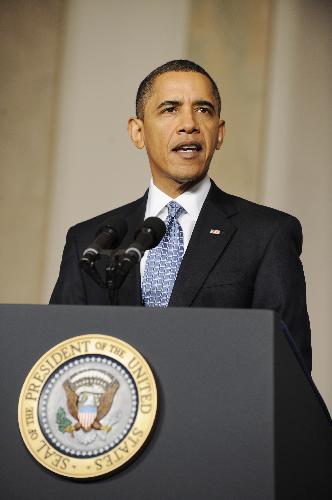
U.S. President Barack Obama speaks on the 2011 budget at the Capitol Hill in Washington Feb. 1, 2010.[Zhang Jun/Xinhua] |
With an all-time high 1.56-trillion-U.S.-dollar deficit in fiscal year 2010 ending in September, the budget shortfall would equal an unsustainable 10.6 percent of the gross domestic product (GDP), the basic measure of a country's overall economic output.
"It's time to save what we can, spend what we must and live within our means once again," Obama said Monday as he unveiled his 3.8-trillion-dollar blueprint for the budget year that begins Oct. 1.
The Heritage Foundation, a Washington-based think tank, said the Obama budget only means higher taxes, higher spending and more debt.
Among the major goals of Obama's new budget, creating jobs is the key concern.
The unemployment rate, currently at 10 percent, remains a 26-year high, and is not expected to drop significantly in the coming years. The budget documents forecast a 9.8-percent unemployment rate by the end of this year. Fighting unemployment has become one of the top priorities for the Obama administration.
The new budget proposal set a 100-billion-dollar job measure that would provide tax breaks to encourage businesses to boost hiring as well as greater government spending on infrastructure and energy projects.
Much of the spending surge over the past two years reflected the cost of the 787-billion-dollar economic stimulus measure that Congress passed in February 2009 to tackle the worst economic downturn since the Great Depression.
The Obama administration vowed again to cut budget deficit. The new budget proposal set measures to reduce spending, including freezing discretionary, non-security spending and endorsing a pay-as-you-go proposal that passed the Senate last week.
Still, U.S. fiscal discipline is unlikely to return in the short run because of economic and political factors.
Basically, there are only two ways to cut deficit: to increase revenue and to decrease spending. Neither is easy to accomplish.
The worst recession since the 1930s has depressed tax revenues. That, combined with spending on two wars and stimulus programs, has swollen the national debt to a whopping 12.1 trillion dollars. This leaves little room to maneuver, either for Obama or Congress. They can only nibble around the edges.
According to the latest data released by the Commerce Department last Friday, the U.S. economy increased at an annual rate of 5.7 percent in the fourth quarter last year, the quickest pace in more than six years. The best showing since 2003 was also much more energetic than the 4.6 percent increase that economists had been expected.
In the third quarter of 2009, real GDP expanded at 2.2 percent. But the two straight quarters of growth last year followed a record four quarters of economic decline
As a Wall Street Journal analysis said the Great Recession continues despite the positive GDP figures.
Lawrence Summers, senior economic advisor to President Obama described the U.S. economic situation as "a statistical recovery but a human recession."
Economists say that spending the tough time out is the easiest way both for the government and Congress.
Capitol Hill deliberations "will be difficult, will be painful, will be partisan," said Stanley Collender, a longtime staff analyst for congressional budget committees and now a budget expert at Qorvis Communications. "The tension is clearly between jobs and deficit reduction."
Political factors also have a role to play.
A recent editorial of the Washington Post noted that U.S. Congress seemed capable only of decreasing revenue and increasing spending. As the two parties helped create this mountain of debt, both parties will be needed to reduce it.
However, the two parties apparently have less cooperation inside the Beltway. Obama has fastened on the idea of a bipartisan commission that would negotiate budget fixes that Congress would vote on as a package. The Republicans considered budget deficit as a major target to criticize the Democratic government and to gain political momentum before the Congress mid-term election in November.
While it is widely believed the trillion-dollar budget deficits will cripple the U.S. economy in the long run, the Obama administration has to follow the more pragmatic approach - to tackle the deficit problem later , when economic recovery is still based on a shaky footing.


Go to Forum >>0 Comments