Share:

The 2025 Children's Science Fiction Nebula Awards were handed out on May 23 in Harbin, northeast China's Heilongjiang province, with prominent science fiction writers Chen Qiufan and Wu Yan taking top honors.
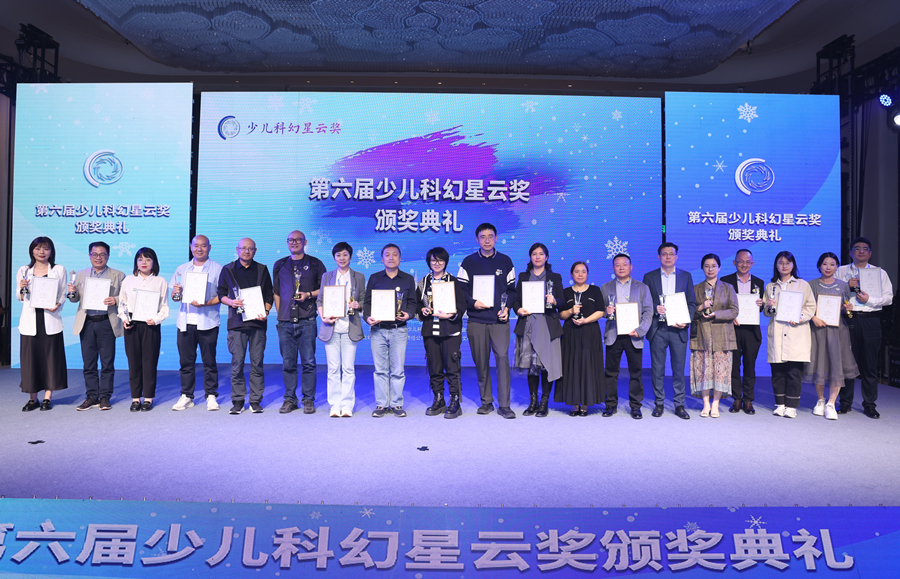
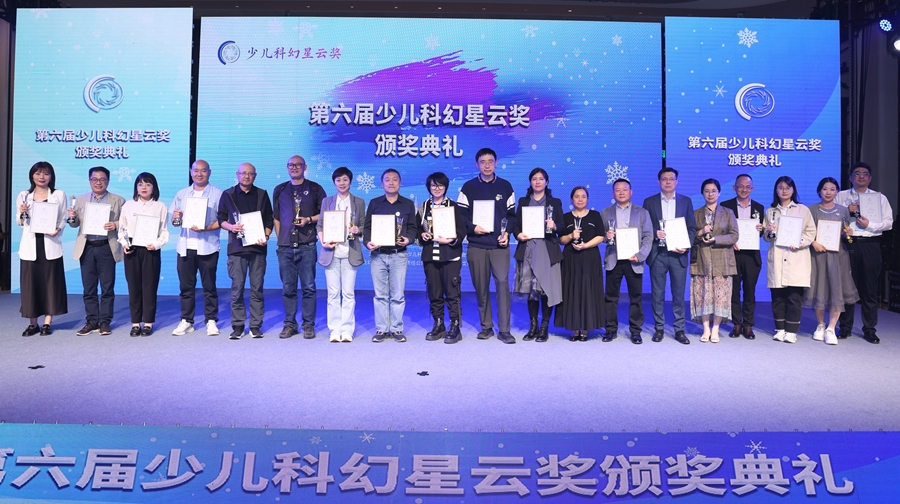
Winners of the sixth Children's Science Fiction Nebula Awards pose for a photo at the ceremony in Harbin, Heilongjiang province, May 23, 2025. [Photo courtesy of Time Vision]
Chen Qiufan's "The Songs of Mountain and Sea" won the gold award for best novel or novella. The story follows a girl from Zhejiang who moves with her scientist father to a mountainous region in Guizhou, where she befriends a girl from the Dong ethnic minority. Together, they embark on an adventure that explores how technology can help preserve traditions and biodiversity, seamlessly blending science fiction with ecological themes to imagine a harmonious future society.
The jury praised "The Songs of Mountain and Sea" for its contrast between a tech-driven city and a rural village, showing how local residents evolve from rejecting to cautiously embracing technology. The novel raises questions about the kind of future the world needs, examining technology's impact on lifestyles, ethics, nature and cultural heritage with a cutting-edge, humanistic and eco-conscious perspective.
Although Chen was in France attending the Cannes Film Festival during the award ceremony, he shared his gratitude on social media and pledged to "continue working hard to create more sci-fi stories for teenagers."
Chen's novel also inspired another accolade: Children's sci-fi critic Cui Xinping won the gold award for sci-fi criticism for her work, "'The Songs of Mountain and Sea': The Fusion of Life's Spirituality and Modern Science."
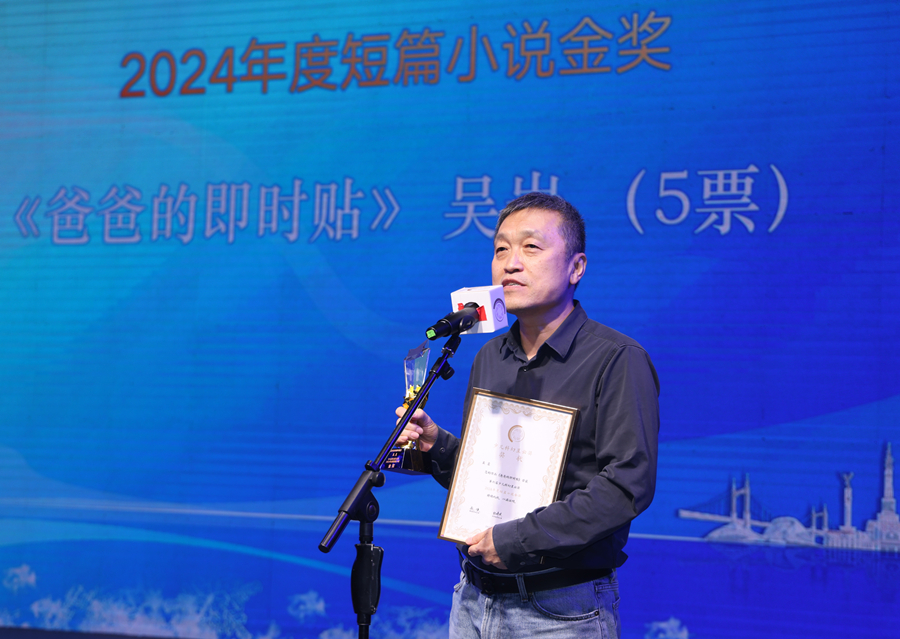
Science fiction writer and scholar Wu Yan accepts his best short story award at the sixth Children's Science Fiction Nebula Awards ceremony in Harbin, Heilongjiang province, May 23, 2025. [Photo courtesy of Time Vision]
The short story gold award went to renowned sci-fi writer and scholar Wu Yan for "Dad's Sticky Notes." The story centers on a third-grade boy who travels through time by using sticky notes as keys to different dimensions. It combines concepts from biomedical science, quantum physics and archaeology in a way that's easy for children to understand. Jurors praised the story for showing how different fields of knowledge can work together to solve problems, all within the framework of an exciting rescue mission. They also commended it for inspiring curiosity and a passion for discovery in young readers.
Wu, who is also a professor at the Southern University of Science and Technology, told China.org.cn that he has drawn on Chinese scientific discoveries for his sci-fi stories since 2000. One example is his story "Mouse Pad," which was inspired by the Chengjiang biota, a renowned fossil site in Yunnan. His award-winning "Dad's Sticky Notes" draws on the ancient astronomical observatory at Shanxi's Taosi site and references his own university.
"I hope this encourages more writers to explore local technological advances and anthropological discoveries in their sci-fi creations," he said.
Other notable awards included the gold award for most influential writer of the year, which went to Yin Chao. Zheng Qiqi received the rising star gold award for 2022–2024, while Song Chuanzhu was named editor of the year. Several sci-fi writers, including Bao Shu and Lu Yang, received silver awards.
The sixth Children's Science Fiction Nebula Awards opened for submissions on Sept. 9, 2024, and ran for 196 days, attracting 262 entries. After two rounds of voting by a committee of more than 50 science fiction professionals, the shortlist for each category was announced on March 23, 2025. A jury of seven experts, chaired by Cheng Jingbo, then reviewed the finalists and selected the gold and silver award winners in each category.
The awards were launched in 2020 as a nonprofit initiative by Chinese sci-fi pioneer Dong Renwei, with support from leading figures in the sci-fi community such as Liu Cixin, Ma Chuansi and Lu Yang. Originating from a children's sci-fi book category established at the 2013 Chinese Nebula Awards, the program became an independent award system in 2020.
While the awards have typically been held alongside the Chinese Nebula Awards, this sixth edition marked the first time the ceremony took place separately in Harbin, Heilongjiang province. The Chinese Nebula Awards will be held in Chengdu, Sichuan province, this September.
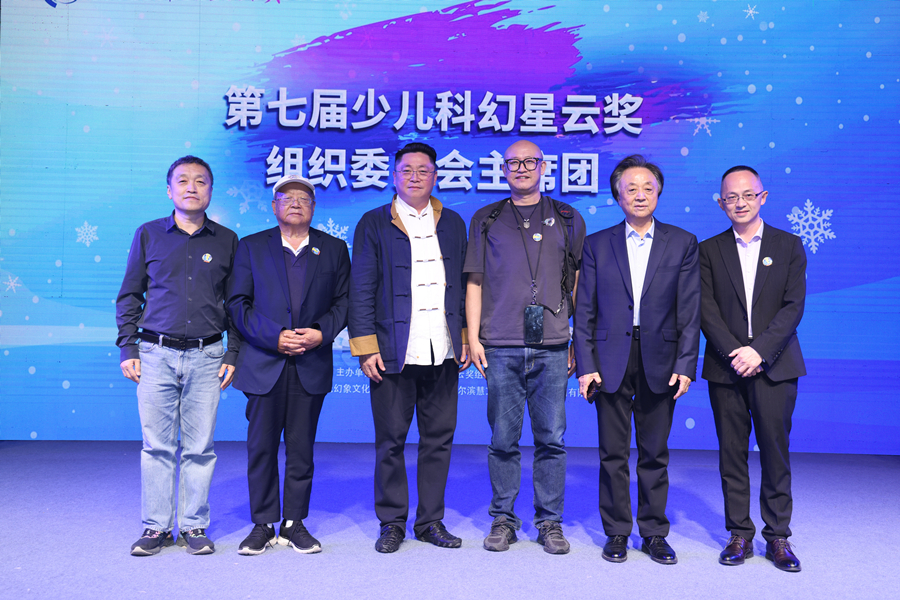
Members of the presidium of the sixth Children's Science Fiction Nebula Awards pose for a photo at the ceremony in Harbin, Heilongjiang province, May 23, 2025. [Photo courtesy of Time Vision]
The Children's Science Fiction Convention and an inaugural sci-fi book-themed exhibition were also held in Harbin to coincide with the awards ceremony. Sci-fi critic Cui Xinping, vice chair of the Shanxi Writers Association, presented the 2024 Children's Sci-Fi Creation Report at the convention. She noted that 189 new children's sci-fi titles were published this year – 169 original domestic works and 20 translations – and described these figures as encouraging.
Organizers said children's science fiction is flourishing in China, with nearly 100 writers and hundreds of original works published annually. The Children's Science Fiction Nebula Awards aim to spotlight the genre's growth, nurture talent, and promote further development of the sector.


 京公网安备 11010802027341号