

 Share:

More than 150 leading dermatologists from China and worldwide gathered in Shanghai on July 12-13 for the International Medical Derm Summit 2025, highlighting the country's expanding leadership in global dermatology research and treatment of chronic skin conditions.

Professor Zhang Jianzhong, chairman of the Chinese Medical Association's 13th Committee of the Chinese Society of Dermatology, speaks at the International Medical Derm Summit 2025 in Shanghai, July 12, 2025. [Photo courtesy of CAWA]
The summit, organized by the Chinese Aging Well Association (CAWA), focused on breakthrough treatments for eczema, alopecia areata and vitiligo, all chronic conditions that severely impact quality of life and require long-term care coordination.
"This meeting has established a high-level, bidirectional academic exchange platform between East and West, showcasing China's groundbreaking achievements in eczema registry studies, innovative systemic therapies, and standardized practices," said Professor Zhang Jianzhong, chairman of the Chinese Medical Association's 13th Committee of the Chinese Society of Dermatology and director of the Department of Dermatology at Peking University People's Hospital.
Zhang added that the summit "offers new approaches to elevating standardized diagnosis, treatment, and full-course management of chronic inflammatory skin diseases — both in China and globally."
The two-day summit underscored China's expanding role in health care innovation by showcasing contributions to international best practices and advancing research that benefits patients worldwide.
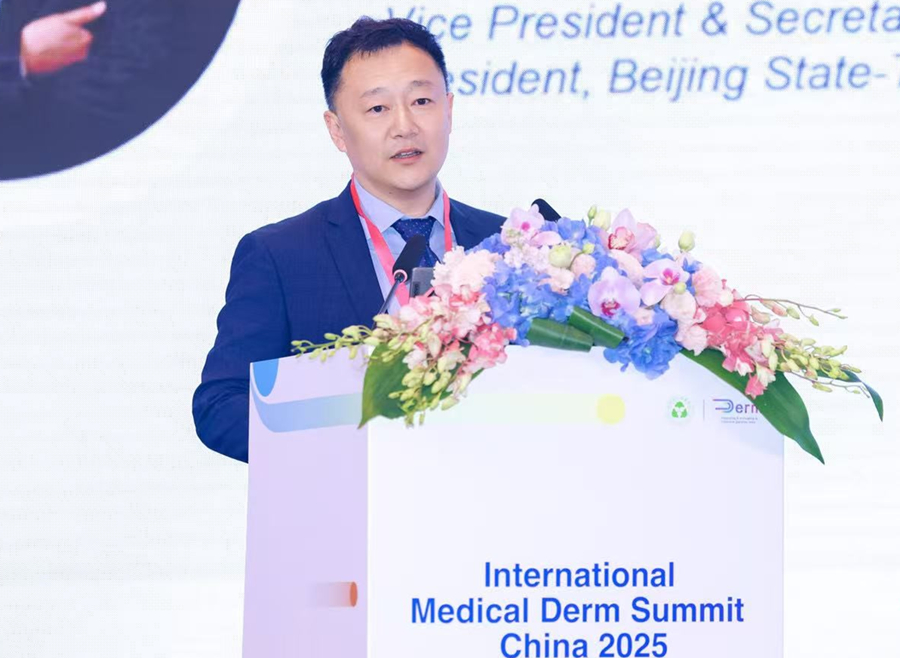
Wen Zhongyi, vice president and secretary-general of the Chinese Aging Well Association, speaks at the International Medical Derm Summit 2025 in Shanghai, July 12, 2025. [Photo courtesy of CAWA]
"This summit's focus on inflammatory skin diseases like eczema is profoundly significant, fully embodying the 'patient-centered' philosophy," said Wen Zhongyi, vice president and secretary-general of CAWA. "We hope that this successful gathering will serve as a pivotal practice in implementing the Healthy China 2030 blueprint, bringing together world-leading dermatology experts, thereby collectively writing a new chapter in skin health."
"Pfizer has long partnered with the Chinese dermatology community to drive the discipline forward, and we are delighted to witness China's accelerated transition from a participant to a source of innovation," said Felix Cao, chief medical officer of Pfizer China. "We will continue to deepen industry-academic collaboration to advance innovation that benefits more patients."
The summit opened with a focused discussion on eczema, a chronic inflammatory skin disease affecting approximately 230 million people globally, including 70 million in China, nearly a third of whom experience moderate to severe symptoms.
Presentations and case discussions covered complete eczema care — from early diagnosis and targeted treatments to long-term management strategies backed by real-world clinical data. Chinese experts presented updates to China's 2025 national eczema treatment guidelines, showing a shift from traditional steroid treatments toward personalized, precision treatments that improve patients' quality of life.
Explaining this new approach, Professor Zhang emphasized that current eczema treatment focuses on patient outcomes, improving symptom control and emotional well-being.

Felix Cao, chief medical officer of Pfizer China, speaks at the International Medical Derm Summit 2025 in Shanghai, July 12, 2025. [Photo courtesy of CAWA]
The summit highlighted the AHEAD registry, the world's largest real-world study of JAK1 inhibitors. The Chinese-led study includes 42 clinical sites with more than 1,000 patients, providing evidence to shape treatment standards globally.
The summit also addressed alopecia and vitiligo, two autoimmune skin conditions affecting physical appearance and emotional well-being, particularly in young patients.
Alopecia causes sudden and unpredictable hair loss and can occur at any age, but often appears in childhood or adolescence. JAK inhibitors offer a treatment option for the condition, with growing evidence supporting their effectiveness in controlling inflammation and promoting hair regrowth. For vitiligo, which causes white skin patches due to pigment cell loss, experts said effective treatment must address more than just cosmetic concerns.
The summit underscored the importance of moving beyond one-size-fits-all care for both conditions, emphasizing how personalized, compassionate treatment improves clinical outcomes and patients' lives.


 京公网安备 11010802027341号