Share:

U.S. President Donald Trump and Russian President Vladimir Putin on Friday wrapped up a high-stakes meeting in Anchorage, the U.S. state of Alaska, but no deal was reached.
The talks, which lasted about three hours, focused primarily on the Ukraine crisis, as well as on reshaping bilateral relations that have largely stalled in recent years.
Though Trump said progress was made during the meeting, no concrete deal was agreed upon, while Ukraine and other European countries voiced concerns about being marginalized.
No deal reached
At a joint press conference following the meeting, Trump said "many points" had been agreed upon, noting "great progress" had been made, though no formal deal was reached.
Putin said he agreed that Ukraine's security should be ensured, adding that the understanding reached could help pave the way toward peace.
Russia is sincerely interested in ending the conflict, Putin said, stressing the need to address the "primary causes" of the conflict and warning Ukraine and European countries not to "throw a wrench in the works."
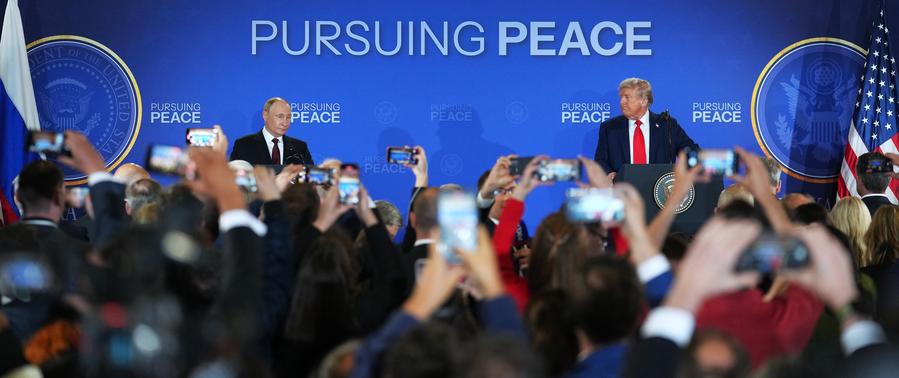
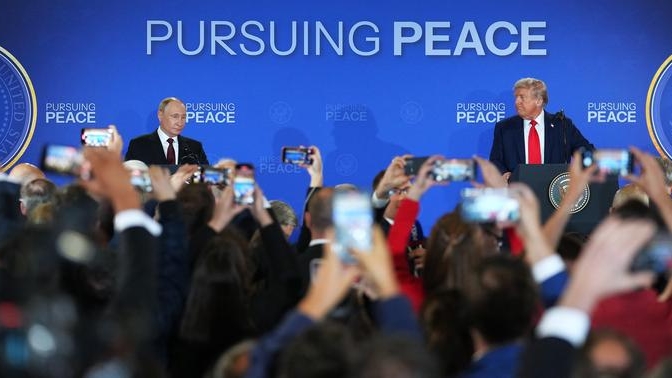
U.S. President Donald Trump (R, Rear) and Russian President Vladimir Putin (L, Rear) attend a joint press conference after concluding their talks in Anchorage, Alaska, the United States, on Aug. 15, 2025. (Xinhua/Wu Xiaoling)
In an interview with Fox News after the meeting, Trump said it is up to Ukrainian President Volodymyr Zelensky to strike a ceasefire deal, while indicating that he and Putin had discussed land transfers and security guarantees for Ukraine, and had "largely agreed".
The U.S. president also said a meeting involving Zelensky, Putin and himself would be arranged soon.
The meeting marked the first visit to the United States by a Russian head of state in nearly a decade and the first face-to-face meeting between the two countries' presidents since 2021.
In addition to the conflict, Putin also expressed hope that the meeting would serve as "a starting point" for restoring "business-like" and "pragmatic" relations between Russia and the United States, highlighting potential for Russia-U.S. cooperation in trade, high technology, space exploration and the Arctic.
The two leaders also left the door open for the next meeting, as Putin invited Trump to meet "next time in Moscow" during the press conference.
"I'll get a little heat on that one," Trump replied. "But I could see it possibly happening."
Many differences remain
Despite the moderately friendly atmosphere between the two leaders -- Trump welcomed Putin with a red carpet at the airport, which, according to Russian Foreign Ministry spokesperson Maria Zakharova, drove Western media "insane" -- many differences still remain between the two sides.
The two leaders did not reach an agreement on "probably the most significant" aspect of their meeting. "We didn't get there," Trump told reporters before leaving the press conference room, without taking questions.
"For the man who likes to tout himself as a peacemaker and a dealmaker, it appears that Trump will leave Alaska with neither," according to a BBC report, noting that Putin and Trump still have major differences in opinion over the Ukraine crisis.
The U.S. president also admitted in the Fox News interview that he was wrong to think the conflict would be easily solved. "I thought this would be the easiest of them all, and it was the most difficult," Trump said.
The summit in Alaska was productive, and the U.S. side received the Russian side "very well," said Kirill Dmitriev, Russia's top economic envoy, on Telegram.
The two countries would continue building relations despite "resistance," Dmitriev said.
Putin's remarks at the press conference, especially his emphasis on the "primary causes" of the conflict and his warning to Ukraine and European countries not to disrupt the talks, were seen by some in the West as evidence of "the summit's lack of actual progress."
Norwegian Foreign Minister Espen Barth Eide downplayed the meeting's "progress." "Too little concrete information has come out," he said.


 京公网安备 11010802027341号