


 Share:

Chinese animators produced a brand-new "Tom and Jerry" animated feature for the big screen in collaboration with Warner Bros. Pictures.
"Tom and Jerry: Forbidden Compass" opened in Chinese theaters nationwide Aug. 2, delighting children and fans alike. Directed and written by Zhang Gang, the film marks the first computer-animated "Tom and Jerry" feature set in China.
The story follows Tom and Jerry's accidental time travel through a magical compass in a museum, where they meet magical creatures from Chinese folklore and battle mysterious rats with their trademark slapstick humor.
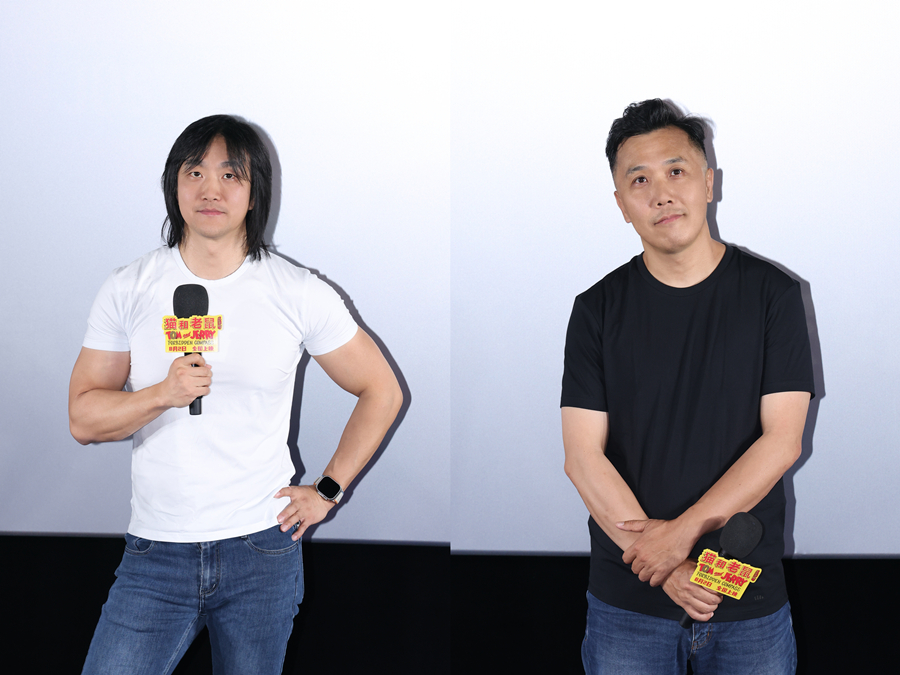
Director Zhang Gang and producer Yang Shaojing at the premiere of "Tom and Jerry: Forbidden Compass" in Beijing, Aug. 2, 2025. [Photo courtesy of Origin Animation Studio]
Zhang told China.org.cn that the project began five years ago when Warner Bros. issued a creative challenge to localize "Tom and Jerry" for the Chinese audience. His inspiration came from his Beijing childhood, when he remembered seeing a rooftop ornament depicting an immortal deity riding a phoenix on his family home.
From that memory, Zhang created a story blending "Tom and Jerry" with Chinese mythology about magical rooftop guardians — decorative figures that traditionally protect buildings in Chinese architecture. His team researched extensively at sites including the Forbidden City to understand the traditional lore behind these figures.
Chief producer Yang Shaojing, co-founder and general manager of Origin Animation Studio, said it was a continuous cycle of feedback to ensure that character designs, plot elements and cultural concepts with Chinese elements would translate well internationally.
Yang said merging the animation styles posed the greatest challenge. "Tom and Jerry," an 85-year-old American franchise, uses exaggerated cartoon movement with extreme squash-and-stretch techniques, while Chinese animation brings distinctive Eastern performance nuances. These elements were thoughtfully blended with the classic "Tom and Jerry" animation principles. The teams conducted extensive testing on everything from artistic approaches to fur and clothing textures.
"The 2D to 3D conversion was extremely challenging," Zhang said of the "Tom and Jerry" franchise, which was originally created as 2D shorts. "Technically speaking, 2D animation uses just six key angles, but 3D requires full 360-degree rendering. For this film, we first drew everything completely in 2D. Then our 3D animators had to master traditional drawing before applying 'Tom and Jerry' animation principles from the 2D reference material."
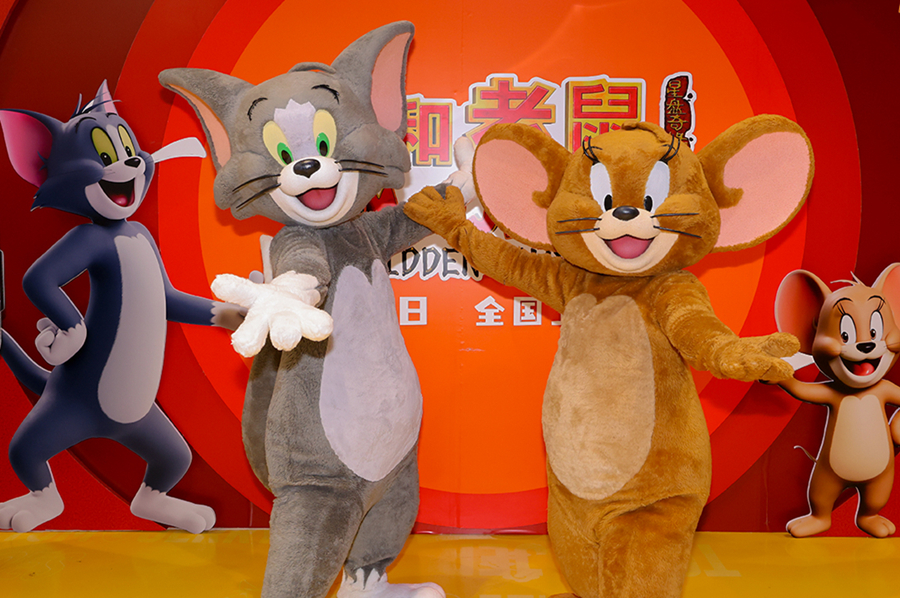
Performers dressed as Tom and Jerry pose at the premiere of "Tom and Jerry: Forbidden Compass" in Beijing, Aug. 2, 2025. [Photo courtesy of Origin Animation Studio]
Zhang said the squash-and-stretch effects from the 2D shorts posed the toughest technical challenges. The team invested significant resources in developing compression and deformation techniques. Scenes like Tom being sliced flat or morphing into a beehive — while honoring classic moments — required rebuilding rigging systems and models from scratch. The process demanded exceptional time and budget to authentically replicate the signature style.
Yang noted China's animation industry has developed exceptional talent over the years, with various studios demonstrating through recent blockbusters that animation isn't just for children.
"China's animation future will undoubtedly produce groundbreaking works," Yang concluded. "For creators, it represents an unparalleled opportunity."


 京公网安备 11010802027341号