

 Share:

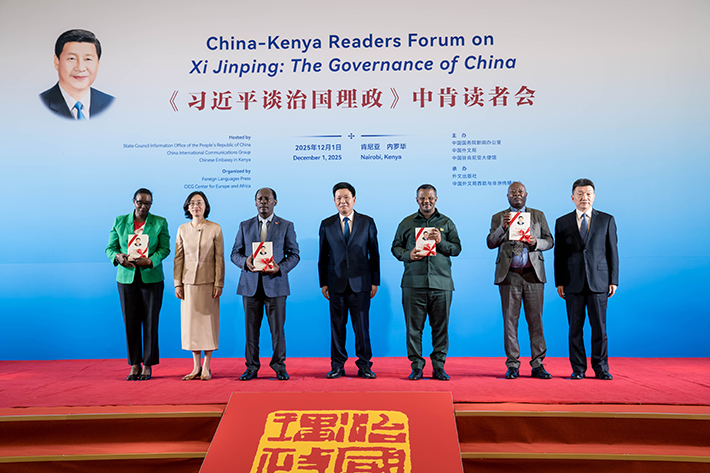
Guests at the China-Kenya Readers Forum on Xi Jinping: The Governance of China are presented with copies of the book in Nairobi, Kenya, on Dec. 1.
As the Global South countries experience a collective rise and growing confidence in independent development, China's development path and governance experience have drawn increasing attention, particularly in Africa. Recent readers' forums and promotional events on Xi Jinping: The Governance of China held in Kenya and South Africa offered an in-depth interpretation of the core elements of Chinese modernisation, sparking wide resonance and discussion among African political and academic circles.
Paths aligned with national conditions
For decades, global discourse has equated modernisation with Westernisation. China's rapid industrialisation achieved over just a few decades while ensuring long-term social stability offers a new vantage point for countries around the world - especially those in the Global South.
Hassan Omar Hassan, secretary general of Kenya's ruling United Democratic Alliance, noted that many African countries once attempted to copy Western democratic and economic models, only to encounter political upheaval and stalled development. Xi Jinping: The Governance of China, he said, reveals a fundamental principle: development has no fixed template and must be grounded in a country's own realities.
This view resonated strongly in South Africa. National Assembly House Chairperson Cedric Frolick argued that Chinese modernisation represents a new model altogether. It rejects the colonialism and plunder often associated with Western modernisation, adheres to peaceful development, and shares opportunities with the world. For countries in the Global South, it offers a new vision: achieving prosperity without sacrificing sovereignty and advancing towards modernity without discarding cultural traditions.
Paul Tembe, founder and director of SELE Encounters of South Africa, emphasised that China's experience is rooted in its 5,000-year civilisation. Much like the South African philosophy of Ubuntu, which highlights community, he said the most important lesson from China is cultural confidence: we must draw on our own philosophical traditions to solve our own problems.

Participants of the China-Kenya Readers Forum on Xi Jinping: The Governance of China read the book in Nairobi, Kenya, on Dec. 1.
Putting people first
Once the correct direction for development is set, effective governance becomes essential. Participants highlighted several key elements of China's governance system found in Xi Jinping: The Governance of China.
The first is the unwavering principle of putting the people first. William Kabogo Gitau, cabinet secretary for Kenya's Ministry of Information, Communications and the Digital Economy, cited a line from the book - "the people's wish for a happy life is our mission" - and noted its strong alignment with Kenya's aspirations to improve livelihoods and empower communities. Beatrice Elachi Kadeveresia, a member of Kenya's National Assembly and secretary general of the Kenya–China Friendship Association, added that China's focus on solving practical livelihood issues and its pragmatic approach are worth learning from.
The second is the political courage of continuous self-reform. Kirtan Bhana, director of the Diplomatic Society of South Africa, was impressed by the book's discussions on combating corruption. Citing the phrase "offend a few thousand rather than fail 1.4 billion," he highlighted the resolve to place national interests above personal interests and the governing party's ability to self-correct, which keeps China dynamic and resilient.
The third is strategic planning marked by foresight and continuity. Frolick pointed to China's five-year plans as a key indicator of governance effectiveness. He said they ensure the consistent implementation of long-term strategies, avoid policy disruptions caused by political cycles, and provide institutional safeguards for long-term goals. This capability, he said, holds important lessons for many African countries.

Copies of Xi Jinping: The Governance of China are presented at a promotional event for the English edition of the fifth volume of the book in Johannesburg, South Africa, on Dec. 3.
Poverty reduction and green development
China's development philosophy is ultimately reflected in tangible outcomes. Among these, its success in poverty alleviation and progress in green transformation drew special interest from African participants, who regarded them as practical case studies.
Thembinkosi Josopu, a member of the National Development Agency Board of South Africa, has visited China to study poverty alleviation initiatives. He was particularly struck by the concept of targeted poverty alleviation. China, he observed, abandoned broad, undifferentiated approaches in favour of a data-driven system that accurately identifies impoverished populations, analyses the causes of poverty, and implements tailored measures for each household and individual. He regarded it as a scientific, comprehensive, and traceable system. Josopu also noted that China's multilevel support in industry, education, and health care provides highly practical lessons for African countries.
Maropene Ramokgopa, minister in the presidency for planning, monitoring and evaluation of South Africa, noted that the country is actively drawing on China's experience in state-owned enterprise reform, green transformation and technological innovation. These specific examples offer African countries directly observable and replicable cases.
Mutually beneficial cooperation
China's governance philosophy extends beyond its borders. Participants generally agreed that China's commitment to peaceful development and initiatives such as the Belt and Road Initiative provide new models for international cooperation.
The Belt and Road Initiative is widely regarded as a prime example. Citing the Mombasa-Nairobi Standard Gauge Railway, Hassan noted that the line is not merely a transport route but an economic corridor that significantly reduces logistics costs, creates jobs, and aligns with Kenya's national development blueprint, embodying the principle of extensive consultation, joint contribution, and shared benefits.
Kadeveresia highlighted China-Kenya cooperation in agricultural technology, industrial park development and other projects, all of which are benefiting ordinary people. These visible and tangible outcomes stand in stark contrast to the unfulfilled promises often associated with some Western partners.
From Nairobi to Johannesburg, these exchanges show that African countries are approaching China's development experience with growing pragmatism and nuance. Their interest reflects both a desire to learn from China's effective governance and development methods, and an appreciation of its principles of peace, equality, cooperation, and mutual benefit in global affairs. Discussions on Chinese modernisation are offering African countries both conceptual inspiration and practical references as they explore their own sustainable development paths.


 京公网安备 11010802027341号