 Share:

As the year draws to a close, the urgency of breaking news gives way to a quieter reckoning: what, in retrospect, actually defined the past 12 months? Headlines fade quickly, but the words that recur across coverage often outlast the events themselves. They signal what captured attention, framed discussions and shaped how a year can be understood.
The top 10 China media buzzwords of 2025, recently released by the National Language Resources Monitoring and Research Center, offer such a linguistic snapshot. Drawn from large-scale monitoring of mainstream print, broadcast and online media, the list records not only what China talked about in 2025, but also how those discussions traced the country's progress through this pivotal year.
The 10 buzzwords of 2025 were: "15th Five-Year Plan," "Sept. 3 Parade," "Global Governance Initiative," "DeepSeek," "humanoid robots," "Jiangsu City Football League (Su Super League)," "ticket-based economy," "child care subsidies," "scientific literacy" and "cyberspace governance." Covering areas such as national planning, technological change and social policy, the buzzwords form a compact narrative of how China's development was discussed and understood in media coverage over the course of the year.
Strategic planning and global responsibility
Several of the most prominent buzzwords were closely linked to China's governance agenda at both the domestic and international levels.
As 2025 marked the year of planning for the 15th Five-Year Plan (2026-2030), the term featured prominently in media coverage. From Oct. 20-23, the fourth plenary session of the 20th Communist Party of China (CPC) Central Committee reviewed achievements made during the 14th Five-Year Plan (2021-2025) period and discussed recommendations for formulating the next five-year blueprint, outlining strategic tasks and major priorities for the years ahead.
Reporting on the meeting highlighted that the 15th Five-Year Plan period represents a critical stage in advancing the goal of basically achieving socialist modernization by 2035. The recommendations reaffirmed high-quality development as the central theme of economic and social development, while emphasizing the need to accelerate high-level scientific and technological self-reliance and strengthen the leading role of innovation.
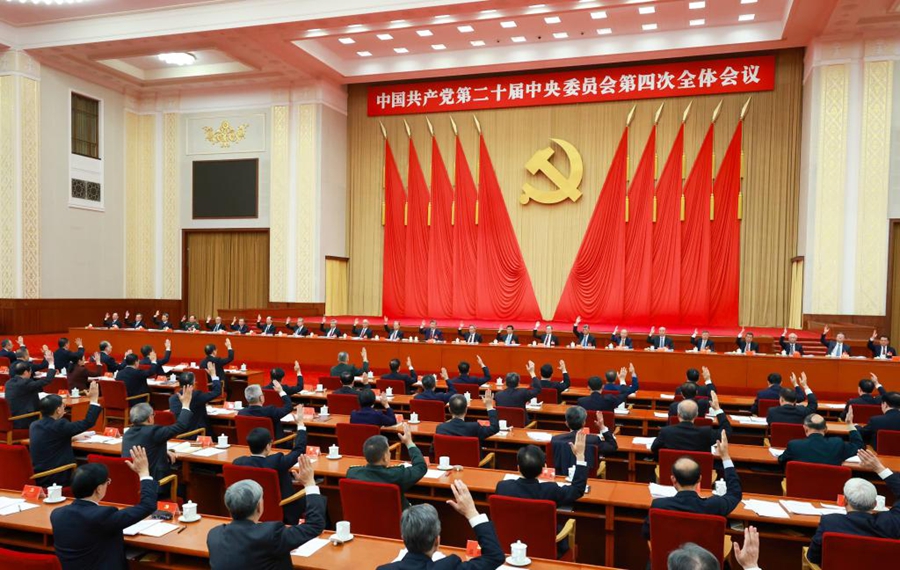
The Political Bureau of the CPC Central Committee presides over the fourth plenary session of the 20th CPC Central Committee in Beijing. [Photo/Xinhua]
If the year's planning discussions were about the road ahead, it was also shaped by a moment that looked back to history while speaking to the wider world. On Sept. 3, China held a major military parade in Tiananmen Square to mark the 80th anniversary of victory in the Chinese People's War of Resistance Against Japanese Aggression and the World Anti-Fascist War. Coverage of the event highlighted China's role as the main eastern theater of the World Anti-Fascist War and its major contributions to the final victory. Reporting also emphasized China's commitment to safeguarding the outcomes of World War II, upholding international fairness and justice, and promoting peaceful development, while actively advancing the building of a community with a shared future for humanity.
Against a backdrop of growing global turbulence and uncertainty, attention in 2025 also turned to questions of international governance practices. The Global Governance Initiative (GCI), proposed at the Shanghai Cooperation Organization Plus meeting, articulated China's approach to improving global governance through principles such as sovereign equality, respect for international law, multilateralism, a people-centered orientation and an emphasis on concrete action. Its rapid circulation in media discourse reflected growing attention to China's ideas and proposals on global governance.
Innovation moves from concept to application
If policy set the direction in 2025, technology supplied the momentum. Technological advancements featured prominently among the year's media buzzwords, reflecting both rapid progress and growing practical deployment.
Few buzzwords captured this better than "DeepSeek," an open-source large language model developed by a Chinese AI company. Following the launch of its official app in January, users were able to interact freely with the DeepSeek-V3 model. As the year progressed, the model was integrated by China's three major telecommunications operators and adopted by more than a dozen central and state-owned enterprises, supporting applications across health care, manufacturing and other sectors. Media coverage often framed DeepSeek as an example of how open-source approaches could accelerate the wider adoption of AI and contribute Chinese solutions to global technological development.
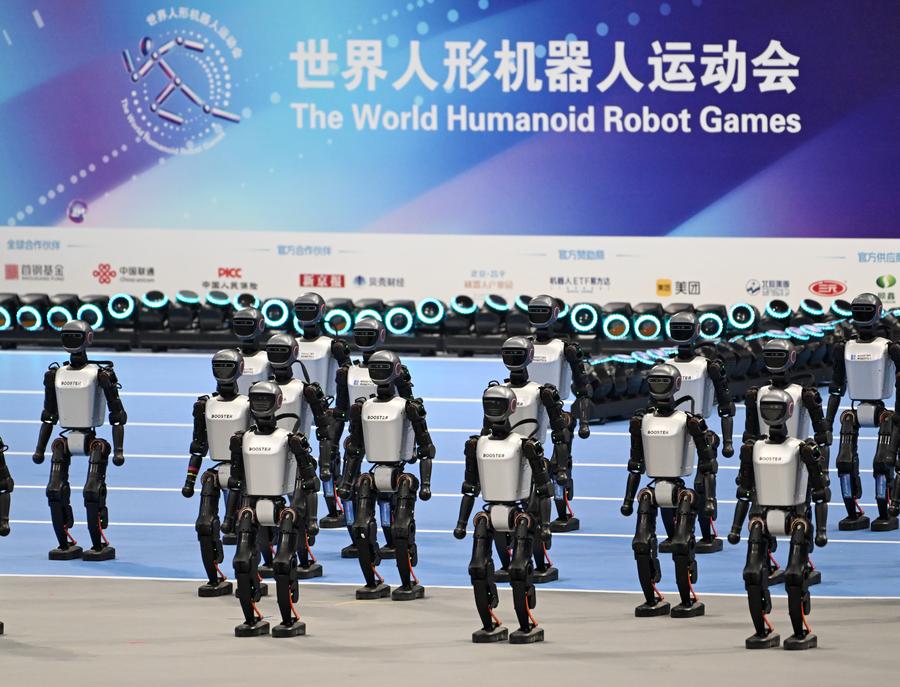
Humanoid robots line up during the opening ceremony of the 2025 World Humanoid Robot Games in Beijing, Aug. 14, 2025. [Photo/Xinhua]
At the same time, humanoid robots entered what industry observers described as a crucial transition from technical validation to commercial application. Incorporated into national plans for future industries, humanoid robots increasingly became a benchmark for assessing technological and industrial strength. In April, an industry blue book identified 2025 as the first year of mass production for the technology, while a series of high-profile events — including the world's first humanoid half-marathon and the World Humanoid Robot Games held later in the year — illustrated how the tech was moving beyond laboratories and into real-world scenarios. Media narratives highlighted not only their industrial potential, but also their implications for everyday life and human-machine interaction.
Consumption, participation and social vitality
Beyond grand strategy and frontier technology, other buzzwords reflected changes taking place closer to daily life, particularly in consumption and urban culture.
In 2025, the ticket-based economy gained momentum across China, driven by rising demand for integrated consumption scenarios and by policy efforts to promote coordinated development across commerce, tourism, culture and sports. In cities such as Shanghai, where the concept was incorporated into targeted initiatives to boost consumption, digital platforms were used to link tickets for sports events, cultural activities and transportation with discounts on dining, accommodation and tourist attractions. The model encouraged repeat and follow-on spending by turning one-off purchases into connected consumption experiences, helping to unlock domestic demand and positioning the ticket-based economy as a new driver of consumption-led growth.

People watch a Su Super League match on a big screen in a square in Xuzhou, Jiangsu province. [Photo/Xinhua]
A similar emphasis on participation and local identity was evident in the popularity of the Jiangsu City Football League, known as the Su Super League. Launched in May and covering all 13 cities in Jiangsu province, the league adopted a city-based home-ground system and low ticket prices, while limiting the number of professional players. Media reports highlighted how the tournament allowed amateur players to represent their hometowns, fostered a strong sense of urban identity and generated spillover effects for cultural tourism and related industries, making it a vivid example of sports-driven regional development.
Investing in people and governance
Several buzzwords also pointed to longer-term social priorities.
Child care subsidies moved into the public spotlight in 2025 after being outlined in the government work report as part of broader efforts to promote childbirth and expand inclusive child care services. Since then, fiscal support has been directed toward establishing a nationwide subsidy scheme and strengthening the public child care system, easing the cost burden on families. Under a dedicated policy, families with children under the age of 3 are eligible for an annual subsidy of 3,600 yuan per child, with applications processed through a unified online system. Media coverage noted that, as a core measure to support fertility, the policy not only boosts household disposable income but also reinforces a fertility-friendly approach, stimulates related sectors such as child care and maternal services, and lays a firmer foundation for long-term balanced population development.
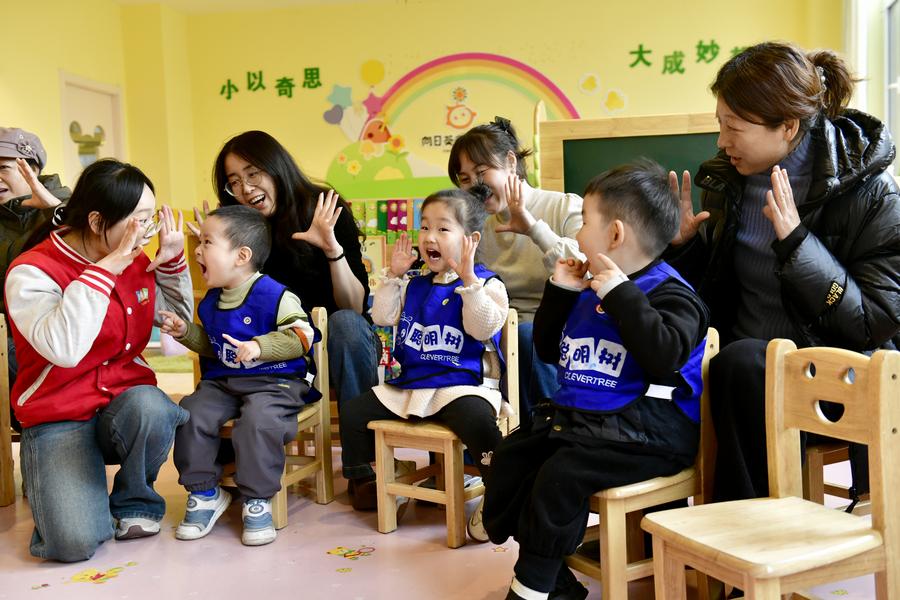
Teachers and parents play games with children at a kindergarten in Rizhao, Shandong province, Feb. 20, 2025. [Photo/Xinhua]
Beyond easing the immediate pressures faced by families, media attention in 2025 also turned to longer-term investment in human capital, with scientific literacy emerging as another key buzzword. In January, the Ministry of Education issued guidelines on science education in primary and secondary schools, outlining a framework to strengthen science education under the "double reduction" policy by fostering curiosity and improving students' inquiry and critical thinking skills. Media coverage framed scientific literacy as a core quality of innovative talent and a vital foundation for building a science and technology powerhouse, linking education reform with efforts to advance high-level technological self-reliance.
Completing the list was cyberspace governance, a term which featured prominently as digital technologies continued to reshape social interaction. On Nov. 28, the Political Bureau of the CPC Central Committee held a group study session on strengthening governance in the online environment. Media coverage emphasized that effective cyberspace governance is closely linked to national development and security, the protection of public interests and the long-term health of the digital ecosystem.
A year seen through its words
Selected from analysis of a corpus exceeding 1 billion Chinese character tokens, the top 10 Chinese media buzzwords of 2025 are not conclusions in themselves. Rather, they function as signposts, pointing back to the events, policies and debates that repeatedly shaped public attention over the year.
Read together, these words chart a year defined by planning and pragmatism, innovation and integration, reflection and reform. They suggest that in 2025, China's story was not told through a single headline, but through a shared vocabulary that captured how the country navigated change, addressed challenges and prepared for what lies ahead.


 京公网安备 11010802027341号