 Share:

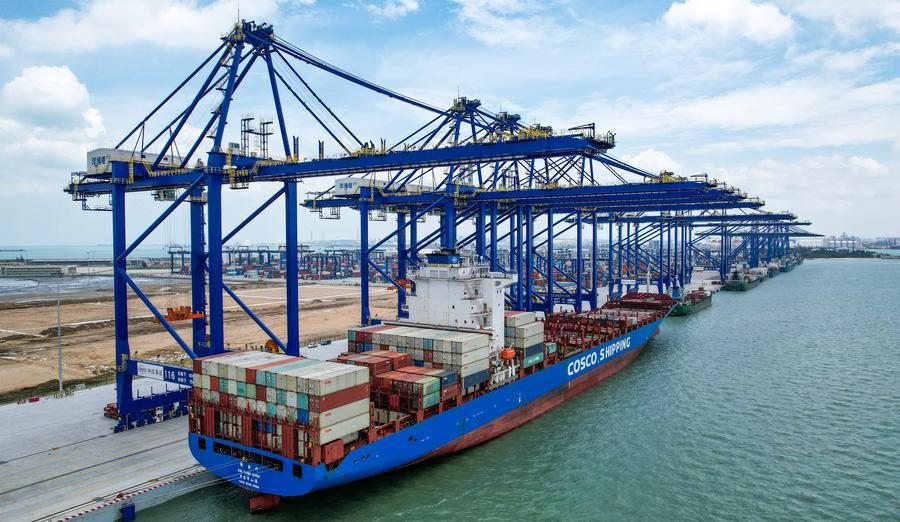
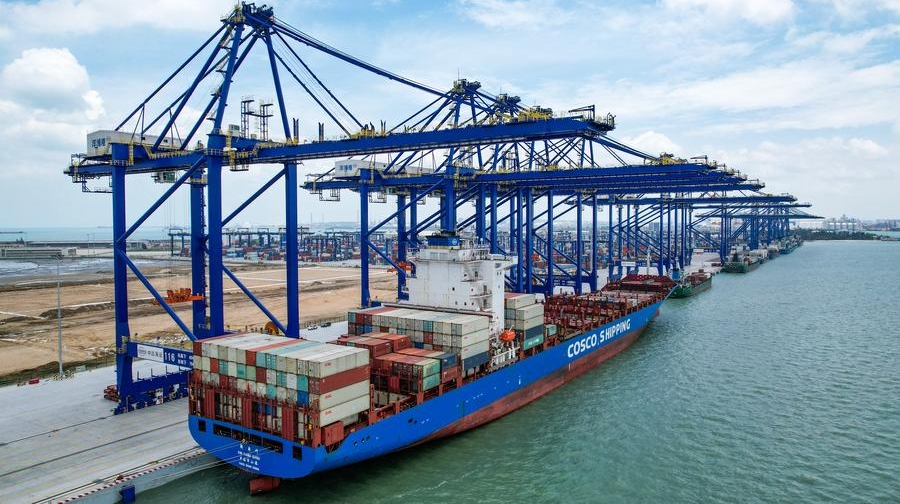
A drone photo taken on May 27, 2025 shows a view of the Yangpu International Container Port in the Yangpu Economic Development Zone in Danzhou, south China's Hainan Province. [Photo/Xinhua]
The Chinese word 韧性 (rènxìng, resilience), which resonated deeply with the public in 2025, ranked No. 1 on the annual list of top 10 Chinese buzzwords recently unveiled by Shanghai-based language and literature magazine Yaowen Jiaozi.
In the ancient Chinese dictionary "Shuowen Jiezi" ("说文解字"), the character 韧 (rèn) is explained as meaning "pliant yet solid." Literally, it describes an object or material that, when subjected to external force, is capable of changing its shape without easily breaking — being both supple and strong. Over the centuries, it has evolved to denote an unyielding, persistent spirit and indomitable will, with virtues possessed by the bamboo which stands firm, tenacious and unshaken regardless of the severity of external pressures or challenges.
With its English equivalent as "resilience," the Chinese word "韧性" was initially applied within the field of physics, denoting the capacity of a system to return to its original state after being subjected to pressure. Over time, this concept expanded into other disciplines including ecology, engineering, sociology and economics. In the realm of economics, "resilience" refers to the capacity of an economy to withstand, absorb and recover from external shocks or disruptions.
In 2025, the world economy encountered strong headwinds from escalating tariff frictions and intensified geopolitical tensions, coupled with persistent trade policy uncertainty and elevated financial market volatility. Amid a complex external environment, China's economy showcased dynamic and resilient performance, injecting greater certainty and fresh momentum into global growth.
Data from the National Bureau of Statistics shows that the country's GDP expanded 5.2% year on year in the first three quarters of 2025, laying a solid foundation for achieving the full-year growth target of around 5%. Its GDP is also expected to reach around 140 trillion yuan ($19.87 trillion) this year to ensure a successful conclusion to the 14th Five-Year Plan (2021-2025).
China has ramped up efforts to effectively navigate various challenges and bottlenecks, steadfastly focusing on its strengths to manage the nation's affairs and achieve sustained, high-quality development.
Fundamentally, China's economic resilience is secured by its unique institutional strength, which allows for long-term strategic planning to ensure continuity and stability in macroeconomic policies, as well as the efficient mobilization of resources to accomplish major national undertakings and address structural bottlenecks. China's five-year plans serve as both development and reform blueprints, with each of them setting phased arrangements to align with the goal of building China into a modern socialist country. This institutional model helps the country balance immediate needs with long-term objectives, and navigate short-term fluctuations and uncertainties with resolve and confidence.
China has rolled out a series of targeted micro policies across fiscal, monetary and industrial sectors throughout 2025. The country has implemented a more proactive fiscal policy to stabilize employment, enterprises, markets and expectations, and a moderately loose monetary policy to ensure ample market liquidity and drive down overall social financing costs. The total amount of ultra-long special treasury bonds was expanded to 1.3 trillion yuan, with 800 billion yuan for key projects to implement major national strategies and strengthen security capacity in key areas, as well as 500 billion yuan to support a new round of large-scale equipment upgrades and consumer goods trade-in programs. Diverse monetary policy tools have been leveraged to support scientific innovation, boost consumption, assist small and micro-sized enterprises, and stabilize foreign trade. Meanwhile, measures were also taken to defuse risks in the real estate sector and local government debt.
In 2025, China's ultra-sized market, with more than 1.4 billion people and around 190 million market entities, continued to serve as a stabilizer for growth by absorbing production capacity and supporting industrial upgrades. The massive domestic demand for diversified goods and services — ranging from traditional commodities to smart appliances and high-end products and services — created ample room for enterprises to grow and offered a crucial buffer against external shocks and trade frictions. In the first three quarters, domestic demand contributed 71% of economic growth. Great efforts have been made to boost the development of a unified national market, better align supply and demand for consumer goods, further stimulate consumption and boost market vitality.
The adaptability of the Chinese economy is also underpinned by its complete industrial system and technological innovation, which allows for a rapid response to market demand with alternative solutions and greater capacity to withstand disruptions to global industrial and supply chains. China is the only country in the world to have all industrial categories as defined by the United Nations.
In 2025, China's advantages in the industrial system are clearly evident in its breakthroughs in sci-tech innovation, its deep transformation and upgrading of traditional industries, and boosting of new quality productive forces, including strategic emerging industries and future industries, as a core driver of economic growth. The surge in emerging industries, including high-tech manufacturing, new energy, new materials, artificial intelligence and biotechnology, has boosted high-quality economic growth and enhanced China's competitiveness in global markets.
China's technological innovation vitality continues to be unleashed thanks to increased R&D spending and talent cultivation efforts. China is now home to over 500,000 high-tech enterprises and 24 of the world's top-100 sci-tech innovation clusters. It has nurtured more than 600,000 innovative SMEs, and over 17,600 national-level "little giant" firms —novel elite SMEs that specialize in a niche market, boast cutting-edge technologies and show great potential. This year, the country broke into the top-10 of the World Intellectual Property Organization's Global Innovation Index for the first time. In the first 11 months, the value added of high-tech manufacturing companies above designated size grew by 9.2% year on year, serving as a major driver for steady upward momentum in the industrial economy.
Hangzhou's "Six Little Dragons" (杭州六小龙, Hángzhōu liù xiǎolóng), which refers to six leading tech startups based in the city — DeepSeek, Unitree Robotics, Game Science, DEEP Robotics, BrainCo, and Manycore Tech — showcase Chinese enterprises' role in shaping the global innovation landscape.
Over the past year, China has also expanded high-standard opening up, and unveiled various policies to ease market access and optimize the business environment for global investment. China has become a major trading partner for over 150 countries and regions, and has signed 23 free trade agreements with 30 nations and regions. In February, the 2025 Action Plan for Stabilizing Foreign Investment was unveiled to encourage and support foreign-invested companies in the country. In October, the China-ASEAN Free Trade Area 3.0 Upgrade Protocol was signed to inject more momentum into regional and global economic growth. In December, the country launched island-wide special customs operations in the Hainan Free Trade Port and unveiled the 2025 version of the Catalogue of Encouraged Industries for Foreign Investment amid its opening up efforts.
Amid a volatile global trade environment, China has diversified export destinations to reduce reliance on any single market and the impact of U.S. protectionist tariff policies. In the first 11 months of the year, the country's foreign trade, a barometer of its economic vitality, hit 41.21 trillion yuan ($5.82 trillion), an increase of 3.6% year on year. Trade with Belt and Road partner countries, ASEAN, the European Union, Latin America and African nations grew by 6%, 8.5%, 5.4%, 5.6% and 18.7%, respectively, during the January-November period. Its export of high-tech and value-added goods were greatly increased amid a structural shift. Exports of mechanical and electrical products grew 8.8%, accounting for 60.9% of total exports.
In 2025, China has struck a balance between development and security amid rising global uncertainties and turbulence, sustaining a stable growth trajectory for the next stage of development. During the 15th Five-Year Plan (2026-2030) period, China will continue to manage its own affairs well no matter how the international situation evolves with a focus on innovation-driven and high-quality development, and remain a crucial stabilizer and driving force for global economic growth.


 京公网安备 11010802027341号