

 Share:

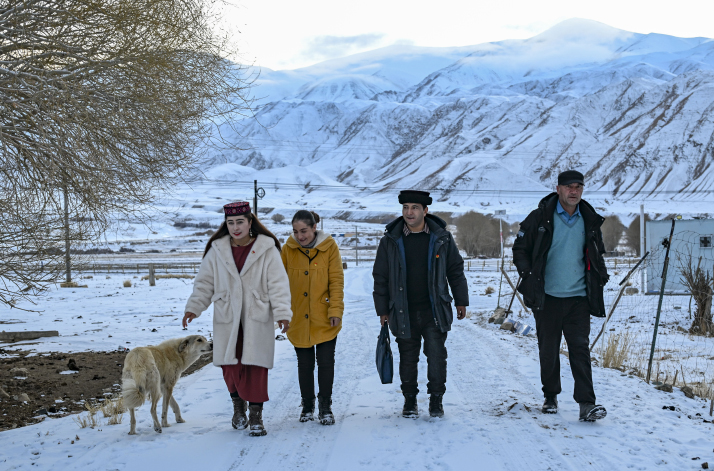
Duolaitiman Kaimike (second right), a village leader and National People's Congress deputy, chats with fellow villagers in Tashikuergan (Taxkorgan or Tashkurgan) Tajik Autonomous County, Kashi Prefecture, on January 3. [Photo/Xinhua]
On November 27, the Information Office of the People's Government of Xinjiang Uygur Autonomous Region held a press conference in Urumqi as part of the series themed CPC (Communist Party of China) Guidelines for Governing Xinjiang in the New Era: Practice and Achievements. The event introduced the measures and results achieved by the regional people's congress of Xinjiang in legislative work, oversight and the performance of deputies' duties.
In recent years, the People's Congress of Xinjiang Uygur Autonomous Region and its standing committee have thoroughly implemented the CPC's guidelines for governing Xinjiang in the new era, with a focus on strengthening the sense of the Chinese nation as one community. By upholding the system of people's congresses and advancing whole-process people's democracy, they have made tangible contributions to advancing Chinese modernization in Xinjiang.
Legislative work
As of October, Xinjiang had 173 local regulations in force, along with 54 resolutions and decisions with regulatory functions or on major matters. In addition, cities with districts, autonomous prefectures and autonomous counties across the autonomous region had 204 local and separate regulations in effect. Covering political, economic, cultural, social and public wellbeing fields, the legal framework with Xinjiang characteristics has steadily improved, providing strong guarantees for social stability and long-term peace in the region.
In key areas such as social stability, public wellbeing and the strengthening of cultural identity and bonds, the regional people's congress and its standing committee have adopted multiple local regulations, including those on the introduction of diverse ways for the resolution of conflicts and disputes, the implementation of the Employment Promotion Law, the protection of the Ancient City of Kashi, and the preservation of the Kirgiz epic Manas, which was included into UNESCO's Representative List of the Intangible Cultural Heritage of Humanity in 2009. The rights to subsistence, development and work of all ethnic groups in Xinjiang are effectively guaranteed.
In emerging areas related to high-quality development and high-standard opening up, Xinjiang has introduced regulations on the China (Xinjiang) Pilot Free Trade Zone, the promotion of the port economy, data management, the facilitation of government services, social credit and the improvement of product and service quality. Together, these regulations help build an open, transparent and predictable legal framework conducive to high-level development.
Xinjiang has also carried out foreign affairs-related legislation for the first time. In August 2024, the Standing Committee of the 14th People's Congress of Xinjiang Uygur Autonomous Region adopted a resolution opposing a series of unjustified U.S. sanctions on Xinjiang and providing support for affected enterprises and industries.
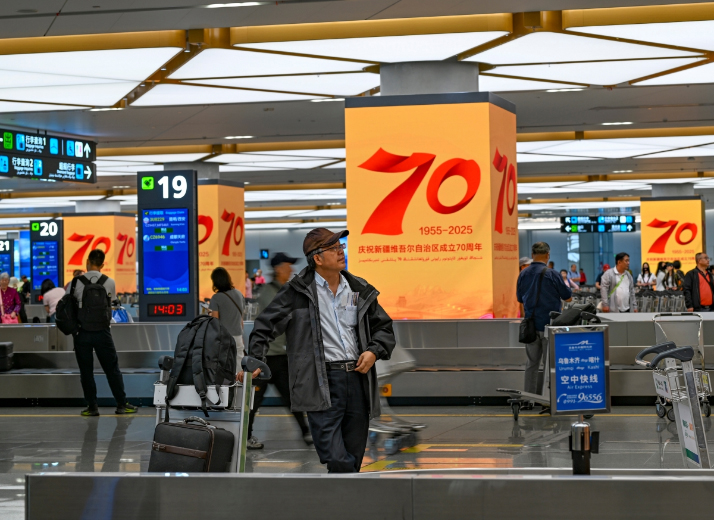
Passengers wait to claim their luggage at Urumqi Tianshan International Airport on September 15. [Photo/Xinhua]
Effective oversight
Committing to a people-centered approach, the regional people's congress and its standing committee have fulfilled their oversight responsibilities through a full range of mechanisms prescribed by law, including hearing and reviewing reports, conducting law enforcement inspections, organizing deputies' inspection tours and holding consultations. In the process, some innovative means have also been adopted.
Priority has been given to improving the legal framework for oversight. By revising measures for implementing the Supervision Law in the region, oversight methods have been refined and related procedures have been standardized, providing stronger legal guarantees for supervisory work.
Oversight in domains related to social stability has been strengthened to safeguard social stability and harmony. The measures for the implementation of the Counterterrorism Law in Xinjiang and the regulations on de-radicalization of Xinjiang have enhanced legal guarantees for countering terrorism and maintaining stability. Supervision has also targeted key areas including primary-level governance and ethnic unity, pressing for rectifications where problems arise and contributing to building a peaceful Xinjiang.
Oversight on economic affairs has been enhanced to support high-quality development. This includes tighter scrutiny of budgets and state-owned assets to ensure the efficient use of public funds, supervision of the implementation of supportive policies for businesses to address development bottlenecks and targeted oversight related to the development of the core area of the Silk Road Economic Belt. Special inspections have covered major projects, rural revitalization initiatives and government debt management, helping drive improvements in economic quality and efficiency across the region.
Supervision in the area of public wellbeing has focused on improving living standards. Guided by the people-centered development philosophy, the regional people's congress and its standing committee have maintained close oversight on education, healthcare, employment, social security and workplace safety, carrying out consistent inspections to see that policies to benefit the people are effectively implemented.
Environmental oversight has played an important role in building a Beautiful Xinjiang. Focus has been placed on preventing and controlling air, water and soil pollution. The long-running Tianshan environmental protection campaign has seen law enforcement inspections conducted for 29 consecutive years, while for seven consecutive years special research projects on air pollution control have been carried out in the Urumqi-Changji-Shihezi region.
Judicial oversight has been strengthened to uphold fairness and justice. With a focus on judicial justice, the regional people's congress and its standing committee have continued to supervise the work of the regional higher people's court and the regional people's procuratorate, striving to see that the people feel justice has been served in each and every judicial case.
In recent years, the standing committee of the regional people's congress has conducted consultations on issues of broad public concern, including social and medical security, rural revitalization, primary-level social governance, ethnic unity and progress, ecological and environmental protection, workplace safety, education and impartial administration of justice. Through the consultations, the committee has promoted the regional government, the regional supervision commission, the regional higher people's court and the regional people's procuratorate and their subordinate departments to reinforce the sense of responsibility and the awareness of rule of law, respond to public concerns, and fulfill their duties in accordance with the law.
Performance of deputies' duties
The standing committees of the successive regional people's congresses have placed great importance on the work related to people's congress deputies. Since the start of its five-year term in 2023, the Standing Committee of the 14th People's Congress of Xinjiang Uygur Autonomous Region has expanded the work through strengthening its ties with deputies and the ties between deputies and the public.
Standing committee members and members of the special committees of the standing committee maintain regular contact with more than 200 primary-level deputies across the region. Mechanisms such as inviting deputies to attend standing committee meetings in a non-voting capacity and holding follow-up meetings with the invited deputies have been further institutionalized and implemented. Whole-process people's democracy is put fully into practice to see that the work of the regional people's congress better responds to the wishes of the public.
Great emphasis has been placed on handling deputies' motions and suggestions effectively. For four consecutive years, major leaders of the regional Party committee and government have personally overseen the processing of deputies' suggestions. A closed-loop mechanism—covering suggestion submission, forwarding, processing and supervision—has been further refined, ensuring deputies' motions are promptly translated into legislative and oversight initiatives. Public concerns reflected in deputies' suggestions are thus incorporated into the work of local organs of power.
Efforts have also focused on establishing and making better use of outreach and liaison offices as platforms for deputies to perform their duties, with 5,366 such offices across the autonomous region enabling residents to convey their wishes and concerns to deputies in a timely manner.
For five consecutive years, initiatives have been carried out to see people's congress deputies visit local households and deliver lectures on the Party's guidelines for governing Xinjiang in the new era. More than 74,000 people's congress deputies at all levels have visited households across the region to collect public feedback and address pressing concerns, contributing to the building of a more prosperous and harmonious Xinjiang.
Over the past 70 years, under the CPC leadership, the system of people's congresses has guaranteed the participation of all ethnic groups in Xinjiang in national and local affairs and the exercise of democratic rights, guaranteed their political, economic, social and cultural rights, and guaranteed unity, progress and common prosperity and development among all ethnic groups in Xinjiang.
From bare subsistence to greater wellbeing and from a relatively closed inland region to a gateway for opening up, Xinjiang has undergone historic, transformative change. For seven decades, successive regional people's congresses have faithfully fulfilled their duties in accordance with the law and in service of the people, making important contributions to safeguarding national unity and ethnic solidarity and to advancing democracy, the rule of law and socioeconomic development in Xinjiang.


 京公网安备 11010802027341号