 Share:

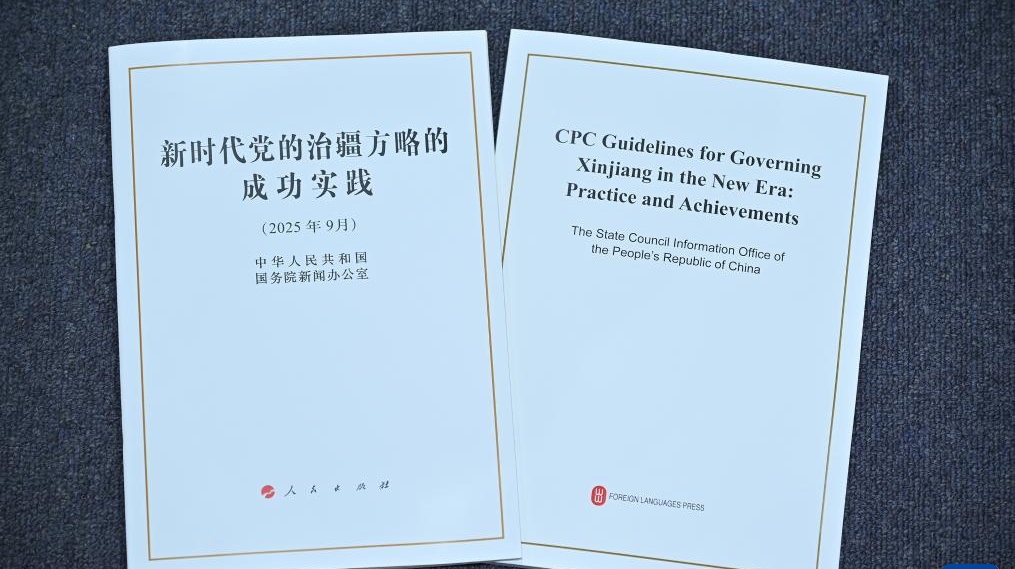
国务院新闻办公室日前发布《新时代党的治疆方略的成功实践》白皮书。全文如下: | China's State Council Information Office on Friday released a white paper titled "CPC Guidelines for Governing Xinjiang in the New Era: Practice and Achievements." The following is the full text of the document: | |
新时代党的治疆方略的成功实践 (2025年9月) 中华人民共和国 国务院新闻办公室 | CPC Guidelines for Governing Xinjiang in the New Era: Practice and Achievements The State Council Information Office of the People's Republic of China September 2025 | |
目录 | Contents | |
前言 | Preface | |
一、历史上中央政权治理新疆的理念经验 ——把治理新疆置于国家治理全局 ——尊崇大一统理念 ——因地制宜加强新疆治理 ——大力开发建设新疆 ——促进民族融合宗教共处 ——以中华优秀传统文化凝聚各族人民 | I. Governance of Xinjiang by Past Central Authorities: Philosophies and Experience -- Placing the administration of Xinjiang in the overall context of national governance -- Upholding national unity -- Strengthening governance over Xinjiang in line with local conditions -- Vigorously developing and building Xinjiang -- Advancing ethnic integration and religious coexistence -- Uniting all ethnic groups with the best of traditional Chinese culture | |
二、中国共产党治理新疆的光辉历程 ——新民主主义革命时期的积极探索 ——社会主义革命和建设时期的全面展开 ——改革开放和社会主义现代化建设新时期的深入推进 ——中国特色社会主义进入新时代 | II. CPC's Governance of Xinjiang: Progress and Achievements -- Active exploration during the New Democratic Revolution between 1919 and 1949 -- Comprehensive governance in the process of socialist revolution and construction between 1949 and 1978 -- Further progress in the process of reform, opening up, and socialist modernization -- A new era for socialism with Chinese characteristics | |
三、新时代党的治疆方略开创治疆新局面 ——新时代党的治疆方略的形成和发展 ——新时代党的治疆方略的核心要义 ——新时代党的治疆方略的原则要求 | III. CPC Guidelines for Governing Xinjiang in the New Era: Opening Up New Dimensions -- The formulation and development of the CPC's guidelines for governing Xinjiang in the new era -- The essence of the CPC's guidelines for governing Xinjiang in the new era -- The principles and requirements of the CPC's guidelines for governing Xinjiang in the new era | |
四、社会稳定和长治久安基础更加稳固 ——反分裂斗争取得显著成效 ——反恐维稳法治化常态化稳步推进 ——反制裁反干涉精准实施 ——社会治理效能明显提升 | IV. Stronger Foundations for Stability, Peace and Security -- Significant achievements in the fight against secession -- Enforcement of regular counterterrorism measures to ensure stability in accordance with the law -- Targeted countermeasures against foreign sanctions and interference -- Notable improvements in social governance | |
五、中华民族共同体建设深入推进 ——中华民族共有精神家园加快构筑 ——各民族交往交流交融更加紧密 ——民族团结进步事业巩固发展 ——我国宗教中国化稳步推进 | V. Uniting the Chinese Nation as One Community -- Faster pace in building a cultural home shared by the Chinese nation -- Increased interactions, exchanges and integration among all ethnic groups -- Greater ethnic unity and progress -- Steady progress in ensuring that religions in China conform to China's realities | |
六、民主法治建设持续深化 ——全过程人民民主成就显著 ——民族区域自治制度优势进一步彰显 ——法治建设取得重大进展 ——人权保障水平不断提升 | VI. Further Progress in Democracy and the Rule of Law -- Remarkable achievements in developing whole-process people's democracy -- Evident strengths of the system of regional ethnic autonomy -- Important advancements in the rule of law -- Greater protection of human rights | |
七、高质量发展和高水平开放协同共进 ——经济持续健康快速发展 ——基础设施建设全面加强 ——现代化产业体系集群效应充分显现 ——绿色低碳发展底色更足 ——丝绸之路经济带核心区建设步伐加快 | VII. High-Quality Development and High-Standard Opening Up -- Sustainable, sound and rapid economic development -- Improved infrastructure -- Cluster effect of the modern industrial system -- Solid green and low-carbon development -- A core area of the Silk Road Economic Belt | |
八、文化发展成效显著 ——文化遗产得到有效保护 ——文化艺术创作繁荣发展 ——公共文化服务体系日趋完善 ——文旅产业加快发展 | VIII. Significant Progress in Cultural Development -- Cultural heritage under effective protection -- Flourishing cultural and artistic creation -- Continuous improvement of the system of public cultural services -- Accelerated development of cultural and tourist industries | |
九、民生福祉持续增进 ——脱贫攻坚取得全面胜利 ——就业不断改善 ——教育事业全方位发展 ——卫生健康服务体系健全优化 ——社会保障网进一步织密扎牢 | IX. Continuous Improvement in People's Wellbeing -- A complete victory in the fight against poverty -- Steady growth in employment -- Comprehensive development of education -- Improved and optimized health service system -- An upgraded social security net | |
十、建设新疆的强大合力不断汇聚 ——党和国家大力支持奠定新疆发展基础 ——对口援疆工作提质增效 ——兵地融合发展注入新动能 ——团结奋斗建设美丽家园 | X. Greater Synergy for Xinjiang's Development -- The Party and the country's solid support – the foundation for Xinjiang's development -- Notable improvements in paired assistance to Xinjiang -- Civil-military integration – new impetus for Xinjiang's development -- Building a beautiful home through hard work | |
结束语 | Conclusion | |
前言 | Preface | |
邦畿千里,维民所止。国之要事,备边封疆。 | As the boundary of national governance is defined by where the people reside, the primary concern of a country should always be its border areas. | |
中华民族是有着五千多年文明史的伟大民族。我国各民族筚路蓝缕、披荆斩棘,共同开拓了祖国的辽阔疆域,共同缔造了统一的多民族国家,共同书写了辉煌的中国历史,共同创造了灿烂的中华文化,共同培育了伟大的民族精神。 | Spanning five millennia, our great civilization has seen all the ethnic groups of the Chinese nation open up the motherland's vast territory through untold hardships and unparalleled perseverance and form a unified multiethnic nation. Together, they have written a glorious Chinese history, created a splendid Chinese culture, and fostered our great national spirit. | |
新疆,古称西域,自古以来就是中国领土不可分割的一部分,是中华文明向世界开放的重要门户。历代中央政权在此设官建制、驻军镇守、屯垦固边,在几千年的探索实践中积累了丰富的历史经验。 | Xinjiang, known as the Western Regions in ancient times, has long been an inseparable part of China and an important gateway of the Chinese civilization to the outside world. Throughout history, successive central governments have established administrative institutions for its governance and stationed garrison troops to reclaim wasteland and guard the border areas. Through millennia of exploration and practice, they have accumulated a wealth of experience in this crucial endeavor. | |
中国共产党一经成立,就将为包括新疆各族人民在内的中国人民谋幸福,为包括新疆各民族在内的中华民族谋复兴作为初心使命。在革命、建设、改革各个历史时期,中国共产党汲取治疆历史经验和教训,不断创新发展治疆理念,赋予新疆工作新的时代内涵和使命任务,推动新疆改革发展、民族团结、社会进步、民生改善、边防巩固取得重大成就。 | Since its birth, the Communist Party of China (CPC) has pursued its mission of working for the wellbeing of the Chinese people and rejuvenation of the Chinese nation, including the people of all ethnic groups in Xinjiang. Throughout the years of revolution, construction and reform, the CPC has drawn from the experience and lessons in governing Xinjiang to continuously renew and develop its governance philosophy for the region. With new missions and tasks, it has responded to today's new imperatives in its work on Xinjiang, achieving major milestones in promoting reform and development, ethnic unity, social progress, people's wellbeing, and border security in the region. | |
进入新时代,以习近平同志为核心的党中央从强国建设、民族复兴的全局和战略高度,审视、谋划、部署新疆工作,不断深化对治疆规律的认识和把握,明确了社会稳定和长治久安总目标,确立了新时代党的治疆方略,引领新疆工作在错综复杂中守正创新、在矛盾风险中胜利前进,推动新疆各项事业取得历史性成就、发生历史性变革。 | In the new era, the CPC Central Committee with Xi Jinping at its core has considered, planned and arranged the work in relation to Xinjiang from the holistic and strategic perspective of building a strong China and pursuing national rejuvenation. It has continuously deepened its understanding of the dynamics of governing Xinjiang, set the overall goal of social stability and lasting peace and security, and established the Party's guidelines for governing Xinjiang in the new era. In providing leadership for the work related to Xinjiang, it has upheld fundamental principles and broken new ground, and successfully driven its progress despite the complex circumstances, challenges, and risks. Historic achievements and transformative change have been witnessed in all undertakings of Xinjiang. | |
一、历史上中央政权治理新疆的理念经验 | I. Governance of Xinjiang by Past Central Authorities: Philosophies and Experience | |
中国历代中央政权始终尊崇大一统理念,将新疆地区置于国家大一统格局下进行治理,维护社会安定,推动开发建设,促进民族交融和文化融通,积淀了国土不可分、国家不可乱、民族不可散、文明不可断的深沉历史意识和牢固共同信念,积累了中华民族边疆治理的理念和经验。 | Central authorities throughout China's history have consistently upheld great unity in their governance, administering the Xinjiang region as an integral part of the country. They maintained social stability, advanced development, and facilitated ethnic interaction and cultural integration, forging a profound awareness and a firm common conviction that Chinese territory must remain intact, the nation must maintain order, all ethnic groups must remain united, and the civilization must be sustained. Their efforts have contributed to the philosophies and experience for governing the nation's border areas. | |
把治理新疆置于国家治理全局。新疆是中国的神圣领土。公元前60年,汉朝设置西域都护府,开创中央政权有效管辖治理新疆地区先河。魏晋南北朝时期,前凉政权设高昌郡(吐鲁番盆地),首次将郡县制推广到西域。隋代,设立鄯善、且末、伊吾三郡,扩大了郡县制在新疆地区的范围。唐代,先后设置安西大都护府和北庭大都护府,统辖天山南北。辽宋夏金时期,辽设于阗国王府、高昌国大王府、阿萨兰回鹘大王府,有效管辖西域。元代,在西域实行行省制,后设北庭都元帅府、宣慰司等管理军政事务。明代,设立哈密卫管理西域事务。清代,设立伊犁将军,对新疆地区实行更加系统的治理;1884年,清政府在新疆地区建省,取“故土新归”之意,改称西域为“新疆”。1912年,新疆积极响应辛亥革命,成为中华民国的一个行省。在中国历史上,历代中原王朝时强时弱,和西域的关系有疏有密,中央政权对新疆地区的管治时紧时松,但任何一个王朝都把西域作为国土不可分割的一部分,行使着对该地区的管辖权。维护祖国统一是中央政权的神圣使命。 | Placing the administration of Xinjiang in the overall context of national governance. Xinjiang is China's sacred territory. In 60 BCE, the Han Dynasty (206 BCE-220 CE) established the Western Regions Frontier Command, pioneering the effective jurisdiction and administration over the Xinjiang region by central authorities. During the period (220-589) from the Three Kingdoms to the Southern and Northern Dynasties, the Former Liang regime established the Gaochang Prefecture in the Turpan Basin, becoming the first to extend the system of prefectures and counties to the Western Regions. The Sui Dynasty (581-618) established three prefectures – Shanshan, Qiemo and Yiwu – further expanding the system in the region. The Tang Dynasty (618-907) successively set up the Grand Anxi Frontier Command and the Grand Beiting Frontier Command to administer the vast areas both north and south of the Tianshan Mountains. During the period of the Liao, Song, Xixia, and Kin dynasties (907-1234), the Liao regime established Prince of the State Office of Yutian Kingdom, Office of the Grand Prince of Gaochang Kingdom, and Arslan Uighur Office of the Grand Prince, thereby exercising effective administration over the Western Regions. The Yuan Dynasty (1206-1368) implemented the system of administrative provinces in the region, before setting up the Beiting Command and the Pacification Commissioner's Office to manage military and political affairs. In the Ming Dynasty (1368-1644), the imperial court established the Hami Garrison Command to manage local affairs. The Qing Dynasty (1616-1911) established the post of Ili General and exercised more systematic administration over the Xinjiang region. In 1884, the Qing court established the region as a province, renaming it Xinjiang, meaning "land newly recovered". In 1912, following the Revolution of 1911, Xinjiang became a province of the Republic of China. Throughout China's history, depending on their strengths, imperial dynasties in the Central Plains maintained varying levels of relations with the Western Regions, and their administration of the Xinjiang region differed in intensity. Yet, all imperial dynasties regarded the Western Regions as an inalienable part of their territory, and all exercised jurisdiction over it. Safeguarding national unity has always been a sacred mission of China's central authorities. | |
尊崇大一统理念。中华民族自古以来就秉持“六合同风,九州共贯”“天下大同”的理念,把大一统视为“天地之常经,古今之通义”。历代中央政权通过建立治理体制、构筑军事布防、主导经济发展、垂范礼法秩序等措施,不断强化大一统理念。历史上的西域地方政权普遍有浓厚的中国一体意识,或认为自己是中原政权的分支,或臣属于中原政权。汉代,莎车王延常教导其子“当世奉汉家,不可负也”。唐代,西北诸部都尊奉唐太宗为“天可汗”。明清时期,西域各地方政权如叶尔羌汗国等,频频到中央政权朝见,并将朝见之路称为“金路”。中华文明长期的大一统传统,决定了国家统一永远是中国核心利益的核心,决定了一个坚强统一的国家是各族人民的命运所系。 | Upholding national unity. Since ancient times, the Chinese nation has embraced the ideas of "shared customs and practices and unified governance across the country" and "great harmony under Heaven", considering national unification "a universal tenet between Heaven and Earth, and a constant creed throughout the past and present". Through measures including establishing administrative systems, building up military defenses, guiding economic growth, and promoting the code of rites and law, central authorities throughout Chinese history continued to strengthen the concept of great unity. Local regimes in the Western Regions also held a strong sense of being an integral part of China, considering themselves either tributaries or vassals of the imperial dynasty in the Central Plains. During the Han Dynasty, King Yan of Shache, in the Western Regions, often told his son that they must serve the Han court from generation to generation and never betray it. During the Tang Dynasty, various tribes in the northwest honored Emperor Taizong of Tang as the "Heavenly Khan". During the Ming and Qing dynasties, local regimes in the Western Regions – such as the Yarkand Khanate – regularly traveled to the imperial capital to pay tribute on a "golden road". The enduring tradition of great unity of the Chinese civilization affirms that unification has always been at the core of China's core national interests, and that a strong and unified country is fundamental to the future of all ethnic groups. | |
因地制宜加强新疆治理。中国历代中央政权高度重视边疆治理,在政治统一前提下,因地制宜、因俗而治。从汉代大鸿胪到唐宋鸿胪寺,再到元代宣政院、清代理藩院,历代中央政权都设有专门机构掌管边疆民族事务。汉代,加强西域管辖治理,对臣属的地方政权首领、官员封授爵位和印绶,维护统治秩序,增进中央集权。唐代,在伊州、西州、庭州地区,实行与中原相同的州县制度;在三州以西的地区,任命当地部族首领担任都督、刺史等,听从中央指令,肩负朝廷使命,为国守土、遣兵助战。清代,实行军府制下的八旗、州县、伯克、札萨克等制度,治理更为系统完善。新疆建省后,全面推行州县制度,实现行政统一。历朝历代将统一政治秩序与因俗而治相结合,确保中央政权治理顺畅、有效管辖。 | Strengthening governance over Xinjiang in line with local conditions. In China, past central authorities attached great importance to the governance of border areas. On the premise of political unity, they adapted to local conditions and administered the region in line with local customs. From Han Dynasty's Chamberlain for Dependencies, to Court of State Ceremonial in the Tang and Song dynasties, to Commission for Buddhist and Tibetan Affairs in the Yuan Dynasty, to Court of Colonial Affairs in the Qing Dynasty, successive central authorities set up specific agencies to oversee ethnic affairs in border areas. The Han court strengthened its administration over the Western Regions by conferring titles on and presenting official seals to the heads and officials of local vassal regimes, so as to maintain the ruling order and consolidate central authority. In the Tang Dynasty, the same system of prefectures and counties as in the Central Plains was applied in the regions of Yizhou, Xizhou and Tingzhou. In areas west of these three prefectures, local tribal leaders, who were granted titles such as prefect or commander-in-chief, would follow the imperial court's orders and carry out its missions by defending the country's territory and sending troops to battles. In the Qing Dynasty, governance in the region was made more systematic and comprehensive through a mechanism that integrated military and political administration and included the Eight Banners system, the system of prefectures and counties, the Baeg and the Jasak systems. After Xinjiang was established as a province, the system of prefectures and counties was adopted across the region like the rest of the country. All the imperial dynasties throughout Chinese history have integrated the maintaining of a unified political order with governing in line with local customs, ensuring efficient and effective administration of Xinjiang by the central authorities. | |
大力开发建设新疆。中国历代中央政权都重视对新疆的开发建设。汉代始创西域屯田,至唐代屯田遍布天山南北,清代新疆屯田规模超一千万亩。水利随之兴盛,若羌县米兰遗址保存有比较完整的汉代水利设施,唐代设掏拓所、水官掏拓使管理水利,清代在新疆积极开展水利建设,修浚河渠、推广坎儿井,至清光绪末年,天山南北渠道总长七万余里,总灌溉能力超一千万亩。新疆自古是丝绸之路要冲,历代中央政权“列邮置于要害之路”,维护商道安全,保障贸易往来,万里丝路“使者相望于道,商旅不绝于途”,千年绵延。随着商贸活跃,于阗、疏勒、西州、庭州、惠远、迪化等一批城镇在新疆地区先后兴建,并带来了经济发展和人口增长。持续开发建设新疆,为实现治边稳边奠定重要物质基础。 | Vigorously developing and building Xinjiang. Central authorities across all historical periods of China attached great importance to the development and building of Xinjiang. The Han Dynasty sent garrison troops to convert wasteland into arable land in the Western Regions, a practice that was continued and expanded to the whole region during the Tang Dynasty. By the Qing Dynasty, the areas of reclaimed farmlands had exceeded 10 million mu (approximately 667,000 hectares). Water conservancy projects have also flourished. The Milan Ruins in Ruoqiang County are a well-preserved and relatively intact example of Han Dynasty water conservancy facilities in the region. During the Tang Dynasty, Taotuo water management offices were established, with officials overseeing water conservancy work. The Qing Dynasty promoted extensive water conservancy construction in Xinjiang, dredging rivers and canals and popularizing the karez system – an underground irrigation system primarily in use in arid regions. By the late Guangxu era (1875-1908) of the Qing Dynasty, the total length of canals in Xinjiang had surpassed 35,000 kilometers, with a total irrigation capacity exceeding 10 million mu (approximately 667,000 hectares). Xinjiang has been a vital hub of the Silk Road since ancient times. Central authorities set up postal stations along key routes to ensure the safety of commercial routes for trade and exchanges. On the Silk Road, envoys and caravans traveled between countries and continents, their activities spanning over a thousand years. With the booming trade, a number of cities and towns, such as Yutian, Shule, Xizhou, Tingzhou, Huiyuan, and Dihua, were built one after another in Xinjiang, driving economic development and population growth. The continuous development and construction of Xinjiang laid a solid material foundation for effective governance and stability in the border areas. | |
促进民族融合宗教共处。中国历代中央政权都把处理好民族和宗教事务作为新疆治理的关键。每个历史时期都有不同民族的大量人口进出新疆地区,各民族经过长期诞育、分化、交融,形成了血浓于水、休戚与共的关系,都为开发、建设、保卫新疆作出了重要贡献。东汉刘平国刻石和尉犁县克亚克库都克烽燧出土的883件唐代文书,记录了各民族共同戍边的生动场景。清代,抽调满、汉、回、蒙古(察哈尔部)、锡伯、索伦等各族军民携带家眷到新疆驻防屯田,巩固西北边防。新疆地区历来多种宗教并存,历代中央政权均将宗教事务管理纳入国家治理体系。唐代,设立都僧统,管理安西四镇佛教事务。清代,颁行《钦定回疆则例》,规定摩提色布伯克办理伊斯兰教教务,不得干预民事。中华文明是由多元文化汇聚成共同文化,从根本上决定了中华民族交往交流交融的历史取向,决定了中国各宗教信仰多元并存的和谐格局。 | Advancing ethnic integration and religious coexistence. Central authorities throughout China's history regarded ethnic and religious affairs as a key priority in the governance of Xinjiang. In each historical period, people from diverse ethnic backgrounds migrated to or left the region in large groups. Ethnic groups had grown, developed and integrated with each other despite periods of isolation and conflict, forging a bond thicker than blood and sharing weal and woe together. All of them have made important contributions to exploring, developing, and protecting Xinjiang. The Liu Pingguo Stele of the Eastern Han Dynasty (25-220) and the 883 Tang-Dynasty documents unearthed from the Keyakekuduke Watchtower site in Yuli County record vivid scenes of people of diverse ethnic groups jointly garrisoning the frontier. In the Qing Dynasty, the court moved military personnel and civilians of various ethnic groups, including the Manchu, Han, Hui, Mongolian (Chahar Tribe), Xibe, and Suolun (Daur), together with their families, to Xinjiang to garrison the border areas and engage in agricultural cultivation, strengthening northwestern border defense. The Xinjiang region has always been a place where multiple religions coexist, and central authorities all incorporated the management of religious affairs into the national governance system. In the Tang Dynasty, the position of Chief Buddhist Monk was established to supervise Buddhist affairs in the four garrison commands of Anxi: Qiuci, Yutian, Shule, and Suiye. The Qing Dynasty promulgated the Administrative Codex for Xinjiang, stipulating that the Motisebu Baeg should administer Islamic affairs without interfering in civil affairs. The fact that the Chinese civilization has been forged through the convergence of diverse cultures fundamentally determines the historical trajectory of ethnic interaction and integration, as well as the harmonious coexistence of religious beliefs in China. | |
以中华优秀传统文化凝聚各族人民。中国历代中央政权都将弘扬主流价值和中华优秀传统文化作为治理新疆不可或缺的重要内容。中华文化的形成与发展离不开汉文字的维系,西汉统一西域后,汉语言文字开始推行,自此通行新疆地区,从未中断。儒家思想对西域影响深远,至唐代儒家经典已广为流传,吐鲁番出土了大量《诗经》《尚书》《礼记》《论语》等写本残卷。中原典章制度在新疆实施,包括周礼在内的中华制度文化在天山南北落地生根,《大清律例》得到广泛运用。近代以来,面对亡国灭种的空前危机,新疆各族群众和全国各族人民一道,共御外侮、同赴国难,各民族国家认同达到新的高度。新疆各民族文化从开始就打上了中华文化多元一体的印记,中华文化始终是新疆各民族的情感依托、心灵归宿和精神家园,也是新疆各民族文化发展的动力源泉。 | Uniting all ethnic groups with the best of traditional Chinese culture. Central authorities across China's historical periods regarded promoting mainstream values and the best of traditional Chinese culture as an indispensable part of governing Xinjiang. The formation and development of Chinese culture could not have been sustained without the Chinese written language. After the Western Han Dynasty unified the Western Regions, the Chinese language and writing system began to be promoted, and has been in continuous use in Xinjiang ever since. Confucianism has a profound impact on the Western Regions. By the Tang Dynasty, Confucian classics had been widely disseminated – numerous fragmented manuscripts of the Book of Songs, Book of History, Book of Rites, and The Analects of Confucius have been unearthed in archeological excavations in Turpan. Institutions and statutes originating from the Central Plains were implemented in Xinjiang, and Chinese institutions and cultural traditions, including the Rites of Zhou, took root in the region, exemplified by the widespread application of the Statutes and Regulations of the Qing Dynasty. For a century or so since the mid-19th century, confronted with an unprecedented crisis of national subjugation and extinction, the people of all ethnic groups in Xinjiang, together with their compatriots across the country, united to resist foreign aggression and fight for national survival. This shared struggle elevated the consciousness of national identity among all ethnic groups to a new height. Since their inception, the cultures of all ethnic groups in Xinjiang have borne the hallmark of unity in diversity of Chinese culture. Chinese culture has always been the harbor and cultural home of all ethnic groups in Xinjiang, as well as the driving force for the development of their respective cultures. | |
中国中央政权治理新疆历经两千多年历史发展,不同时期采取了不同方式,新疆始终是中国统一多民族国家不可或缺的重要组成部分。客观地看,历代中央政权治疆理念和举措也存在时代局限,对新疆的治理时强时弱,治理精准性和有效性是不足的,特别是近代以后,在境外势力策动支持下,分裂活动更时有发生。历史呼唤着真正能够带领中华民族实现民族独立、人民解放、伟大复兴使命的承担者,这个光荣的使命责无旁贷地落在了中国共产党身上。 | Over 2,000 years, China's central authorities adopted distinct approaches in their governance of Xinjiang across different historical periods. And Xinjiang has always remained an indispensable and vital part of the unified, multiethnic Chinese nation. Objectively speaking, their concepts and measures for governing Xinjiang had some unavoidable shortcomings: Their governance over Xinjiang varied in intensity, and lacked precision and effectiveness. Especially after the mid-19th century, separatist activities instigated and backed by foreign forces occurred from time to time. History was calling for a true leader capable of leading the Chinese nation to independence, people's liberation, and national rejuvenation. This glorious mission rightfully fell on the Communist Party of China, which was duty bound to fulfill these goals. | |
二、中国共产党治理新疆的光辉历程 | II. CPC's Governance of Xinjiang: Progress and Achievements | |
中国共产党自成立之日起,就殷切关注新疆这片土地,始终牵挂新疆各族人民的前途命运。在中国共产党带领下,新疆各族人民从翻身解放、当家作主到走上社会主义道路,从改革开放、全面小康到迈上中国式现代化新征程,同全国人民一道迎来了从站起来、富起来到强起来的伟大飞跃。一百多年来,中国共产党人接力探索,不断推进理论创新、实践创新、制度创新,实现了对治疆规律认识和把握的不断深化。 | Since its founding, the CPC has always held deep concern for Xinjiang, and the future and wellbeing of the people of all ethnic groups living on this vast land. Under the leadership of the Party, the people of Xinjiang have traversed a remarkable path: from achieving emancipation and becoming their own masters, to embarking on the socialist road; from embracing reform and opening up and achieving moderate prosperity in all respects, to setting out on the new journey towards Chinese modernization. Together with the rest of the nation, they have witnessed the great transformation from standing up and growing prosperous to becoming strong. Over the past century and more, generations of Chinese Communists have continued to explore and advance theoretical, practical, and institutional innovations, deepening their understanding and grasp of the dynamics of governance in Xinjiang. | |
新民主主义革命时期的积极探索。这一时期中国共产党团结带领新疆各族人民英勇斗争、百折不挠,实现了翻身解放、当家作主。1921年7月,中国诞生了共产党,这是开天辟地的大事变。从此,新疆各族人民和全国人民一样有了主心骨。中国共产党成立初期,就把目光投向新疆,对新疆问题给予明确重视,一批共产党人进入新疆地区,传播马克思主义,播撒革命火种,开启民智、唤醒觉悟。在全民族抗战中,中国共产党高举抗日民族统一战线旗帜,带领新疆各族人民积极开展抗日募捐运动,保障国际援华交通线,建设抗战大后方,积极投身抗日救亡运动。1938年8月,新疆各族人民捐款购买10架战斗机,命名为“新疆号”,支援抗日前线。在中国共产党的影响和带动下,新疆各族人民中华民族整体意识空前增强,一批先进分子积极投身革命洪流。随着解放战争取得决定性胜利,中共中央英明决策和平解放新疆,人民解放军凯歌进新疆,打破了帝国主义和民族分裂分子肢解中国的妄想,维护了中华民族的根本利益。这是祖国统一事业的重大胜利,是新疆各族人民团结进步的历史转折。 | Active exploration during the New Democratic Revolution between 1919 and 1949. During this period, the CPC united the people of all ethnic groups in Xinjiang and led them in heroic and unrelenting struggle, bringing them emancipation and enabling them to be their own masters. The founding of the CPC in July 1921 was an epoch-making event in Chinese history. Ever since, the Party has remained a pillar on which the Chinese people, including those in Xinjiang, can rely. In its early years, the Party had given clear emphasis on Xinjiang, sending members to the region to spread Marxism, sow the seeds of revolution, enlighten the people, and raise their political awareness. During the whole nation's war of resistance against Japanese aggression (1931-1945), the CPC – holding high the banner of a national united front – led the people of Xinjiang in supporting the war effort: organizing donations, ensuring the safe transport of international aid to China, fortifying Xinjiang to support the war front from China's interior, and proactively engaging in movements to rescue the country from Japanese occupation. In August 1938, donations from the people of Xinjiang were used to purchase 10 fighter planes – named "Xinjiang" in their honor – to assist the front line. Thanks to the CPC's persistent effort, people in Xinjiang developed an unprecedented sense of the Chinese nation as one community, and a large number of progressives devoted themselves to the revolutionary cause. Having secured a decisive victory in the War of Liberation (1946-1950), the CPC central leadership decided to peacefully liberate Xinjiang. The People's Liberation Army (PLA) marched triumphantly into the region, shattering the wild ambition of imperialist and separatist forces to dismember China and safeguarding the fundamental interests of the Chinese nation. This marked a major victory in the cause of national unification and a historic turning point in advancing unity and progress among the people of all ethnic groups in Xinjiang. | |
社会主义革命和建设时期的全面展开。这一时期中国共产党团结带领新疆各族人民战天斗地、改天换地,实现了昂首迈进社会主义社会的历史飞跃。1949年10月1日,中华人民共和国成立,中国人民从此站起来了,新疆历史开启了新纪元。同年12月17日,新疆省人民政府正式成立。中国共产党领导新疆各族人民巩固新生人民民主政权,建立社会主义新型民族关系,废除封建土地制度,慎重稳进推行全面社会改革,完成社会主义改造,在新疆确立社会主义制度,新疆和全国一道阔步进入社会主义社会,实现了新疆历史上最深刻最伟大的变革。1954年10月7日,中国人民解放军新疆军区生产建设兵团成立,10万驻疆部队铸剑为犁、屯垦戍边。1955年10月1日,新疆维吾尔自治区宣告成立,这是新疆发展史上具有里程碑意义的大事,是中国共产党民族政策的又一伟大胜利。为尽快改变贫穷落后面貌,在中国共产党领导下,新疆各族人民自力更生、奋发图强,全国人民心系边疆、倾力支援,新疆工业体系初步建立,农业生产条件显著改变,教育、科学、卫生、交通、水利事业有很大发展,实现从百废待兴到欣欣向荣的历史性跨越,取得社会主义革命和建设的伟大成就,创造了“敢教日月换新天”的人间奇迹。 | Comprehensive governance in the process of socialist revolution and construction between 1949 and 1978. During this period, the CPC united the people of all ethnic groups in Xinjiang and led them in bringing tremendous changes to a region with hard natural conditions, achieving a historic leap into socialist society. The founding of the People's Republic of China (PRC) on October 1, 1949 ushered in a new era: the Chinese people had stood up, and a new chapter for Xinjiang had begun. On December 17 the same year, the People's Government of Xinjiang Province was officially established. Under the Party's leadership, the people of Xinjiang consolidated the newly established people's democratic power, created a new, socialist form of ethnic relations, and abolished the feudal land system. Together, they prudently advanced comprehensive social reforms and completed the socialist transformation, establishing the socialist system in Xinjiang that enabled the region to stride forward with the rest of the country – marking the greatest and most profound change in Xinjiang's history. On October 7, 1954, the Production and Construction Corps of the Xinjiang Military District of the PLA was formed. A total of 100,000 garrison troops began to open up large swaths of wastelands while guarding the border areas. On October 1, 1955, the Xinjiang Uygur Autonomous Region was formally established, marking a milestone in the region's development and a new success of the CPC's policies on ethnic affairs. In order to end poverty and catch up, the people of Xinjiang pursued self-reliance and worked with determination under the leadership of the CPC to strengthen their home region, supported by selfless assistance from people across the nation. Consequently, Xinjiang has basically built up its industrial system, improved its agricultural production conditions significantly, and achieved marked progress in education, science and technology, health care, transportation, and water conservancy. It has witnessed a historic transformation from barrenness and poverty to flourishing prosperity, secured pivotal achievements in socialist revolution and construction, and created a miracle that changed its future with the people's undaunted spirit. | |
改革开放和社会主义现代化建设新时期的深入推进。这一时期中国共产党团结带领新疆各族人民意气风发、锐意进取,阔步踏上中国特色社会主义康庄大道。1978年12月,党的十一届三中全会召开,实现了新中国成立以来党的历史上具有深远意义的伟大转折,166万平方公里的新疆大地上涌动着改革开放浪潮。1981年12月,中央政府决定恢复兵团建制,名称改为“新疆生产建设兵团”。随着改革起步与发展,党中央强调新疆大有可为,要加速现代化建设,促进各民族共同繁荣,大力支持新疆实施优势资源转换战略,推动新疆工作中心实现战略转移,农村城市改革全面展开,外引内联促进开放,天山南北焕发新气象。党的十三届四中全会后,党中央强调新疆发展和安定是一件关系全局的大事,要促进新疆发展繁荣和长治久安,组织全国对口支援新疆,推动新疆建立和完善社会主义市场经济体制,抢抓西部大开发战略机遇,开创全面改革开放新局面。党的十六大后,党中央强调要坚定不移推进新疆改革开放和社会主义现代化建设,坚定不移维护新疆社会大局稳定,坚定不移维护民族团结,作出“稳疆兴疆、富民固边”重大战略部署,推动新疆经济社会又好又快发展。在推进中国特色社会主义事业的伟大进程中,新疆实现从生产力相对落后到经济实力显著增强,从封闭半封闭到全方位开放,从人民生活温饱不足到总体小康、奔向全面小康的历史性转变,同全国一道大踏步赶上了时代。 | Further progress in the process of reform, opening up, and socialist modernization. During this period, the CPC has united the people of all ethnic groups in Xinjiang and led them confidently onto the broad path of socialism with Chinese characteristics, aiming for greater heights. The convening of the Third Plenary Session of the 11th CPC Central Committee in December 1978 was a pivotal juncture of far-reaching significance in the history of the Party and the country. Xinjiang's vast land of 1.66 million square kilometers was awash with the strong tides of reform and opening up. In December 1981, the central government decided to restore the production and construction corps system, giving it the name the Xinjiang Production and Construction Corps (XPCC). As reforms rolled out, the CPC Central Committee – noting Xinjiang's great potential – decided to accelerate its modernization and promote common prosperity among all ethnic groups in the region. The Central Committee lent vigorous support to the region in transforming its advantage in superior resources into growth, guiding it to achieve a strategic shift in its focus. Comprehensive reforms were implemented in both rural and urban areas, while opening up was expanded by attracting external resources and strengthening internal coordination, bringing about new prospects on either side of the Tianshan Mountains. After the Fourth Plenary Session of the 13th CPC Central Committee in 1989, the Party Central Committee emphasized that Xinjiang's development and stability was of overarching importance to the nation. For its development, prosperity, and lasting peace and security, the central leadership pooled resources nationwide in assistance to Xinjiang and saw that the socialist market economy was established and improved in the region. This enabled Xinjiang to seize the strategic opportunities presented by the large-scale development of China's west and pioneer a new phase of all-round reform and opening up. Following the 16th CPC National Congress in 2002, the Central Committee reaffirmed its commitment to unswervingly advancing reform and opening up and socialist modernization in Xinjiang, maintaining social stability, and promoting ethnic unity. Guided by the major strategic plan of stabilizing and revitalizing Xinjiang, enriching the people, and safeguarding the border areas, the region has achieved sound and rapid economic and social development. In advancing the great cause of socialism with Chinese characteristics, Xinjiang has experienced a historic transformation. Its economy has been markedly strengthened by improving its once relatively backward productive forces, and its society has shifted from a closed and semi-closed outlook to one defined by openness. The people's living standards have also borne witness to profound transformation, evolving from bare subsistence to a basic level of moderate prosperity, and then ultimately to moderate prosperity in all respects. Xinjiang has caught up with the rest of the country in making great strides towards the goals of our time. | |
中国特色社会主义进入新时代。中国共产党团结带领新疆各族人民团结奋斗、守正创新,创造了新的人间奇迹。2012年11月,党的十八大召开,中国特色社会主义进入新时代。以习近平同志为核心的党中央统筹把握中华民族伟大复兴战略全局和世界百年未有之大变局,把新疆工作放在党和国家工作全局的重要地位,不断深化对治疆规律的认识和把握。2014年、2020年先后召开第二次、第三次中央新疆工作座谈会,2014年、2022年、2023年习近平总书记三次亲临新疆考察,明确了社会稳定和长治久安总目标,确立了新时代党的治疆方略。在新时代党的治疆方略指引下,新疆以铸牢中华民族共同体意识为主线,锚定在国家全局中的战略定位,统筹发展和安全,扎实推进依法治疆、团结稳疆、文化润疆、富民兴疆、长期建疆,经济社会发展和民生改善取得前所未有的成就,各族群众获得感、幸福感、安全感显著增强,处于历史上最好的发展时期。2600多万新疆各族儿女团结奋进、自信开放,像胡杨一样根连着根、心连着心,像石榴籽一样籽籽同心、紧紧相拥,在全面建设社会主义现代化国家新征程上阔步前行,为实现中华民族伟大复兴不懈奋斗。 | A new era for socialism with Chinese characteristics. The CPC has united the people of all ethnic groups in Xinjiang and led them in pressing forward with hard work, upholding fundamental principles and breaking new ground, creating new miraculous achievements. The 18th CPC National Congress held in November 2012 ushered Chinese socialism into a new era. While pursing national rejuvenation within a wider context of global change on a scale unseen in a century, the Party Central Committee with Xi Jinping at its core has put its work related to Xinjiang high on the agenda of the Party and the country and continued to further its understanding and grasp of the dynamics of governance in the region. The Central Committee convened its second and third meetings on the work related to Xinjiang in 2014 and 2020, and in 2014, 2022 and 2023, General Secretary Xi traveled three times to Xinjiang on inspection tours, establishing the overall goal of social stability and lasting peace and security in the region, laying down the Party's guidelines for governing Xinjiang in the new era. With the guidelines in place, Xinjiang has focused on forging a strong sense of the Chinese nation as one community, adhered to its strategic positioning in the country, and ensured both development and security. Solid steps have been taken to govern Xinjiang in accordance with the law, maintain stability through ethnic unity, strengthen cultural identity and bonds, bring greater prosperity to the region and its people, and develop Xinjiang from a long-term perspective. This has contributed to unprecedented economic and social development and significant improvement of people's wellbeing, and brought a greater sense of gain, happiness and security to the people. Today's Xinjiang is experiencing the best period of development in its history. Over 26 million Xinjiang people of all ethnic groups are tightly knit like the roots of poplar trees and closely united like the seeds of a pomegranate. Confident and open-minded, they are marching forward on the new journey towards a modern socialist country in all respects and striving for the rejuvenation of the Chinese nation through hard work and perseverance. | |
三、新时代党的治疆方略开创治疆新局面 | III. CPC Guidelines for Governing Xinjiang in the New Era: Opening Up New Dimensions | |
党的十八大以来,以习近平同志为核心的党中央汲取历代中央政权治理新疆的经验教训,继承和发展中国共产党治疆宝贵经验,系统谋划、整体推进事关长治久安的根本性、基础性、长远性工作,在治疆稳疆兴疆上开辟了新境界、达到了新高度。 | Since the 18th CPC National Congress, the Party Central Committee with Xi Jinping at its core has drawn experience and lessons from past central authorities in governing Xinjiang, and continued to apply and improve the Party's best practices in this regard. It has adopted a systematic and holistic approach to planning and advancing fundamental, essential and long-term undertakings for the region's lasting peace and security. These efforts have explored new dimensions in Xinjiang's governance, enabling the Party to scale new heights in maintaining stability and driving development in the region. | |
新时代党的治疆方略的形成和发展。在中华民族伟大复兴战略全局和世界百年未有之大变局相互交织、相互激荡、相互影响背景下,新疆在国家全局中的战略地位日益凸显。以习近平同志为核心的党中央将新疆工作摆在治国理政的重要位置,从战略和全局高度对新疆工作作出系统谋划部署,科学回答一系列方向性、全局性、战略性问题。 | The formulation and development of the CPC's guidelines for governing Xinjiang in the new era. The rejuvenation of the Chinese nation is interwoven with – and interacts with – global change on a scale unseen in a century. Consequently, the strategic role of Xinjiang has become ever more pivotal to the nation's overall trajectory. Prioritizing Xinjiang in the governance of the country, the CPC Central Committee with Xi Jinping at its core has systematically planned all work related to Xinjiang from an overall strategic perspective and provided answers to a series of questions on the future direction and strategy in governing the region. | |
习近平总书记始终高度关注新疆工作,情系新疆各族人民。每当新疆工作进入关键时期,习近平总书记都亲自谋篇布局、把脉定向、领航掌舵。2014年4月,习近平总书记到新疆考察,强调“党中央历来高度重视新疆工作,始终强调新疆工作在党和国家工作全局中具有特殊重要的战略地位”“中央关于做好新形势下新疆工作的大政方针”“以社会稳定和长治久安为工作的着眼点和着力点,统筹推进各方面工作”。2014年5月,党中央召开第二次中央新疆工作座谈会,再次明确“党中央关于新疆工作的大政方针”这一重要概括,正式把社会稳定和长治久安确立为新疆工作总目标。 | General Secretary Xi has always paid close attention to the work related to Xinjiang, from a place of care for the people of all of its ethnic groups. At each critical stage in work related to Xinjiang, he has provided strategic direction and guidance, personally steering the course of its development. In April 2014, during an inspection visit to Xinjiang, he highlighted, "The CPC Central Committee has continued to attach great importance to the work related to Xinjiang, emphasizing Xinjiang's special and important strategic role in the work of the Party and the country." He emphasized the major principles and policies of the central leadership to improve the work related to Xinjiang in the new era, and the need to "take a coordinated approach in all undertakings with a focus on social stability and lasting peace and security". In May 2014, the CPC Central Committee held its second meeting on the work related to Xinjiang, at which it reiterated its major principles and policies in this effort and established social stability and lasting peace and security as the overall goal. | |
第二次中央新疆工作座谈会后,习近平总书记多次主持召开中央政治局常委会会议、中央政治局会议等重要会议,研究部署新疆工作。2020年9月,党中央召开第三次中央新疆工作座谈会,习近平总书记在会上正式提出并全面系统阐释“新时代党的治疆方略”,强调坚持依法治疆、团结稳疆、文化润疆、富民兴疆、长期建疆,努力建设新时代中国特色社会主义新疆。 | After the meeting, Xi presided over a number of important meetings of the Political Bureau of the CPC Central Committee and its standing committee, to make plans for the work related to Xinjiang. In September 2020, at the third central meeting on the work related to Xinjiang held by the CPC Central Committee, he raised the CPC's guidelines for governing Xinjiang in the new era, explaining them in detail. He emphasized governing Xinjiang in accordance with the law, maintaining stability through ethnic unity, strengthening cultural identity and bonds, bringing greater prosperity to the region and its people, and developing Xinjiang from a long-term perspective, to build a socialist Xinjiang with Chinese characteristics in the new era. | |
2022年7月,习近平总书记再次亲临新疆考察,指出要聚焦新疆工作总目标,推动事关长治久安的根本性、基础性、长远性工作。2023年8月,习近平总书记又一次来到新疆,专门听取自治区和兵团工作汇报,强调要完整准确全面贯彻新时代党的治疆方略,牢牢把握新疆在国家全局中的战略定位,扭住工作总目标,把依法治疆、团结稳疆、文化润疆、富民兴疆、长期建疆各项工作做深做细做实,稳中求进、绵绵用力、久久为功,在中国式现代化进程中更好建设团结和谐、繁荣富裕、文明进步、安居乐业、生态良好的美丽新疆。习近平总书记还在许多重要场合发表重要讲话和重要论述、作出重要指示批示,就做好新形势下新疆工作提出一系列新思想新观点新要求,进一步丰富和发展了新时代党的治疆方略。 | In July 2022, on another inspection visit to Xinjiang, Xi pointed out the need to promote the fundamental, essential and long-term undertakings for Xinjiang's lasting peace and security, with a focus on the overall goal. In August 2023, he visited Xinjiang again to hear reports about the work of the Xinjiang Uygur Autonomous Region government and the XPCC. He emphasized the full, accurate and faithful implementation of the Party's guidelines for governing Xinjiang in the new era, and the strategic positioning of Xinjiang in the country. With the overall goal in mind, we will make thorough and meticulous efforts to deliver practical results in governing Xinjiang in accordance with the law, maintaining stability through ethnic unity, strengthening cultural identity and bonds, bringing greater prosperity to the region and its people, and developing Xinjiang from a long-term perspective. We will pursue progress while ensuring stability, devote continued and long-term sustained efforts in our work, and build Xinjiang into a beautiful home characterized by unity, harmony, prosperity, cultural progress, and a sound eco-environment in which people live and work in peace and contentment on the path to Chinese modernization. In addition, he has delivered speeches, made remarks, and provided instructions on many occasions, putting forward new ideas, perspectives and requirements on improving the work related to Xinjiang that have further enriched and developed the CPC's guidelines for governing Xinjiang in the new era. | |
新时代党的治疆方略的核心要义。新时代党的治疆方略饱含着以习近平同志为核心的党中央对新疆局势的深刻洞察和对新疆工作的深邃思考,体系严整、逻辑严密,内涵丰富、博大精深,构成了一个系统完整的理论体系,是做好新时代新疆工作的纲和魂。 | The essence of the CPC's guidelines for governing Xinjiang in the new era. The CPC's guidelines for governing Xinjiang in the new era represent a thorough understanding of the situation in Xinjiang and embody a profound reflection on the work related to the region by the CPC Central Committee with Xi Jinping at its core. They comprise a complete system of theories with a sound logic and rich content, and sit at the core of all work related to Xinjiang in the new era. Their main content is as follows: | |
坚持从战略上审视和谋划新疆工作。新疆工作事关祖国统一、民族团结、国家安全,事关强国建设、民族复兴大局。必须看清新疆发展大势,看清做好新疆工作对全党全国大局的影响,看清新疆工作在统筹国内国际两个大局中的地位,谋长远之策、行固本之举、建久安之势、成长治之业。 | Viewing and planning the work related to Xinjiang from a strategic perspective. The work related to Xinjiang bears not only on national reunification, ethnic unity, and national security, but also on the initiative to build China into a great country and the goal of national rejuvenation. We must have a clear understanding of the prevailing trend of development in Xinjiang, of the impact of good work in Xinjiang on the overall situation of the Party and the country, and of the work's significance in addressing both domestic and international imperatives, thereby laying a solid foundation for its long-term development, peace and security. | |
坚持把社会稳定和长治久安作为新疆工作总目标。总目标是新疆工作的总纲,各项工作必须围绕社会稳定和长治久安来谋划推进。既要集中力量解决当前维护社会稳定面临的突出问题,又要一环扣一环解决影响长治久安的各种深层次矛盾和问题。 | Upholding social stability and lasting peace and security as the overall goal of the work related to Xinjiang. This means that all undertakings must be planned and advanced to achieve this goal. We should both channel our resources to address the pressing problems in maintaining social stability and systematically tackle the deep-rooted issues that undermine Xinjiang's lasting peace and security. | |
坚持以凝聚人心为根本。凝聚不住人心,一切都是空转。必须坚持人民至上,相信各族群众、依靠各族群众、服务各族群众,同时教育引导群众,让各族群众知道稳定安宁多么重要,幸福生活源于党的好政策,来自各族人民团结一心并肩奋斗,新疆发展进步离不开全党全国人民支持。 | Rallying the people's support is fundamental. Without the people's support, all efforts are futile. We must put the people first, have faith in the people of all ethnic groups, rely on them, and be of service to them. We should provide them with guidance, and let them understand the importance of stability and peace, that a happy life stems from the Party's good policies and the hard work of all ethnic groups united as one, and that the development of Xinjiang cannot be achieved without the support from the whole Party and the whole country. | |
坚持铸牢中华民族共同体意识。这是做好新疆工作最基础、最长远的问题。必须以铸牢中华民族共同体意识为主线,全面贯彻党的民族政策,深化民族团结进步教育,加快构建各民族互嵌式社会结构和社区环境,加强各民族交往交流交融,促进各民族像石榴籽一样紧紧抱在一起。 | Fostering a stronger sense of the Chinese nation as one community. This is fundamental to the work related to Xinjiang in the long run. We must focus on fostering a stronger sense of national identity, fully implement the Party's policies concerning ethnic affairs, and heighten public awareness of ethnic unity and progress. We must move faster to build an ethnically integrated society and neighborhoods and encourage more exchanges, interactions and integration among different ethnic groups, so that they remain as closely united as the seeds of a pomegranate. | |
坚持我国宗教中国化方向。我国宗教中国化工作事关新疆工作大局。必须全面贯彻党的宗教工作基本方针,坚持保护合法、制止非法、遏制极端、抵御渗透、打击犯罪,引导信教群众树立国家意识、公民意识、法治意识,积极引导宗教与社会主义社会相适应。 | Ensuring that religions in China conform to China's realities. This concerns the overall work related to Xinjiang. We must fully implement the Party's basic policy on religious affairs, protect lawful practices, proscribe illegal activities, contain extremism, resist infiltration, and punish crime. We must guide religious believers to foster a keen sense of national identity, citizenship, and law-based governance, and provide active guidance to religions so that they can adapt to socialist society. | |
坚持弘扬和培育社会主义核心价值观。必须坚持以社会主义先进文化为引领,深入推进文化润疆,加强群众性思想教育,不断增进对伟大祖国、中华民族、中华文化、中国共产党、中国特色社会主义的认同。 | Fostering and carrying forward the core socialist values. We must uphold the guiding role of advanced socialist culture and strengthen the cultural identity and bonds of people in Xinjiang. We must guide the people and inspire them to identify more closely with our motherland, the Chinese nation, the Chinese culture, the CPC, and socialism with Chinese characteristics. | |
坚持紧贴民生推动高质量发展。新疆发展要落实到改善民生、惠及当地、增进团结上。必须坚持以人民为中心的发展思想,紧紧围绕各民族安居乐业推进经济社会发展和民生改善,不断增强各族群众获得感、幸福感、安全感。 | Promoting high-quality development centered on the people's wellbeing. Xinjiang's development should manifest in the people's wellbeing, betterment of local economy and society, and greater ethnic unity. We must uphold the people-centered development philosophy, and advance economic and social development while improving people's wellbeing so that the people of all ethnic groups live and work in peace and contentment, thereby enabling them to enjoy a stronger sense of gain, fulfillment and security. | |
坚持加强党对新疆工作的领导。做好新疆工作,必须坚持和加强党的全面领导,建设政治上强、能力上强、作风上强的高素质干部队伍,确保党中央政令畅通。必须把抓基层、打基础作为稳疆安疆的固本之举,把基层党组织建设成为服务群众、维护稳定、反对分裂的坚强战斗堡垒。 | Strengthening the Party's leadership over the work related to Xinjiang. To improve the work related to Xinjiang, we must uphold and strengthen the Party's overall leadership, cultivate a contingent of officials with strong political commitment, professional competence, and exemplary conduct, and ensure the smooth execution of the Central Committee's policies and decisions. We must regard building solid foundations at the grassroots level as the fundamental measure to ensure stability and security in Xinjiang, and strengthen grassroots Party organizations to serve the people, maintain stability, and oppose division. | |
新时代党的治疆方略的原则要求。新时代党的治疆方略是做好新疆工作的根本遵循,必须深刻把握、统筹推进依法治疆、团结稳疆、文化润疆、富民兴疆、长期建疆。 | The principles and requirements of the CPC's guidelines for governing Xinjiang in the new era. The CPC's guidelines for governing Xinjiang in the new era are the foundation for the work related to Xinjiang. We must have a thorough understanding of governing Xinjiang in accordance with the law, maintaining stability through ethnic unity, strengthening cultural identity and bonds, bringing greater prosperity to the region and its people, and developing Xinjiang from a long-term perspective, and advance these undertakings in a coordinated manner. | |
依法治疆,就是要坚持以习近平法治思想为引领,高举法治旗帜,弘扬法治精神,坚守法治原则,把全面依法治国的要求落实到新疆工作各个领域,善于运用法治思维和法治方式防范风险、打击犯罪、处理问题、化解矛盾,推进反恐维稳法治化常态化,确保新疆各项工作始终在法治轨道上运行。 | To govern the region in accordance with the law, we should uphold Xi Jinping Thought on the Rule of Law, advance law-based governance, promote its concept across society, adhere to its principles, and implement its requirements in all sectors of the work related to Xinjiang. We should employ law-based thinking and approaches to forestall risks, combat crimes, handle problems, and address disputes, and strengthen law-based and persistent efforts in combating terrorism and maintaining stability, thereby ensuring that all the work related to Xinjiang is carried out under the rule of law. | |
团结稳疆,就是要坚持以凝聚人心为根本,把民族团结作为各族人民的生命线,高举中华民族大团结的旗帜,不断铸牢中华民族共同体意识,系统推进我国宗教中国化,把各族人民更加紧密地团结在党的周围,凝聚奋发有为建设美丽新疆的强大正能量。 | To maintain stability through ethnic unity, the fundamental issue is to rally people's support. We should regard ethnic unity as the lifeline of the people of all ethnic groups, safeguard the unity of the Chinese nation, and continue to foster a stronger sense of the Chinese nation as one community. We should make systematic efforts to ensure that religions in China conform to China's realities, to unite the people of all ethnic groups closer around the Party, and to forge tremendous momentum to build a beautiful Xinjiang. | |
文化润疆,就是要坚持以增强认同为目标,以社会主义核心价值观为引领,发展社会主义先进文化,弘扬革命文化,传承中华优秀传统文化,构筑中华民族共有精神家园,教育引导各族群众铸牢中国心、中华魂,从根本上解决政治认同、人心向背的问题,夯实社会稳定和长治久安的思想根基。 | To strengthen cultural identity and bonds, we should see that people in Xinjiang identify with the Chinese culture. Upholding the core socialist values, we should develop advanced socialist culture, promote revolutionary culture, carry forward the best of traditional Chinese culture, and build a spiritual home shared by all the Chinese people. We should provide education and guidance to the people of all ethnic groups to strengthen their sense of Chinese national identity, and reinforce their political commitment and win their support, thus consolidating the ideological foundations for social stability and lasting peace and security. | |
富民兴疆,就是要坚持完整准确全面贯彻新发展理念,锚定新疆在建设社会主义现代化强国中的战略定位,充分发挥新疆的区位、资源、政策优势,积极服务和融入新发展格局,拓展高水平对外开放,紧贴民生推动高质量发展,推动发展成果惠及民生、凝聚人心。 | To bring greater prosperity to Xinjiang and its people, we should fully and faithfully apply the new development philosophy on all fronts in line with the strategic positioning of Xinjiang in building a great modern socialist country. Giving full play to Xinjiang's advantages in geographic location, resources, and policies, we should actively support Xinjiang in serving and integrating with the new development dynamic and promoting high-quality opening up. We should advance high-quality development centered on the people's wellbeing, and ensure that the benefits of development improve the people's wellbeing and win their support. | |
长期建疆,就是要坚持和加强党的全面领导,深入推进新时代党的建设新的伟大工程,按照新时代好干部标准建设高素质干部队伍,保持战略定力,坚持谋定后动,稳中求进、绵绵用力、久久为功做好工作,着力解决深层次矛盾和问题,为实现新疆工作总目标打下坚实基础。 | To develop Xinjiang from a long-term perspective, we should uphold and strengthen the Party's overall leadership and advance the great new project of strengthening the Party in the new era. We should foster highly competent officials based on the criteria for assessing the caliber of officials in the new era, maintain our strategic resolve, and make meticulous plans before taking any actions. We should pursue progress while ensuring stability, devote continued and long-term sustained efforts in our work, and address deep-rooted problems, to lay solid foundations for achieving the overall goal of the work related to Xinjiang. | |
新时代党的治疆方略既有理论观点上的创新和突破,又有工作布局上的部署和要求,是习近平新时代中国特色社会主义思想关于新疆工作的集中体现,是中国共产党领导人民治疆稳疆兴疆成功经验的总结提炼和创新发展,是指引新疆工作行稳致远的康庄大道,标志着中国共产党对边疆治理的规律性认识达到了新高度,在党的新疆工作历史上、在新疆发展历史上具有里程碑意义。 | The CPC's guidelines for governing Xinjiang in the new era represent both innovations and breakthroughs in theory, and concrete plans and requirements for their implementation. Embodying Xi Jinping Thought on Socialism with Chinese Characteristics for a New Era, they encapsulate and build on the past successes of the CPC who lead the Chinese people in governing, stabilizing and developing Xinjiang. They have opened a wide avenue leading to steady and sustained progress in the work related to Xinjiang, marking a new height of the CPC's understanding of the underlying principles in border governance. They are a milestone in the Party's work related to Xinjiang and in the development of the region. | |
新疆2600多万各族干部群众在党中央坚强领导下,在全国人民大力支持下,完整准确全面贯彻新时代党的治疆方略,牢记嘱托、感恩奋进,知重负重、实干苦干,奋力将以习近平同志为核心的党中央为新疆擘画的宏伟蓝图变为现实。 | Under the strong leadership of the Party Central Committee and with the support of the whole country, over 26 million people of all ethnic groups in Xinjiang are applying the Party's guidelines for governing Xinjiang in the new era in full, to the letter, and in all fields. Keeping the requirements in mind, they are working hard with gratitude and forging ahead in the face of daunting challenges to translate into reality the grand blueprint for Xinjiang drawn up by the CPC Central Committee with Xi Jinping at its core. | |
四、社会稳定和长治久安基础更加稳固 | IV. Stronger Foundations for Stability, Peace and Security | |
新疆社会稳定和长治久安,关系全国改革发展稳定大局。新疆统筹发展和安全,把维护社会稳定摆在首位,深入推进反恐维稳法治化常态化,有效防范化解各领域风险和外部势力干扰破坏,社会大局实现由乱到稳、由稳向治的历史性转变。 | Social stability and lasting peace and security in Xinjiang are of overarching importance to overall reform, development and stability in China. While balancing development and security, Xinjiang has maintained social stability as a top priority. It has continued to fight terrorism and maintain stability in a law-based and regular manner, preventing and defusing risks in various fields, as well as interference and sabotage by external forces. A historic transformation from chaos to stability and from stability to governance has been achieved in the region. | |
反分裂斗争取得显著成效。分裂主义危害国家统一、破坏民族团结,是新疆恐怖主义、极端主义产生的温床。过去一段时间,新疆民族分裂势力、宗教极端势力、暴力恐怖势力大肆实施破坏活动,给新疆社会稳定带来极大危害,给各族人民造成极大伤痛。中国政府反对一切形式的分裂主义、恐怖主义和极端主义,对任何分裂国家、危害公共安全、侵犯公民人权的行为,依法严厉打击。新疆坚决维护国家统一,依法严厉打击组织、策划、实施分裂国家、破坏国家统一,煽动分裂国家、破坏国家统一的违法犯罪行为,坚决抵御“双泛”思想渗透传播,努力从源头上消除恐怖主义、极端主义滋生蔓延的土壤和条件。经过不懈努力,新疆反分裂斗争取得重要阶段性成果,连续多年没有发生暴恐事件,有力地维护了新疆社会稳定和民族团结。 | Significant achievements in the fight against secession. Separatism endangers national unity and undermines ethnic unity, breeding terrorism and extremism in Xinjiang. In the past, ethnic separatists, religious extremists, and terrorists have engaged in rampant sabotaging activities in Xinjiang, disrupting local stability and bringing enormous suffering to the people of all ethnic groups in the region. The Chinese government stands firm against all forms of separatism, terrorism, and extremism, and takes robust action against any acts that aim to split the country, endanger public security, or infringe upon human rights in accordance with the law. Xinjiang is resolute in safeguarding national unity and takes robust action against illegal acts and crimes, including the incitement, organization, plotting, and execution of acts that divide the country or jeopardize national unity. It is resolute in guarding against the infiltration and spread of "Pan-Turkism" and "Pan-Islamism" and strives to root out the breeding grounds for terrorism and extremism to sprout and spread. The hard work over the years has reaped notable results in Xinjiang's fight against separatism. Violent and terrorist events have not happened for many years, and social stability and ethnic unity have been effectively safeguarded in the region. | |
反恐维稳法治化常态化稳步推进。推进反恐维稳法治化常态化是保持新疆社会大局持续稳定长期稳定、实现长治久安的重要途径。新疆高举社会主义法治旗帜,弘扬法治精神,把全面依法治国要求落实到工作各个领域,依据《中华人民共和国刑法》《中华人民共和国反恐怖主义法》等,深入推进反恐维稳工作,确保这项工作始终在法治轨道上规范、常态、高效运行。健全严打暴恐斗争长效机制,充分运用法治思维和法治方式开展斗争、维护稳定,始终做到依法打击、精准打击、及时打击。构建反恐维稳法治化常态化工作体系,建设社会治安整体防控体系,反恐维稳工作由末端治理向源头治理转变,工作方式从临战应急状态向规范精细常态转变。优化反恐维稳政策策略和方式方法,既防住极少数暴恐分子,又方便绝大多数群众,保障群众正常工作学习生活秩序,实现了更有利于长治久安的根本性变化。新时代以来,新疆反恐维稳工作取得重大成就,扭转了过去一个时期暴恐活动多发频发的局面。 | Enforcement of regular counterterrorism measures to ensure stability in accordance with the law. This is central to sustaining long-term social stability, peace, and security in Xinjiang. Upholding and promoting the socialist rule of law, Xinjiang has exercised law-based governance in full and across all areas. In accordance with the Criminal Law and Counterterrorism Law of the People's Republic of China, it has advanced the fight against terrorism and continued to maintain stability with standardized, regular and efficient operations within the legal framework. The autonomous region government has improved the long-term mechanism for rigorous crackdowns on violent and terrorist acts, employed law-based thinking and approaches to combat crimes and maintain stability, and ensured that these efforts were law-based, targeted, and timely. It has established a system for fighting terrorism and maintaining stability in a law-based and regular manner, and a comprehensive prevention and control system for social security, shifting the focus from the very end to the source and evolving from emergency response to a standardized, refined, and regular approach. Policies and measures have been improved to guard against the few terrorists without interrupting the normal order of work, study, and daily life of the majority of people, effecting a fundamental change more conducive to ensuring peace and stability. Since the start of the new era, counterterrorism and stability-maintaining efforts have achieved significant outcomes, bringing an end to the frequent violent and terrorist attacks seen in the past. | |
反制裁反干涉精准实施。近年来,以美国为首的部分西方国家借所谓“种族灭绝”“强迫劳动”等涉疆谎言谬论,制裁涉疆企业及个人,干涉我国内政,其实质是打着“人权”的幌子搞政治操弄和经济霸凌。反制裁反干涉是应对美国等部分西方国家反华势力“以疆制华”图谋的必要之举,更是维护国家主权、安全、发展利益的严正之举。中国出台《中华人民共和国对外关系法》《中华人民共和国反外国制裁法》《实施〈中华人民共和国反外国制裁法〉的规定》《不可靠实体清单规定》等法律法规和部门规章,对极个别国家的无理涉疆制裁实施反制措施。自治区人大常委会出台反对美国所谓“涉疆制裁系列法”、支持受制裁企业及相关产业发展的有关决议,坚决反击美国滥施单边制裁。积极为受制裁企业提供服务,支持企业依法维护自身合法权益,支持相关产业发展,为受制裁企业各族员工创造就业机会。 | Targeted countermeasures against foreign sanctions and interference. In recent years, a number of Western countries, led by the United States, have imposed sanctions on businesses and individuals related to Xinjiang on the account of "genocide" and "forced labor" – lies and absurd fallacies they have concocted to interfere in China's internal affairs. Their purpose is political manipulation and economic bullying under the guise of human rights protection. Countering sanctions and interference is essential for breaking the containment of China by the anti-China forces in the US and some Western countries, which use Xinjiang as a handle. It is a just response for safeguarding our national sovereignty, security, and development interests. China has promulgated relevant laws, regulations, and departmental rules, such as the Foreign Relations Law, the Anti-Foreign Sanctions Law, the Provisions on the Application of the Anti-Foreign Sanctions Law, and the Provisions on the Unreliable Entity List, taking countermeasures against the unjustified sanctions involving Xinjiang imposed by a mere handful of countries. The Standing Committee of the People's Congress of the Xinjiang Uygur Autonomous Region has adopted a resolution opposing a series of US sanctions on Xinjiang and supporting the development of sanctioned enterprises and related industries, fighting back against unilateral sanctions by the US. In addition, the government has provided a range of services for sanctioned businesses, supported them in safeguarding their legitimate rights and interests in accordance with the law, given a boost to relevant industries, and created new employment opportunities for people affected by the sanctions. | |
社会治理效能明显提升。良好的社会治理是社会和谐稳定、人民安居乐业的前提和保障。新疆坚持和发展新时代“枫桥经验”,健全党组织领导的自治、法治、德治相结合的城乡基层治理体系,加强基层党建引领,完善共建共治共享的社会治理制度,不断夯实基层基础。常态开展风险研判、防范协调、化解处置等工作,有效防范化解各类风险隐患。紧盯人民群众反映强烈的违法犯罪活动,重拳打击严重暴力犯罪,严厉打击黄赌毒、食药环、盗抢骗和电信网络诈骗等领域多发性违法犯罪,常态化推进扫黑除恶。推进矛盾纠纷多元化解,加强信访工作法治化建设,大力推进以县级为重点的综治中心规范化建设,打造“马背调解室”“盖碗茶调解室”等一批矛盾纠纷化解阵地,把问题解决在基层、化解在萌芽状态,2024年新疆人民调解案件调解成功率98.52%。新疆持续维护社会稳定,全力守护人民安宁,平安新疆建设成效显著,各族群众的获得感、幸福感、安全感得到显著提升。 | Notable improvements in social governance. Sound social governance is a prerequisite and guarantee for social harmony, stability, and people's wellbeing. Xinjiang has applied and further developed the Fengqiao model for community-level governance in the new era, and improved the urban and rural primary-level governance system that combines self-governance, the rule of law, and the rule of virtue under the leadership of Party organizations. The autonomous region has strengthened grassroots governance through Party development and improved the social governance system based on collaboration, participation, and common interests, consolidating the grassroots foundations. It has conducted regular risk assessment, combined with prevention, coordination, and resolution measures, to effectively forestall and defuse any potential risks or dangers. The autonomous region government monitors and takes resolute action against illegal acts of grave concern to the public, including severe violent crimes and recurrent offences such as pornography, gambling, drug abuse, food and drug safety violations, environmental crimes, theft, robbery, and conventional, telecom, and online fraud, carrying out regular campaigns targeting criminal gangs and organized crime. It has introduced diverse ways for the resolution of conflicts and disputes by promoting law-based handling of public complaints, advancing the standardized development of integrated management centers with a focus on the county level, and created new forms of dispute resolution such as "horseback mediation teams" and "tea-serving mediation rooms". These initiatives have helped to resolve issues at the community level as soon as they arise. In 2024, 98.52 percent of civil disputes in Xinjiang were solved through mediation. The autonomous region government is firmly committed to maintaining social stability and ensuring people's safety and wellbeing. Significant progress has been made in building a peaceful Xinjiang, providing the people of all ethnic groups with a greater sense of gain, fulfillment, and security. | |
五、中华民族共同体建设深入推进 | V. Uniting the Chinese Nation as One Community | |
铸牢中华民族共同体意识是新时代党的民族工作的主线,也是民族地区各项工作的主线。新疆扎实推进中华民族共同体建设,按照增进共同性的方向做好民族工作,教育引导各族人民牢固树立休戚与共、荣辱与共、生死与共、命运与共的共同体理念,共同建设伟大祖国,共同创造美好生活。 | Forging a stronger sense of the Chinese nation as one community is the focus of the CPC's work on ethnic affairs in the new era and the focus of all work in ethnic minority areas. Taking solid steps to heighten the sense of national identity, Xinjiang endeavors to improve commonality among its people of all ethnic groups, and guides them to unite as one through both rough times and the smooth towards a shared future, encouraging them to contribute to building China into a great country and creating a better life together. | |
中华民族共有精神家园加快构筑。新疆不断提升主流思想舆论、中华文化吸引力凝聚力,持续筑牢各民族团结奋斗的共同思想政治基础。坚持以社会主义核心价值观为引领,加强党史、新中国史、改革开放史、社会主义发展史、中华民族发展史宣传教育,广泛开展“铸牢共同体 共圆中国梦”等群众性主题宣传教育活动,用共同理想信念凝心铸魂。深入实施红色基因传承工程,建成各级各类爱国主义教育基地471个,大力弘扬胡杨精神、兵团精神,不断厚植各族干部群众爱党报国情怀。研究和挖掘中华传统文化的优秀基因和时代价值,打造一批各民族共享的中华文化符号和中华民族形象示范点,常态化开展中华优秀传统文化学习体验活动,繁荣发展社会主义先进文化,各族群众中华文化认同不断增强。加强现代文明培育,依托新时代文明实践中心(所、站),深入推进“文明新风进万家”行动,持续深化科普教育和法治宣传教育,积极引导各族群众融入现代文明生活。全面推广普及国家通用语言文字,学校国家通用语言文字教育教学持续加强,全社会使用国家通用语言文字意识和能力明显提升,以语言相通促进心灵相通、命运相通。 | Faster pace in building a cultural home shared by the Chinese nation. Xinjiang continues to promote mainstream opinions and increase the appeal of the Chinese culture and its power to unite people, consolidating the common ideological and political foundations for ethnic unity and progress. Under the guidance of the core socialist values, it has strengthened public education on the history of the CPC, the PRC, reform and opening up, the development of socialism, and the development of the Chinese nation, and carried out extensive educational campaigns, such as the one on "forging a stronger sense of the Chinese nation as one community to realize the Chinese Dream", to enhance cohesion and forge the nation's soul with shared ideals and convictions. Under an initiative for carrying forward revolutionary traditions and heritage, Xinjiang has built 471 education bases for patriotism at all levels, inspiring officials and the public to love the Party and dedicate themselves to the country by promoting the Desert Poplar Spirit and the XPCC Spirit. Studying and exploring the inherent values and contemporary relevance of traditional Chinese culture, Xinjiang has established demonstration sites, where shared Chinese cultural symbols and the collective images of the Chinese nation are showcased; and it has organized regular trips to learn and experience traditional Chinese culture, thus further developing the advanced socialist culture and fostering a stronger sense of identity with the Chinese culture among all ethnic groups. To promote modern civilization, it has advanced campaigns to introduce modern values and encourage modern lifestyles with the help of specialized education centers. It has carried out extensive programs to popularize science and raise awareness of the law, to guide the people in adapting to life of modern civilization. Standard spoken and written Chinese is promoted across the region, and used and taught at schools. As a result, the public has developed a stronger awareness and capability to use standard Chinese, which has united hearts and minds for a shared future through a common tongue. | |
各民族交往交流交融更加紧密。统筹城乡建设布局规划和公共服务资源配置,逐步推进各族群众在空间、文化、经济、社会、心理等方面全方位嵌入,促进各民族像石榴籽一样紧紧抱在一起。加快推进以人为核心的新型城镇化建设,推动城市群、大中小城镇合理布局,积极构建互嵌式社会结构和社区环境,以城促产、以产兴城、以业聚人,创造各族群众共居共学、共建共享、共事共乐的社会条件。深入实施青少年“筑基”工程,深化拓展“祖国情·中华行”新疆青少年爱国主义研学活动,2024年8.6万名中小学生赴其他省市研学交流,广泛开展援疆省市、兵地、南北疆学校“手拉手”活动,全面推进各族学生混班混宿,各族学生学习在一起、生活在一起、成长在一起成为常态。坚持以文塑旅、以旅促融,把铸牢中华民族共同体意识融入新疆旅游业高质量发展全过程,旅游已成为促进各民族交往交流交融的重要载体。深入开展“民族团结一家亲”等活动,各族干部群众在来往互动中加深了解、增进感情。 | Increased interactions, exchanges and integration among all ethnic groups. Xinjiang coordinates urban and rural construction planning and the allocation of public service resources to advance all-round integration for the people of all ethnic groups physically, culturally, economically, socially, and psychologically, so that all are closely united like the seeds of a pomegranate. It has accelerated the development of people-centered new urbanization, introducing a more rational distribution of city clusters and small, medium and large cities, and building an ethnically integrated society and community. This approach makes full use of the mutually reinforcing effect between urban and industrial development, attracts populations with a flourishing industry, and makes it possible for all ethnic groups to live, study, work, and enjoy life side by side, as they contribute and share benefits together. Further efforts have been made to carry forward the Foundation Project for young people and expand the patriotic education program that brings Xinjiang youth to other parts of the country on study trips. In 2024, 86,000 elementary and secondary school students traveled to other provinces and cities on such trips. Extensive "hand-in-hand" student activities have been organized between Xinjiang and provinces providing assistance to it, between schools run by the XPCC and regular schools, and between southern and northern Xinjiang. They are intended to create mixed-classes and mixed-dormitories that give students from different ethnic groups the opportunity to study, live, and grow together. Upholding the cultural core of tourism and promoting integration through tourism, Xinjiang strives to heighten the sense of the Chinese nation as one community throughout its high-quality development of the tourist industry. Tourism has become an important facilitator of interactions, exchanges and integration between ethnic groups. The region has also held activities to promote unity, increase understanding, and forge a stronger bond among the people of all ethnic groups. | |
民族团结进步事业巩固发展。新疆着眼于促进各民族共同团结奋斗、共同繁荣发展,实施固边兴边富民行动,扎实推进各民族共同富裕。持续深化民族团结进步创建,将这项工作纳入地方立法和经济社会发展总体规划,颁布实施民族团结进步模范区创建条例、“十四五”民族团结进步模范区创建规划,持续开展民族团结进步表彰,各民族平等团结互助和谐的社会主义新型民族关系不断巩固和发展。截至2024年,新疆共有全国民族团结进步示范区示范单位101个、全国民族团结进步教育基地14个,评选自治区级及以上民族团结进步模范集体1555个(次)、模范个人2690人(次)。涌现出“人民卫士”巴依卡·凯力迪别克、“人民楷模”布茹玛汗·毛勒朵等一批民族团结进步模范。 | Greater ethnic unity and progress. With a focus on unity, progress, and common prosperity and development among all ethnic groups, Xinjiang has implemented initiatives to safeguard and develop border areas and advance common prosperity among all ethnic groups. It has incorporated ethnic unity and progress into the regional legislative work and plans for economic and social development, and has promulgated and implemented the Regulations on the Establishment of Model Areas for Ethnic Unity and Progress, alongside the 14th Five-Year Plan for the Establishment of Model Areas for Ethnic Unity and Progress. Model units and individuals have been commended for contributing to ethnic unity and progress, with marked progress in strengthening and developing a new type of socialist ethnic relationship characterized by equality, unity, mutual assistance, and harmony. As of 2024, there were 101 national model areas and units, 14 national education bases, 1,555 model units and 2,690 exemplary individuals at the autonomous region level and above in Xinjiang, including the "People's Guardian" Bayika Kalidibek and the "People's Model" Burmahan Mawluda. | |
我国宗教中国化稳步推进。新疆历来是多种宗教并存地区,目前主要有佛教、道教、伊斯兰教、天主教、基督教等。新疆完整准确全面贯彻党的宗教信仰自由政策,尊重群众宗教信仰,依法管理宗教事务,坚持独立自主自办原则,积极引导宗教与社会主义社会相适应。坚持我国宗教中国化方向,加强对宗教界的思想政治引领,开展国旗、宪法和法律法规、社会主义核心价值观、中华优秀传统文化进宗教活动场所活动,增进宗教界人士和信教群众“五个认同”。支持宗教界加强经学思想建设,对教义教规作出符合时代发展进步要求、符合中华优秀传统文化的阐释,增强中华文化认同感。加强宗教界人士队伍建设,制定培养培训工作规划,着力培养一批精通经典教义、精通中华优秀传统文化“双通”人才,促进宗教健康传承。依法加强宗教事务治理,支持宗教界深入开展去极端化,自觉抵御和防范宗教极端思想渗透。引导支持宗教界全面从严治教,加强自我教育、自我管理、自我约束,示范带动信教群众为推进强国建设、民族复兴伟业贡献力量。 | Steady progress in ensuring that religions in China conform to China's realities. Xinjiang is a region where religions have coexisted since ancient times. Buddhism, Taoism, Islam, Catholicism, and Christianity all flourish in the region. Xinjiang fully, accurately, and faithfully implements the Party's policy on freedom of religious belief by respecting people's religious beliefs, administering religious affairs in accordance with the law, allowing religious groups to manage their own affairs independently, and guiding religions to be compatible with socialist society. Following the principle that religions in China should conform to China's realities, the region has strengthened theoretical and political guidance for the religious circle, and has introduced the national flag, the Constitution, laws and regulations, the socialist core values, and fine traditional Chinese culture into venues for religious activities. Efforts have been made to inspire religious figures and believers to identify more closely with the motherland, the Chinese nation, the Chinese culture, the CPC, and socialism with Chinese characteristics. The autonomous region government supports the religious circle in the study of scripture, and encourages interpretations of religious doctrines and precepts that align with contemporary development and with traditional Chinese culture, thereby enhancing religious people's Chinese cultural identity. To ensure the healthy development of religion in Xinjiang, the region has issued plans on training for religious figures to cultivate talent who are completely versed in both classical religious doctrines and traditional Chinese culture. It has strengthened governance on religious affairs in accordance with the law, and supports the religious circle in countering radicalization and guarding against the infiltration of religious extremism. It guides and supports the religious community to exercise full and strict self-governance, improve self-education, self-management and self-discipline, and lead its believers to contribute to building a great nation and realizing the rejuvenation of the Chinese nation. | |
六、民主法治建设持续深化 | VI. Further Progress in Democracy and the Rule of Law | |
全过程人民民主是社会主义民主政治的本质属性,是最广泛、最真实、最管用的民主。新疆深入贯彻全过程人民民主重大理念,把党的领导、人民当家作主、依法治国有机统一起来,保证人民代表大会制度、中国共产党领导的多党合作和政治协商制度、民族区域自治制度、基层群众自治制度贯彻落实,民主法治建设迈出新步伐。 | Whole-process people's democracy is the defining feature of socialist democracy; it is democracy in its most extensive, genuine and effective form. Acting on this key concept, Xinjiang is committed to the unity of CPC's leadership, the people's position as masters of the country, and law-based governance, and guarantees the implementation of the people's congress system, the system of CPC-led multiparty cooperation and political consultation, the system of regional ethnic autonomy, and the system of community-level self-governance. It has made new strides in advancing democracy and the rule of law. | |
全过程人民民主成就显著。新疆贯通民主选举、民主协商、民主决策、民主管理、民主监督各环节,不断健全全过程人民民主制度体系。人民代表大会制度是实现全过程人民民主的重要制度载体,截至2024年,新疆共有各级人大代表74412名,其中基层代表占78.69%,少数民族代表占69.21%,体现了各阶层、各民族在国家政治生活中的平等地位。协商民主是实践全过程人民民主的重要形式,截至2024年,新疆共有各级政协委员16121名,其中党外委员占49.06%,少数民族委员占46.13%,体现了组织上的广泛代表性和政治上的巨大包容性。基层民主是全过程人民民主的重要体现,新疆100%的村(社区)建立群众自治制度,基层自治组织决策事项中85%以上来自群众建议,展现了基层民主的真实性、广泛性、有效性。统一战线是推进全过程人民民主的强大力量,新疆统筹做好民主党派和无党派人士、党外知识分子、非公有制经济人士等工作,广泛凝聚共识。民主监督是全过程人民民主的关键环节,新疆各级人大及其常委会加强对“一府一委两院”履行法定职责情况的监督,各级政协以提出意见、批评、建议等方式进行协商式监督,保障各族人民合法权益得到维护和实现。 | Remarkable achievements in developing whole-process people's democracy. By practicing democracy throughout the whole process of elections, consultations, decision-making, administration, and oversight, Xinjiang has continued to improve the institutional framework for whole-process people's democracy. The people's congress system serves as a fundamental institutional pillar of whole-process people's democracy. As of 2024, a total of 74,412 people were serving as deputies to people's congresses at all levels in Xinjiang. Among them, 78.69 percent were from the grassroots level, and 69.21 percent were from ethnic minority groups. This composition demonstrates that the people of Xinjiang enjoy an equal status in political affairs, irrespective of ethnic or social background. Consultative democracy is an important form of whole-process people's democracy in practice. As of 2024, Xinjiang had 16,121 members serving on its CPPCC committees at all levels, with 49.06 percent of non-CPC members and 46.13 percent of members from ethnic minority groups. These figures underscore the broad representation and political inclusiveness of the CPPCC system. Primary-level democracy is a key manifestation of whole-process people's democracy. The system of community-level self-governance has been established for all villages and communities across Xinjiang. Over 85 percent of the matters for decision-making at grassroots self-governance organizations come from public proposals, demonstrating the authenticity of primary-level democracy and its extensive coverage and effectiveness. The united front is a powerful force in advancing whole-process people's democracy. Xinjiang coordinates efforts to unite members of non-CPC political parties, prominent individuals without party affiliation, non-CPC intellectuals, and businesspeople working in the non-public sector, building extensive consensus. Democratic oversight is an integral component of whole-process people's democracy. People's congresses at all levels in Xinjiang and their standing committees are continuing to improve their scrutiny of the people's governments, supervision commissions, people's courts, and people's procuratorates at the same level in performing their statutory duties. CPPCC committees at all levels in Xinjiang exercise consultative supervision by expressing views, making criticisms, and giving advice to ensure the legitimate rights and interests of the people of all ethnic groups are protected and realized. | |
民族区域自治制度优势进一步彰显。新疆坚持统一和自治相结合、民族因素和区域因素相结合,充分保障新疆各民族共同当家作主、参与国家事务管理。新疆维吾尔自治区是三级自治地方(区、州、县)俱全的自治区,现有5个自治州、6个自治县,依法享有广泛的自治权。各自治地方的人民代表大会常务委员会中,均有实行区域自治的民族的公民担任主任或者副主任;各自治地方政府的主席、州长、县长,均由实行区域自治的民族的公民担任。各族人民享有平等的法律地位,享有宪法和法律赋予的选举与被选举的权利,同时还享有参与国家事务管理、宗教信仰自由、接受教育、使用和发展本民族语言文字、传承和保护本民族优秀传统文化等各项权利。新疆尊重和保障少数民族语言文字学习和使用,科学保护各民族语言文字,提倡各民族相互学习语言文字。 | Evident strengths of the system of regional ethnic autonomy. By upholding national unity while practicing regional autonomy, and by leveraging regional features while highlighting its multiethnic composition, Xinjiang fully protects the right of all ethnic groups to jointly administer state affairs as masters of the country. Xinjiang Uygur Autonomous Region has autonomous areas at all three levels – regional, prefectural, and county level. It has five autonomous prefectures and six autonomous counties, all of which enjoy extensive autonomy as prescribed by law. On all standing committees of people's congresses of ethnic autonomous areas, there are citizens from the ethnic groups exercising autonomy holding the office of chair or vice chair. The chair of the autonomous region, the governors of autonomous prefectures, and the heads of autonomous counties are all citizens from the local ethnic groups exercising regional autonomy. The people of all ethnic groups have equal legal status, enjoying the right to vote and stand for election, as endowed by the Constitution and the law. They enjoy freedom of religious belief, and have the rights to participate in the administration of state affairs, to receive education, to use and develop their own spoken and written languages, and to preserve and protect the fine traditional culture of their own groups. Xinjiang respects and protects ethnic minorities' right to learn and use their own spoken and written languages, takes a sound approach to protecting the spoken and written languages of all ethnic groups, and encourages them to learn languages from each other. | |
法治建设取得重大进展。贯彻落实党中央全面依法治国决策部署,新疆积极推动法治新疆、法治政府、法治社会一体建设。把尊重和保障人权贯穿立法、执法、司法、守法各个环节,努力让人民群众在每一项法律制度、每一个执法决定、每一宗司法案件中都感受到公平正义。依法行使地方立法权,截至2024年底,自治区人大及其常委会制定修改自治区地方性法规、法规性决议决定和重大事项决议决定,批准地方性法规、单行条例共874件,其中现行有效的地方性法规175件,法规性决议决定和重大事项决议决定56件,为维护社会稳定和长治久安奠定了坚实的法治基础。积极推进民主立法,设立国家级基层立法联系点2个、自治区级23个、设区的市级112个,广泛听取基层群众对立法工作的意见建议。深入推进法治政府建设,各级行政执法部门累计公示执法信息超50万条,开展执法监督检查2100余次。不断加强基层法治体系建设,在乡镇(街道)设立司法所,在村(社区)设立人民调解委员会,发挥好法律顾问、法律明白人作用,建立起覆盖城乡的公共法律服务体系。涉外法治建设迈上新台阶,自治区人大常委会修订边境管理条例,颁布《中国(新疆)自由贸易试验区条例》等法规,为丝绸之路经济带核心区建设保驾护航。 | Important advancements in the rule of law. To fully implement the CPC Central Committee's decisions and plans on law-based governance, Xinjiang has actively promoted the rule of law within the government and across society. It respects human rights and ensures its protection throughout the process of legislation, law enforcement, judicature, and law observance, so that the people can see justice served in every law, every enforcement action, and every judicial ruling. Xinjiang exercises its local legislative powers in accordance with the law. By the end of 2024, the People's Congress of Xinjiang Uygur Autonomous Region and its Standing Committee had formulated, revised and approved 874 local regulations, resolutions and decisions with regulatory functions or on major issues, and special ordinances. Among them, currently in effect are 175 local regulations and 56 resolutions and decisions with regulatory functions or on major issues. They have laid a solid legal foundation for maintaining local social stability and lasting peace and security. Xinjiang actively promotes democratic legislation. It has established two grassroots legislative outreach offices at the national level, 23 at the autonomous region level, and 112 at the city level, to extensively solicit public opinions and suggestions on legislative work. Xinjiang strives to build a law-based government. Over 500,000 pieces of information on law enforcement were made known to the public by the administrative law enforcement departments at all levels, and law enforcement supervision and inspection were conducted on more than 2,100 occasions. Continuous efforts have been made to strengthen community-level legal systems. Judicial offices have been established for townships and urban sub-districts, and people's mediation committees have been set up for villages and communities, both of which serve as legal counsels for ordinary people. A public legal service system is now in place to cover both urban and rural populations. Law-based governance of foreign-related affairs has been elevated to a new level. The Standing Committee of the People's Congress of Xinjiang Uygur Autonomous Region has revised the regulations on border administration and released the Regulations on China (Xinjiang) Pilot Free Trade Zone, to build Xinjiang into a core area of the Silk Road Economic Belt. | |
人权保障水平不断提升。尊重和保障人权是中国的宪法原则。推动人权事业全面发展,是包括新疆各族人民在内的全中国人民的不懈追求。以习近平同志为核心的党中央,坚持把尊重和保障人权作为新时代党的治疆方略的重要内容,采取有力举措,切实保障各族人民的基本权利。新疆始终坚持以人民为中心的人权理念,把增进各族人民福祉作为一切工作的出发点和落脚点,依法维护社会和谐稳定,加快推动高质量发展,持续保障和改善民生,不断巩固发展民族团结,依法保障宗教信仰自由,重视保护传承各民族优秀传统文化,各族人民的生存权、发展权得到切实保障,各族人民的政治、经济、社会、文化、环境等各项权利得到充分实现。当前,中国特色社会主义制度为新疆人权事业发展进步提供了坚强的制度保障,经济社会高质量发展为新疆人权事业发展进步奠定了坚实的物质基础,持续稳定的社会环境为新疆人权事业发展进步创造了良好的发展条件,新疆人权事业发展取得前所未有的成就。 | Greater protection of human rights. Respecting and protecting human rights is a constitutional principle in China. Comprehensive progress in human rights is an ongoing quest of all ethnic groups in Xinjiang and all Chinese people. The CPC Central Committee with Xi Jinping at its core has integrated this principle into the Party's guidelines for governing Xinjiang in the new era, and made vigorous and solid efforts to protect the basic rights of the people of all ethnic groups in the region. Adopting a people-centered view of human rights, Xinjiang has made the improvement of people's lives the ultimate goal of all its work. It has maintained social harmony and stability in accordance with the law, accelerated the pace of high-quality development, ensured and improved living standards, developed and consolidated ethnic unity, protected the freedom of religious belief by law, and attached importance to the protection and preservation of the fine traditional culture of all ethnic groups. The rights to subsistence and development of all ethnic groups in Xinjiang are effectively guaranteed, and their political, economic, social, cultural, environmental and other rights are fully realized. Unprecedented progress has been made in Xinjiang's human rights cause, owing to multiple factors. The Chinese socialist system offers a strong institutional guarantee, China's high-quality economic and social development lays a solid material foundation, and sustained social stability has created favorable conditions for its development. | |
七、高质量发展和高水平开放协同共进 | VII. High-Quality Development and High-Standard Opening Up | |
推进中国式现代化、实现共同富裕,一个民族都不能少。新疆完整准确全面贯彻新发展理念,积极服务和融入新发展格局,进一步全面深化改革、扩大高水平开放,经济社会发展“稳”的基础更加牢固、“进”的动能显著增强、“新”的质效大幅提升,中国式现代化新疆实践迈出坚实步伐。 | In the pursuit of Chinese modernization and common prosperity, none of the nation's 56 ethnic groups should be left behind. Xinjiang has fully, accurately and faithfully applied the new development philosophy and actively contributed to and been integrated with the new development dynamic. The region continues to drive deeper all-round reform and wider high-standard opening up. The foundation for Xinjiang's stable economic and social development has been strengthened, the momentum for growth has been accelerated, and the new development quality and efficiency have been substantially enhanced. Overall, Xinjiang has made solid progress in advancing Chinese modernization. | |
经济持续健康快速发展。新疆锚定在国家全局中的战略定位,始终把握创新、协调、绿色、开放、共享的内在统一,全力推动高质量发展,经济综合实力显著增强,多项指标实现历史性跃升。地区生产总值由2012年的7499.47亿元增至2024年的20534.08亿元,首次突破2万亿元大关,按不变价核算,年均增速7.0%;人均地区生产总值由2012年的33495元增至2024年的78660元,现价增长1.3倍。一般公共预算收入由2012年的908.97亿元增至2024年的2409.69亿元,年均增收超过100亿元。产业结构持续优化,三次产业结构由2012年的16.1∶44.3∶39.6优化为2024年的12.5∶39.6∶47.9。统筹推动乌克昌、北疆、东疆、南疆等片区优势互补、联动发展,加快新型城镇化步伐,构建高质量发展的区域经济和空间布局。新疆常住人口城镇化率由2012年的44.22%增至2024年的60.36%,提高16.14个百分点。 | Sustainable, sound and rapid economic development. By focusing on its strategic positioning in the nation's overall development, and upholding the integrity of innovative, coordinated, green, open and shared development, Xinjiang has been fully committed to high-quality development, seeing significant improvement in its overall economic strength and historic leaps in multiple indicators. The region's GDP increased from about RMB749.95 billion in 2012 to more than RMB2.05 trillion in 2024, exceeding the threshold of RMB2 trillion for the first time with an annual growth rate of 7 percent at constant prices. Its per capita nominal GDP increased 2.3 times from RMB33,495 in 2012 to RMB78,660 in 2024. The revenue in the general public budget jumped from nearly RMB90.9 billion in 2012 to nearly RMB240.97 billion in 2024, representing an average annual growth of more than RMB10 billion. Continuous efforts have been made to optimize Xinjiang's industrial structure. In 2012, the shares of the primary, secondary and tertiary industries were 16.1 percent, 44.3 percent, and 39.6 percent respectively, and in 2024, the figures were 12.5 percent, 39.6 percent, and 47.9 percent. The interconnected and complementary development between the Urumqi-Karamay-Changji Area, northern Xinjiang, eastern Xinjiang, and southern Xinjiang is now fully coordinated. Measures to accelerate new urbanization and advance the regional economic planning and spatial planning for high-quality development have been put in place. The proportion of permanent urban residents in Xinjiang rose from 44.22 percent in 2012 to 60.36 percent in 2024, up by 16.14 percentage points. | |
基础设施建设全面加强。新疆围绕优化基础设施布局、结构、功能和系统集成,全面谋划铁路、公路、航空、电力、天然气、商贸物流、算力等“十张网”建设。交通网络“大动脉”更加畅通,铁路运营里程从2012年的4914公里增至2024年的9202公里,通达所有地州市、覆盖80%以上县级行政区;公路里程从2012年的16.59万公里增至2024年的23万公里,所有地州市和九成以上县(市、区)迈入“高速公路时代”;民航航线达595条,25条国际客运航线通达17个国家和地区,“东西成扇、疆内成网”的航线格局已经形成。“疆电外送”第一、二、三通道稳定供电,750千伏线路长度超过1.2万公里,外送电量连续五年突破千亿千瓦时,“点亮”全国22个省区市。“信息高速路”在新疆大地上铺展延伸,光缆线路长度达178.4万公里,实现县县通千兆、乡乡通5G、村村通宽带。 | Improved infrastructure. To optimize infrastructure layout, structure, functions, and system integration, Xinjiang has made overall planning for the construction of 10 networks covering railways, highways, aviation, power, natural gas, logistics and computing. Transportation has been largely improved in the region. The operating mileage of railways totaled 9,202 km as of 2024 – up from 4,914 km in 2012. This network now reaches all prefectures, as well as over 80 percent of county-level administrative regions. The highway network has also grown, from 165,900 km in 2012 to 230,000 km in 2024. All prefectures in Xinjiang are now accessible by highway, as are more than 90 percent of administrative regions at county level. The number of civil air routes in Xinjiang now totals 595, of which 25 are international routes, connecting to 17 countries and regions. A network of air routes covering entire Xinjiang and radiating to the east and west has now basically formed. The first, second, and third channels consistently transmit locally generated electricity to other parts of the country, with 750 kV transmission lines extending more than 12,000 km and delivering in excess of 100 billion kWh of electricity to 22 provinces and equivalent administrative units for five consecutive years. Information highway is also taking shape, with optical cables now extending 1.78 million km. All of its counties are connected with 1000M fiber optic networks, towns with 5G networks, and villages with broadband networks. | |
现代化产业体系集群效应充分显现。新疆聚焦国家所需、自身所能,立足资源禀赋和产业基础,加快建设特色优势现代化产业体系。全国优质农牧产品供给基地加速形成,2024年粮食单产达每亩1049.7斤,跃居全国第一,粮食总产由2012年的303.5亿斤增至2024年的466亿斤,增长53.6%;棉花总产568.6万吨,占全国92.3%,连续32年居全国第一,耕种收综合机械化率达到97%。国家能源资源战略保障基地加快建设,2024年油气产量当量达6664万吨,原煤产量达5.43亿吨。2024年电力装机规模达1.927亿千瓦,其中新能源装机突破1亿千瓦,乌昌石光伏集群入选国家先进制造业集群。因地制宜发展新质生产力,设立100亿元人才发展基金,推动教育科技人才一体改革发展,怀柔实验室新疆基地落地运行,国家风力发电技术创新中心揭牌,塔里木油田万米超深钻井刷新亚洲纪录,“疆算入渝”纳入国家算电协同任务试点,全疆首个智算中心建成投用。乌昌石国家自主创新示范区引领带动作用持续增强,5家国家高新技术产业开发区发展质量显著提升。优质企业培育力度不断加大,截至2024年底,新疆培育制造业单项冠军企业11家、专精特新“小巨人”企业52家、高新技术企业2742家。 | Cluster effect of the modern industrial system. Focusing on national strategic needs, and leveraging its natural resources and industrial capabilities, Xinjiang has accelerated efforts to develop a modern industrial system with its own unique advantages. The region is also rapidly emerging as a national base for high-quality agricultural and livestock products. In 2024, grain yield per unit area reached 7872.75 kg/ha, the highest in the country. The total food output surged from nearly 15.18 million tonnes in 2012 to 23.3 million tonnes in 2024, up 53.6 percent. Xinjiang's cotton output of about 5.69 million tonnes accounted for 92.3 percent of the national total in 2024, maintaining its position as the country's top producer for the 32nd consecutive year. The mechanization rate in plowing, planting, and harvesting has reached 97 percent. Xinjiang is accelerating efforts to build itself into a strategic base of the nation's energy resources. In 2024, the oil and gas production equivalent reached 66.64 million tonnes, and the raw coal output stood at 543 million tonnes. Installed capacity of electricity hit 192.7 million kW in 2024, of which capacity from new energy sources surpassed 100 million kW. The Urumqi-Changji-Shihezi photovoltaic cluster was put on the list of national advanced manufacturing clusters. Xinjiang fosters its new quality productive forces in light of local conditions. A talent development fund of RMB10 billion was set up to promote the integrated development and reform of education, talent, and science and technology. The Xinjiang Research Institute of Huairou Laboratory has been put into operation, and the National Innovation Center for Wind Power Generation has been officially launched. Exceeding 10,000 m, the Tarim Oilfield's ultra-deep drilling is now the deepest in Asia. The Xinjiang-to-Chongqing Computing Resource Transfer project was listed as the pilot project for coordinated development of computing and power, and the region's first intelligent computing center has been established and put into use. The Urumqi-Changji-Shihezi national innovation demonstration zone is continuing to improve its leading role, while other five new high-tech industrial development zones have made substantial progress. The region continues to improve its support for high-quality enterprises, developing 11 single-product champion enterprises in the manufacturing sector, 52 exemplary specialized enterprises that use advanced technologies to produce unique and innovative products, and 2,742 high-tech enterprises as of the end of 2024. | |
绿色低碳发展底色更足。新疆牢固树立绿水青山就是金山银山的理念,坚持山水林田湖草沙一体化保护和系统治理,着力提升生态安全保障能力和水平。大气环境治理成效显现,2024年新疆地级及以上城市空气质量优良天数比例为78.1%。科学利用水资源,提高用水效率,强化水环境治理,2024年新疆地表水达到或好于Ⅲ类水体比例为95.9%。实施塔里木河流域生态输水工程,下游两岸地下水水位明显抬升,促进了流域内经济社会发展和人口、资源、环境相协调。科学开展国土绿化行动,持续推进“三北”工程建设,森林覆盖率由2012年的4.24%增至2024年的5.07%;近30年来,绿洲面积增长56.6%。持续打好塔克拉玛干沙漠边缘阻击战,实现3046公里的世界最长环沙漠生态屏障顺利“合龙”,创造了防沙治沙新奇迹。加快推进绿色转型,积极推动碳达峰碳中和工作,单位地区生产总值二氧化碳排放量持续下降。 | Solid green and low-carbon development. Xinjiang upholds the principle that lucid waters and lush mountains are invaluable assets, and takes a holistic and systematic approach to the conservation and improvement of mountains, rivers, forests, farmlands, lakes, grasslands and deserts, constantly strengthening its capabilities in safeguarding eco-environmental security. The region has made significant progress in improving air quality. In 2024, the proportion of days with good air quality was 78.1 percent in cities at or above the prefectural level. Water management has also improved, as the region moves towards a more efficient and rational use of its water resources. In 2024, the proportion of surface water at Grade III (good water quality) or above reached 95.9 percent. The water supply program in the Tarim River Basin has significantly raised the groundwater level of the lower reaches, thereby promoting the region's coordinated economic and social development with its population, resources, and the eco-environment. Large-scale greening programs have been rolled out in a well-planned manner, including developing shelterbelt networks in northwest, north and northeast China, which has seen the forest coverage rate increase from 4.24 percent in 2012 to 5.07 percent in 2024. Oases area has expanded by 56.6 percent over the past three decades. The battle against desertification on the fringes of the Taklimakan Desert has been stepped up, with the desert now entirely encircled with a sand-blocking green belt stretching 3,046 km – the longest in the world. Xinjiang's accelerated green transformation can also be seen in the region's active efforts to achieve peak carbon emissions and carbon neutrality, with carbon dioxide emissions per unit of GDP continuing to drop. | |
丝绸之路经济带核心区建设步伐加快。新疆自觉将区域性开放战略融入国家向西开放总体布局,以“一港、两区、五大中心、口岸经济带”建设为抓手,打造亚欧黄金通道和向西开放桥头堡。对外开放大通道加快建设,对外开放口岸达19个,红其拉甫口岸实现常年开放;共开通双边国际道路运输线路119条、开放多边国际道路货运线路10条;2024年过境中欧(亚)班列1.64万列,已连续五年保持在万列以上。经贸伙伴持续扩大,从20世纪50年代的贸易伙伴仅几国,到2012年与196个国家和地区开展经贸合作,2024年已与全球211个国家和地区实现经贸往来。贸易规模持续提升,进出口总额由2012年的1589.6亿元增至2024年的4341.6亿元,2022年、2023年、2024年分别跨越2000亿元、3000亿元、4000亿元大关。对外开放平台更加健全,中国(新疆)自由贸易试验区于2023年10月获批设立,2024年新增企业9000余家,进出口总额占到全疆三成以上;塔城重点开发开放试验区、霍尔果斯经济开发区、喀什经济开发区建设加快推进。 | A core area of the Silk Road Economic Belt. Xinjiang has consciously integrated its regional opening up strategy into the country's overall plan of opening up to the west. Focusing on the construction of "One Port, Two Zones, Five Centers, and One Port Economic Belt" , it aims to build a golden channel across the Eurasian continent and a gateway for opening up to the west. Consequently, it has accelerated the development of broader channels for opening up. Xinjiang has established 19 ports, including the Kunjirap Port, which is open all year round. There are 119 bilateral transport routes and 10 multilateral road freight routes. A total of 16,400 freight trains traveled through Xinjiang on the China-Europe Railway Express in 2024, marking the fifth consecutive year that the number of trains on the line had exceeded 10,000. The number of Xinjiang's economic and trade partners also increased significantly from a small handful in the 1950s to 196 countries and regions in 2012, and to 211 in 2024. Trade volume has also expanded, with the total import and export value surging from RMB158.96 billion in 2012 to RMB434.16 billion in 2024, surpassing RMB200 billion, RMB300 billion, and RMB400 billion in 2022, 2023 and 2024 respectively. The platform for opening up has improved further. China (Xinjiang) Pilot Free Trade Zone was approved and set up in October, 2023. Over the following year, more than 9,000 enterprises moved into the Zone, whose total import and export value accounted for over 30 percent of the region's total. The region has also prioritized the construction of the Tacheng Pilot Zone for Development and Opening Up, the Horgos Economic Development Zone and the Kashi Economic Development Zone. | |
八、文化发展成效显著 | VIII. Significant Progress in Cultural Development | |
文化养人心志、育人情操。新疆深入学习实践习近平文化思想,坚定文化自信,深入推进文化润疆,以更加积极的姿态、更加有力的措施发展繁荣包括各民族文化在内的中华文化,持续推进文化遗产系统性保护,不断激发文化创新创造活力,推动社会主义文化繁荣发展,更好满足各族群众精神文化生活新期待。 | Culture nurtures the mind and cultivates lofty aspirations. In studying and carrying out Xi Jinping Thought on Culture, Xinjiang has bolstered stronger cultural confidence, strengthened cultural identity and bonds, and developed the Chinese culture, including its diverse ethnic cultures, with greater momentum and more robust measures. The region has continued its systematic protection of cultural heritage, boosted cultural creativity, and promoted the prosperous development of socialist culture, to better meet the new aspirations of the people of all ethnic groups for enriched intellectual and cultural lives. | |
文化遗产得到有效保护。新疆坚持保护第一、合理利用和最小干预原则,全面提升文化遗产保护传承水平。研究编制新疆文化遗产保护规划,先后出台喀什古城保护条例、玛纳斯非物质文化遗产保护条例等地方性法规,不断夯实文化遗产保护的法治保障。截至2024年,新疆共有各级文物保护机构195个,登记备案博物馆150家,已核定登记不可移动文物9545处,其中世界文化遗产6处、全国重点文物保护单位133处、自治区级文物保护单位779处;有联合国教科文组织非遗项目3项,入选国家级、自治区级非物质文化遗产代表性名录的项目分别有141项、567项。统筹协调文化遗产保护与城乡建设发展关系,对历史文化名城、名镇、名村、传统村落和历史文化街区进行有效保护、合理利用、科学管理。有序推进中央政权有效治理新疆重点遗址遗迹保护展示,加强西域都护府遗址群、乌拉泊古城、北庭故城遗址、伊犁将军府等保护利用,建成北庭故城国家考古遗址公园、西域都护府博物馆、丝绸之路·长城文化博物馆等。新疆考古纳入“考古中国”重大项目,实施环塔里木盆地宗教遗址保护利用等项目,建成龟兹博物馆、龟兹魏晋遗址博物馆等,组织推进克孜尔石窟、苏巴什佛寺遗址、楼兰故城遗址、西旁景教寺院遗址等文物保护项目。通天洞遗址、克亚克库都克烽燧遗址、莫尔寺遗址等先后入选年度全国十大考古新发现。 | Cultural heritage under effective protection. Adhering to the principle of prioritizing protection, promoting sound utilization, and minimizing interference, Xinjiang has improved its comprehensive preservation of cultural heritage. It has formulated plans for the protection of regional cultural heritage, and released local regulations such as Regulations on the Protection of the Ancient City of Kashi and Regulations on the Protection of the Intangible Cultural Heritage of Manas, as part of its continuing efforts to strengthen legal guarantees for preserving cultural heritage. By 2024, Xinjiang had housed 195 institutions of cultural heritage protection at all levels, 150 registered museums, and 9,545 verified and registered immovable cultural relics, among which 6 were world cultural heritage sites, 133 were key cultural relics sites under national-level protection, and 779 were cultural relics sites under the protection of the autonomous region. The region also boasts 3 intangible cultural heritage items on the list of the UNESCO, 141 items on the national representative list, and 567 items on the list of the autonomous region. Xinjiang has coordinated the protection of cultural heritage and the development of urban and rural areas, provided effective protection and sound management for historic and cultural cities, towns and villages, traditional villages, and streets and districts with historical and cultural significance, and ensured their rational utilization. The region has promoted the preservation and exhibition of key ruins and sites reflecting past central authorities' viable governance of Xinjiang. For instance, the ruins of the Western Regions Frontier Command, Ulanbay Ancient City, Beiting City, and the Ili Commandery have been well preserved and put into good use. Also, the construction of the National Archeological Park of the Site of Beiting City, Museum of the Western Regions Frontier Command, and Silk Road and Great Wall Culture Museum has been completed. The archeological research of Xinjiang falls under the broader "Archeological Finds in China" project. Xinjiang has implemented projects such as the protection and utilization of religious ruins on the rim of the Tarim Basin, built the Qiuci Museum and the Qiuci Wei and Jin Ancient Tomb Site Museum, and promoted the protection of the Kizil Grottoes, Subashi Buddhist Temple Ruins, Loulan Ancient City Ruins, and the Nestorian monastery site on the west side of Turpan City. Xinjiang's Tongtiandong Cave, Keyakekuduke Watchtower site, and Mo'er Temple ruins have all featured on China's "top 10 archeological discoveries of the year" list. | |
文化艺术创作繁荣发展。新疆把创作生产优秀作品作为文艺工作中心环节,改进文艺创作生产服务、引导、组织工作机制,形成文艺精品不断涌现的良好局面。文学创作方面,设立天山文学奖,一批新疆题材的作品享誉全国,《本巴》荣获茅盾文学奖,《遥远的向日葵地》《西长城》等获鲁迅文学奖,《花儿永远这样红》等获全国少数民族文学创作骏马奖。歌舞戏剧创作方面,歌曲《可可托海的牧羊人》《苹果香》等让新疆旋律传唱大江南北,舞剧《五星出东方》《张骞》等用艺术书写民族精神、映照历史根脉,舞蹈《阳光下的麦盖提》《爷爷的萨玛瓦尔》接连荣获中国舞蹈最高奖“荷花奖”金奖,秦腔《焚香记》表演者获中国戏剧梅花奖。影视创作方面,《远去的牧歌》等新疆题材电影连续7届荣获“五个一工程”奖,少儿影片《小马鞭》荣获中国电影华表奖,电视剧《我的阿勒泰》走红荧屏并在多国热播,纪录电影《地上的云朵》引发热烈反响。2024年央视春晚喀什分会场演出精彩绝伦、惊艳全球。 | Flourishing cultural and artistic creation. Focusing on producing excellent cultural and artistic works, Xinjiang has improved its mechanism for serving, guiding and organizing literary and artistic creation, resulting in a continuous emergence of excellent works. In terms of literary creations, it has launched the Tianshan Literature Award, and many Xinjiang-themed literary works have received nationwide acclaim, including Ben Ba, winner of the Mao Dun Literature Prize; Distant Sunflower Fields and The Western Great Wall, winners of the Lu Xun Literature Prize; and The Flowers Are Always This Red, winner of the national Steed Awards for Ethnic Literature. In the performing arts, songs such as The Shepherds of Koktokay and Apple Fragrance have familiarized the whole country with melodies from Xinjiang; dance dramas such as Five Stars Rise in the East and Zhang Qian have powerfully reflected the nation's history and spirit; dances such as Markit Under the Sunshine and Grandpa's Samawar have been honored with the Lotus Award, China's highest honor in dance; and the performer of the Shaanxi opera Burning Incense received the prestigious China Theater Plum Blossom Awards. In film and television, Xinjiang-themed films have won the Best Works Award for seven consecutive years, including the highly acclaimed Fade Away Pastoral; the children's film The Little Horsewhip was a winner at the China Movie Awards; the TV drama To the Wonder gained viral recognition and was broadcast in several other countries; and the documentary film Fabric of Lives received substantial praise from audiences. Additionally, the brilliant performance at the Kashi sub-venue of the Central Television Station's 2024 Spring Festival Gala captivated viewers around the world. | |
公共文化服务体系日趋完善。新疆积极促进公共文化服务标准化、均等化,推动优质文化资源直达基层,充分保障人民文化权益,有效改善人民生活品质。截至2024年底,建成111个公共图书馆、118个文化馆、1126个乡镇(街道)综合文化设施、11783个村级综合性文化中心,每万人拥有群众文化设施建筑面积695.86平方米;累计建成体育场地8.88万个,区地县乡村五级公共文化服务网络构建完备。坚持文化惠民,持续推进广播电视“村村通”“户户通”工程,广播、电视综合人口覆盖率分别达99.26%和99.37%,各族群众在家门口就能共享丰富文化成果。2012年至2024年,农村公益电影累计放映136.8万场,每年在农村、社区近9000个放映点放映,实现行政村放映全覆盖。举办中国新疆民间艺术季、新疆全民阅读大会,开展覆盖所有乡村、社区的群众“村晚”,组建石榴籽文艺小分队,让文艺常下乡、常在乡、常惠乡。 | Continuous improvement of the system of public cultural services. Xinjiang has promoted consistent and equal access to public cultural services and channeled quality cultural resources to the community level, protecting the people's cultural rights and interests and improving their quality of life. By the end of 2024, Xinjiang had established 111 public libraries, 118 cultural centers, 1,126 cultural facilities in towns, townships and sub-districts, and 11,783 village cultural centers, providing 695.86 sq m of public cultural facilities per 10,000 people. The autonomous region now boasts 88,800 sports venues, and has established a comprehensive, five-tier public cultural service network spanning the village, township, county, prefecture, and the autonomous region levels. Believing that culture should serve the interests of the people, Xinjiang has made great efforts to ensure every village and household has access to radio and television programs, with coverage rates now reaching 99.26 and 99.37 percent, respectively. The people of all ethnic groups now have easy access to rich cultural products in their neighborhoods. From 2012 to 2024, nearly 1.37 million movie screenings were held for free in nearly 9,000 venues in rural villages or communities and covered all administrative villages. The region has held the China Xinjiang Folk Art Season, Conference on Reading, and village Spring Festival galas that also reached all villages and communities. Additionally, the establishment of the pomegranate seed art troupes has expanded access to literature and the arts in rural areas through regular performances that benefit local residents. | |
文旅产业加快发展。新疆坚持以文塑旅、以旅彰文,推动文化和旅游深度融合发展,让游客领略自然之美、感悟文化之美、陶冶心灵之美。出台自治区文化和旅游产业集群发展规划,设立产业发展专项资金,着力打造万亿元级文旅产业集群。持续推进体育旅游、体育培训、体育赛事等产业发展,举办中国环塔(国际)拉力赛、中国新疆环赛里木湖公路自行车赛、世界野雪巡回赛等,文化旅游体育产业聚合效应逐渐凸显。集中力量打造冰雪旅游等旅游品牌,截至2024年底,新疆共有滑雪场地72个、国家级滑雪旅游度假地5家,冰雪游进入全国“第一方阵”。自驾游、特种游等备受追捧,G219线(新疆段)、新疆101省道、独库公路、阿禾公路、环博斯腾湖公路等成为“网红公路”,旅游产品业态持续丰富。接待游客量由2012年的4860万人次增至2024年的3.02亿人次,增长5.21倍,2024年游客总花费3595.42亿元。 | Accelerated development of cultural and tourist industries. Xinjiang encourages the positive interplay between culture and tourism, and continues to advance the deeper integration of the two sectors. This enables tourists to embrace not only Xinjiang's breathtaking landscapes, but also its profound culture. To advance this deeper integration, the region has worked out a development plan for cultural and tourist industry clusters, the worth of which could reach RMB1 trillion and more. In its efforts to promote the development of sports tourism, sports training and competition, Xinjiang has hosted the Taklimakan Rally, Tour of Salimu Lake Road Cycling Race, and Freeride World Tour. The industrial cluster effect is becoming increasingly apparent in the region. Resources are now being channeled into developing the winter sports tourism sector, with 72 skiing venues and five national ski resorts established across the region by the end of 2024. Xinjiang now stands among the top in the country's winter tourism. Road trips and special interest tours are immensely popular here, with the Xinjiang section of the G219 national highway, the S101 provincial highway, the Dushanzi-Kuqa highway, the Altay-Hemu highway, and the highway around the Bosten Lake all becoming viral travel destinations among tourists, giving rise to new forms of tourism products in the region. The number of tourists to Xinjiang has increased from 48.6 million in 2012 to 302 million in 2024, a 6.21-fold increase, and the total revenues from tourism in Xinjiang were RMB359.5 billion in 2024. | |
九、民生福祉持续增进 | IX. Continuous Improvement in People's Wellbeing | |
人民幸福生活是最大的人权,让老百姓过上好日子是推动新疆发展的出发点和落脚点。新疆坚持以人民为中心,把发展落实到改善民生、惠及当地、增进团结上,用心用情用力解决各族群众最关心、最直接、最现实的利益问题,每年将一般公共财政预算支出的70%以上用于保障和改善民生,使发展成果更加公平地惠及各族群众。 | Living a life of contentment is the ultimate human right, and a happy life for the people is the ultimate goal of development in Xinjiang. Committed to a people-centered approach, Xinjiang pursues development to improve its people's wellbeing, benefit local society, and strengthen unity. To this end, the regional government works tirelessly to solve the most pressing and immediate concerns of the people of all ethnic groups. Every year, more than 70 percent of Xinjiang's general public budget is allocated to safeguard and improve people's wellbeing, to ensure that development benefits the people of all ethnic groups in a fair way. | |
脱贫攻坚取得全面胜利。新疆曾是全国贫困面最大、贫困程度最深的地区之一。党的十八大以来,新疆把脱贫攻坚作为第一民生工程,尽锐出战、精准施策,经过接续奋斗,攻克了贫困堡垒。截至2020年底,新疆306.49万农村贫困人口全部脱贫、3666个贫困村全部退出、35个贫困县全部摘帽,困扰新疆数千年的绝对贫困问题得到历史性解决,新疆同全国一道全面建成小康社会。脱贫地区基础设施条件得到历史性改善,所有乡镇和具备条件的建制村100%通硬化路、100%通客车、100%通动力电,彻底结束农村贫困人口住危房的历史,彻底告别喝苦咸水的历史。2021年是脱贫攻坚全面胜利后的第一年,脱贫地区农村居民人均可支配收入达14477元,比2012年的5090元增加1.8倍,年均增速达12.3%,每百户拥有家用汽车、洗衣机、冰箱、计算机分别比2012年增加14.6辆、51.6台、49.5台、5.1台,生活品质不断提档升级。打赢脱贫攻坚战后,新疆再启新程,巩固拓展脱贫攻坚成果,推进乡村全面振兴,各族群众日子过得越来越有滋味、越来越有奔头。 | A complete victory in the fight against poverty. Xinjiang was once one of the areas with the highest incidence and intensity of poverty in all of China. After the 18th CPC National Congress in 2012, the region prioritized the fight against poverty, pooling the best of its resources and adopting targeted measures to end poverty through hard work and perseverance. By the end of 2020, over 3.06 million of Xinjiang's impoverished rural population, its 3,666 impoverished villages, and 35 impoverished counties had all emerged from poverty. Once the specter of absolute poverty that had haunted Xinjiang for millennia was finally eradicated, the region was able to complete the building of a moderately prosperous society in all respects, along with the rest of the country. The infrastructure in areas that have escaped poverty has been significantly improved. All towns and townships, as well as administrative villages where conditions permit, now have access to paved roads, bus services, and three-phase power. Dilapidated houses in rural areas have become a thing of the past and the days of drinking bitter and saline water are forever gone. In 2021, the first year after achieving complete victory against absolute poverty, the per capita disposable income of residents in once impoverished rural areas rose to RMB14,477, a 2.8-fold increase from RMB5,090 in 2012, with an average annual growth rate of 12.3 percent. The numbers of family cars, washing machines, refrigerators, and computers per 100 households had risen by 14.6, 51.6, 49.5 and 5.1 respectively, compared with figures in 2012, reflecting the broader improvements in people's quality of life. Xinjiang has embarked on a new journey after eradicating absolute poverty. It has consolidated and expanded its achievements in poverty elimination, promoted all-round rural revitalization, and enabled the people of all ethnic groups to live a more fulfilling and promising life. | |
就业不断改善。新疆坚持实施就业优先战略,千方百计促进高质量充分就业。就业规模持续扩大,就业人员总数从2012年的1246万人增加至2024年的1391万人,增长11.64%。就业结构更趋合理,2024年三次产业就业人员占比分别为31.34%、14.45%、54.21%;2024年城镇就业人数818万人,占比达58.8%,城镇吸纳就业能力持续增强。收入稳步增长,2024年,城镇居民人均可支配收入42820元、农村居民人均可支配收入19427元,比2012年分别增加23801元和12551元。劳动就业创造美好生活,新疆通过健全公平的就业政策体系和劳动权益保障机制,既维护了劳动者合法权益,又让有劳动能力的人都能实现就业,最大限度保障各族群众自愿就业、体面劳动。 | Steady growth in employment. Xinjiang implements the employment-first strategy and tries its best to achieve high-quality full employment. Employment rates are continuing to improve, with the region's employed population rising from 12.46 million in 2012 to 13.91 million in 2024, up 11.64 percent. The employment structure has also witnessed continued improvement. In 2024, the proportion of people working in the primary, secondary and tertiary sectors stood at 31.34 percent, 14.45 percent, and 54.21 percent respectively. The hiring capacity of urban areas has continued to increase, with the number of people working in cities reaching 8.18 million in 2024, accounting for 58.8 percent of the total employed population. People's income has increased. In 2024, the per capita disposable income of urban and rural residents reached RMB42,820 and RMB19,427, an increase of RMB23,801 and RMB12,551 respectively, compared with 2012 figures. Better employment has created a better life for all of the region's people. By improving the employment policy system and the mechanism for protecting labor rights and interests, Xinjiang has safeguarded workers' legitimate rights and interests, ensured employment for those with the ability to work, and enabled the people of all ethnic groups to look for the jobs that suit them best and work in decent conditions. | |
教育事业全方位发展。新疆坚持教育优先发展,加快建设高质量教育体系,促进教育发展成果更多更公平惠及各族群众。2024年,新疆学前教育毛入园率达到102.72%、九年义务教育巩固率达到99%以上、高中阶段毛入学率达到97.74%,均高于全国平均水平。教育投入持续加大,2012年以来,国家财政性教育经费累计对新疆投入1.1万亿元,仅改善中小学办学条件就累计投入479亿元,有序推进义务教育优质均衡发展。建立覆盖全学段的学生资助体系,对家庭经济困难学生应助尽助,资助金额从2012年的20.39亿元增加到2024年的93.06亿元。南疆阿克苏、喀什、和田地区和克孜勒苏柯尔克孜自治州实行从幼儿园到高中的15年免费教育。高等教育布局结构持续优化,2024年新疆有普通高校63所、较2012年增加24所,特别是南疆五地州实现本科教育全覆盖的历史性突破。职业教育规模进一步扩大,2024年在校生规模57.5万人,较2012年增长60.69%,培养了一批高素质技术技能人才,现代职业教育体系基本建立。 | Comprehensive development of education. Prioritizing the development of education, Xinjiang has moved faster to build a high-quality education system, and worked to ensure that educational development offers greater benefits to the people of all ethnic groups in a fair way. In 2024, the gross enrollment rate of preschool education in Xinjiang reached 102.72 percent, the completion rate of the nine-year compulsory education was over 99 percent, and the gross enrollment rate of senior high schools was 97.74 percent, all above the national average. Educational investment has continued to expand. Since 2012, fiscal expenditure from the central government on education in Xinjiang has reached RMB1.1 trillion, among which RMB47.9 billion have been used to improve conditions of elementary and secondary schools. These efforts have helped to promote the quality and balanced development of compulsory education. A student financial assistance system covering all stages of education for every student from disadvantaged families has been established, with the amount of assistance increasing from RMB2.039 billion in 2012 to RMB9.306 billion in 2024. Students in Aksu, Kashi, and Hotan prefectures and the Kizilsu Kirgiz Autonomous Prefecture in southern Xinjiang receive free education for 15 years, from preschool to senior high school. Xinjiang has continued to optimize the configuration and structure of higher education. By 2024, the region had 63 institutions of higher learning, 24 more than 2012, and all five prefectures and autonomous prefectures in southern Xinjiang housed universities offering undergraduate programs, a historic breakthrough. The region has further expanded the scale of vocational education, with the number of students in vocational schools growing by 60.69 percent between 2012 and 2024 to reach 575,000. Through the establishment of a modern vocational education system, Xinjiang has cultivated a large number of highly skilled workers. | |
卫生健康服务体系健全优化。新疆坚持完善人民健康促进政策,大幅提升健康保障水平。截至2024年,新疆各级各类医疗卫生机构超过1.9万家,卫生健康系统人员总数达到31.46万人,每千人口拥有医疗机构床位数7.85张、执业(助理)医师数3.19人、注册护士数4.12人,服务体系不断完善。累计建设55个国家级临床重点专科、358个自治区级临床重点专科,建成54个自治区级专科联盟、74个远程医疗协作网,方便各族群众“看得上病、看得好病”。推进优质医疗资源扩容下沉和均衡布局,紧密型县域医共体占比达到86.05%,乡镇卫生院、村卫生室标准化率达到100%,基本实现“大病不出疆,一般病在市县解决,日常疾病在基层解决”。积极推进新疆国际医疗中心建设,打造丝绸之路经济带核心区医疗服务的标志性、示范性项目;加快推进新疆3个国家区域医疗中心和4个自治区级区域医疗中心建设,落实功能定位,实现医疗服务从“有”到“优”的质变。公共卫生保障能力显著增强,14个地州市、96个县(市、区)疾控和监督机构全面完成整合重组,疾病预防控制体系日益完善。随着卫生健康事业发展壮大,人民群众健康水平持续提升,人均预期寿命从1949年的30岁提高到2024年的77岁。 | Improved and optimized health service system. Xinjiang continues to improve its policies on promoting public health and has significantly increased its protection of people's health. By 2024, Xinjiang had over 19,000 medical institutions of various types at all levels and 314,600 staff in the healthcare system. The number of beds in medical institutions per thousand people in 2024 was 7.85, the number of licensed and assistant doctors was 3.19, and the number of registered nurses was 4.12. The service system has continued to improve. Xinjiang has established a total of 55 national-level key clinical specialties, 358 key clinical specialties and 54 specialty alliances at the autonomous region level, and 74 telemedicine coordination networks, all of which ensure that the people of all ethnic groups have access to affordable and effective medical services. It has worked to increase the availability of quality medical resources and ensure such resources are channeled towards the community level. The proportion of Xinjiang's closely integrated medical and health consortia at the county level has reached 86.05 percent, with all town and township health centers and village clinics in the region operating up to standards. Local patients can now obtain treatment for everyday health issues at the community level, for common illnesses in counties and prefectures, and for serious diseases within the autonomous region. Xinjiang has worked to build an international medical center and make it a signature and demonstration medical project in the core area of the Silk Road Economic Belt. It has sped up the development of three regional medical centers at the national level and four regional medical centers at the autonomous region level, and worked to fulfill their designated roles to ensure all people have access to medical services of higher quality. The region's ability to safeguard public health has seen significant improvement. Disease prevention and control centers and health monitoring institutions in 14 prefectures, autonomous prefectures and cities, and 96 counties, county-level cities, and districts in Xinjiang have been restructured to improve the system for disease prevention and control. The development of the health sector has helped improve people's health, with the average life expectancy in the region increasing from 30 years in 1949 to 77 years in 2024. | |
社会保障网进一步织密扎牢。新疆不断健全完善覆盖全民、统筹城乡、公平统一、安全规范、可持续的多层次社会保障体系,民生保障安全网越织越密。截至2024年底,新疆基本养老保险参保人数达到1691.15万人,基本医疗保险参保人数达到2366.9万人,参保率稳定在95%以上;失业、工伤保险参保人数分别达419.83万人、543.42万人。在保障体系不断完善的同时,保障水平也在同步提高,改革发展成果更多更公平惠及各族群众。新疆建立完善社会救助标准动态增长机制、社会救助和保障标准与物价上涨挂钩联动机制,2012年以来连续13次提高低保标准,切实兜住、兜准、兜好基本民生底线。 | An upgraded social security net. Xinjiang has continued to improve the multitiered social security system that covers the entire population in the urban and rural areas, see that it is fair, unified, reliable, well-regulated and sustainable, and speed up the formation of a strong safety net to ensure people's wellbeing. By the end of 2024, the number of people under the basic old-age pension scheme and the basic medical insurance system in Xinjiang stood at 16.91 million and 23.67 million respectively, each accounting for over 95 percent of Xinjiang's total population in their category. The number of people under the unemployment insurance and work-related injury insurance exceeded 4.19 million and 5.43 million, respectively, in the same period. While improving its social security system across the board, Xinjiang has worked to upgrade its services to ensure that the fruits of reform and development can benefit more people in a fair way. Xinjiang has established and improved the dynamic growth mechanism for social assistance standards and the price-linked adjustment mechanism for social assistance and social security standards. Since 2012, Xinjiang has increased the subsistence allowance 13 consecutive times to meet the people's basic living needs. | |
十、建设新疆的强大合力不断汇聚 | X. Greater Synergy for Xinjiang's Development | |
新时代的伟大成就是党和人民一道拼出来、干出来、奋斗出来的!新时代新疆各项事业取得历史性成就、发生历史性变革,根本在于以习近平同志为核心的党中央的坚强领导,是全国人民无私支援的结果,是新疆各族人民团结奋斗的结果。 | China's great achievements in the new era have been forged through the hard work of the Party and the people. The historic success in all undertakings in Xinjiang and all the epoch-making changes are fundamentally attributed to the strong leadership of the CPC Central Committee with Xi Jinping at its core. It is the result of unconditional assistance from all parts of the country and the hard work of the people of all ethnic groups in Xinjiang. | |
党和国家大力支持奠定新疆发展基础。中国共产党的坚强领导是新疆在中国式现代化进程中攻坚克难、奋勇前行的最大政治优势。以习近平同志为核心的党中央给予新疆关心厚爱,确立了新时代党的治疆方略,赋予新疆“五大战略定位”,出台更好紧贴民生凝聚人心推动新疆经济社会高质量发展等政策举措,引领新疆工作守正创新、胜利前进。在党中央统一领导下,全党全国牢固树立“一盘棋”思想,完善中央部门支持指导、各省市支援配合、新疆发挥主体作用的工作机制,形成共同建设美丽新疆的强大合力。国家在财政资金、项目建设、优惠政策、产业扶持和投资引导等方面给予特殊支持,2012年以来,中央财政累计对新疆转移支付超4万亿元,2024年增至5434.79亿元。党中央的坚强领导和亲切关怀,为做好新时代新疆工作提供了根本指引,注入了强大的政治动力、精神动力和工作动力。 | The Party and the country's solid support – the foundation for Xinjiang's development. The CPC's firm leadership is the greatest political strength for Xinjiang to overcome all challenges and press forward on the path of Chinese modernization. The CPC Central Committee with Xi Jinping at its core has given utmost attention to Xinjiang's development by setting the Party's guidelines for governing Xinjiang in the new era, delineating Xinjiang's five strategic roles in national development, and issuing policy measures for improving people's wellbeing, strengthening social cohesion, and promoting high-quality economic and social development in the region. The Party central leadership has ensured that fundamental principles are upheld in the work related to Xinjiang while breaking new ground. Under the unified leadership of the CPC Central Committee, the whole Party and the entire nation have adopted a unified approach to national development through overall planning and coordinated action. In the case of Xinjiang, the country has put in place mechanisms under which central departments provide policy support and guidance, provincial and municipal governments cooperate and provide assistance, and Xinjiang's government plays a principal role. These mechanisms have created great synergy for the autonomous region's development. The central government provides special support for Xinjiang in terms of funds, projects, preferential policies, industry support, and investments. Since 2012, it has allocated more than RMB4 trillion in transfer payments to Xinjiang, including nearly RMB543.48 billion in 2024 alone. The firm leadership of the Party Central Committee and its solid support provide fundamental guidance for Xinjiang-related work in the new era, giving it a strong impetus. | |
对口援疆工作提质增效。对口援疆是实现新疆社会稳定和长治久安的战略之举。中央和国家机关、中央企业和相关省市坚持全面援疆、精准援疆、长期援疆,在干部人才、产业项目、科技教育、医疗卫生、文化旅游等各方面实施全方位对口支援。党的十八大以来,累计安排援疆资金超2000亿元,协调落地经济合作项目投资金额3万亿元,引进1.5万余家企业,推动新疆迈上高质量发展轨道。援疆工作一直把保障和改善民生作为重点,“十四五”期间,援疆项目资金89.2%投向民生领域,91.3%投向基层,推动新疆各族群众民生福祉不断提升。通过援疆工作,选派大批援疆干部人才进疆工作,推动援受双方干部群众双向奔赴,安排新疆基层干部赴援疆省市轮训,组织开展各民族文化交流活动,推动疆内外各族群众多层次、多形式互动起来。广大援疆干部人才支援新疆、奉献新疆,把新疆各族群众和全国人民的心紧紧连在了一起,形成了同心共圆中国梦的强大合力。 | Notable improvements in paired assistance to Xinjiang. Paired assistance is a strategic policy measure to maintain lasting stability, peace and security in Xinjiang. Central Party and government departments, state-owned enterprises directly administered by the central government, and designated provinces and municipalities provide paired assistance to Xinjiang on a comprehensive, targeted and long-term basis. These assistance efforts include dispatching officials and professionals, implementing projects in specific industries, advancing sci-tech and education development, providing medical and health services, and promoting culture and tourism. Since the 18th CPC National Congress in 2012, the central government has allocated over RMB200 billion in paired assistance funds for Xinjiang, secured RMB3 trillion in investments for economic cooperation projects, and introduced more than 15,000 enterprises into the region, helping Xinjiang onto a path of high-quality development. Paired assistance to Xinjiang prioritizes safeguarding and improving people's wellbeing. During the 14th Five-year Plan period (2021-2025), 89.2 percent of assistance funds for Xinjiang were earmarked for projects related to the people's wellbeing, and 91.3 percent of funds served grassroots needs, improving the welfare of the people from all ethnic groups. Under this mechanism, large groups of officials from other parts of the country have been selected and dispatched to work in Xinjiang, and Xinjiang's grassroots officials have received training in more developed places that provide assistance, thereby increasing communication and exchanges between them. Cultural exchanges have been organized to boost communication between people from various ethnic groups in and outside Xinjiang, at multiple levels and in diverse forms. Officials and professionals stationed in Xinjiang have provided effective assistance with selfless devotion, and strengthened the bond between people in Xinjiang and in other parts of the country, helping build a strong synergy for realizing the Chinese Dream of national rejuvenation. | |
兵地融合发展注入新动能。新疆生产建设兵团是实现新疆工作总目标的重要战略力量。自治区和兵团坚持兵地一盘棋,大力推动战略规划一体布局、总体规划一体制定、专项规划有效衔接、区域规划统筹协调,构建优势互补、深度嵌入的发展格局。创新完善兵地融合发展工作机制,共同实施一批重要基础设施项目,联合建设哈密、准东、环塔里木3个千万千瓦级新能源基地,积极推进自贸试验区、综合保税区、开发开放试验区、经济技术开发区等开放平台高质量发展。持续推进资源共享、服务共融,10对高校、20对中职学校、590所中小学(幼儿园)建立“手拉手”结对互助关系,兵地已成功组建各类医联体196个。兵地融合发展深度和广度不断拓展,谱写了团结互助、优势互补、共同发展的动人篇章。 | Civil-military integration – new impetus for Xinjiang's development. The Xinjiang Production and Construction Corps serves as a major strategic force for realizing Xinjiang's development goals. Upholding the policy of coordination between civilian and military sectors, the autonomous region and the Corps have aligned themselves in designing strategic plans, formulating overarching plans, dovetailing special plans, and coordinating local plans. This integrated approach aims to foster development by leveraging complementary strengths and building close-knit communities. Xinjiang has improved the mechanisms for civil-military integration through innovative practices. The civilian and military sectors have jointly implemented a group of key infrastructure projects, including three 10 million-kW new energy bases in Hami City, the Zhundong Economic-Technological Development Park, and around the Tarim Basin. They have worked together to promote high-quality development of platforms for opening up, such as pilot free trade zones, comprehensive bonded areas, pilot zones for development and opening up, and economic and technological development zones. The civilian and military sectors in Xinjiang have promoted resource sharing and service integration. Twenty higher education institutions, 40 secondary vocational schools, and 590 kindergartens, elementary schools and secondary schools have been respectively paired up for mutual assistance, while a total of 196 medical partnerships have been established. Civil-military integration in Xinjiang is going wider and deeper, contributing to common development through unity and mutual assistance and by leveraging complementary strengths. | |
团结奋斗建设美丽家园。今日之新疆,社会安定和谐、发展动能强劲、民族团结进步、文化繁荣发展、宗教和睦和顺、人民安居乐业,天山南北处处呈现一派安定祥和、蓬勃发展的新气象。在党中央坚强领导下,在全国人民大力支持下,新疆2600多万各族干部职工群众牢记嘱托、感恩奋进,完整准确全面贯彻新时代党的治疆方略,牢牢扭住社会稳定和长治久安总目标,以铸牢中华民族共同体意识为主线,发挥主体作用,实干担当作为,扎实推进事关长治久安的根本性、基础性、长远性工作,焕发出前所未有的历史主动精神、历史创造精神,正信心百倍书写着中国式现代化的新疆篇章,奋力将以习近平同志为核心的党中央为新疆擘画的宏伟蓝图变为现实。 | Building a beautiful home through hard work. Today's Xinjiang is characterized by social stability and harmony, ethnic unity and progress, and a strong development momentum. It is a region of cultural prosperity and religious harmony where the people enjoy peace and contentment in life and work. The vast lands on both sides of the Tianshan Mountains are enjoying peace and pulsating with vigor and energy. Under the firm leadership of the CPC Central Committee, and with the strong support of the entire nation, the more than 26 million people in Xinjiang are working hard to achieve greater progress, bearing in mind the Party's hopes in them. Following the Party's guidelines for governing Xinjiang in the new era in full, to the letter, and in all fields, they uphold the overall goal of stability, peace and security, and focus their work on fostering a stronger sense of the Chinese nation as one community. They have fulfilled their principal role and contributed substantial efforts in advancing Xinjiang's development, an endeavor of fundamental, indispensable and long-term significance to China's overall development. With unprecedented initiative and a strong motivation to create history, they are adding Xinjiang's chapters to the annals of Chinese modernization with unparalleled confidence, striving to turn into reality the grand blueprint for Xinjiang drawn up by the Party Central Committee with Xi Jinping at its core. | |
结束语 | Conclusion | |
历史如潮,大道如砥。雄关漫道,云帆再扬。 | In the mighty tides of history, we must temper our will and character to prepare for new journeys and surmount new obstacles that come before us. | |
新时代新疆改革发展稳定取得的伟大成就,根本在于习近平总书记作为党中央的核心、全党的核心领航掌舵,根本在于习近平新时代中国特色社会主义思想的科学指引,根本在于完整准确全面贯彻新时代党的治疆方略。 | The great achievements in pursuing reform, development and stability in Xinjiang in the new era are, fundamentally, attributed to the leadership by General Secretary Xi Jinping as the core of both the CPC Central Committee and the entire Party, to the guidance of Xi Jinping Thought on Socialism with Chinese Characteristics for a New Era, and to the full, accurate and faithful implementation of the Party's guidelines for governing Xinjiang in the new era. | |
新时代党的治疆方略指引边疆治理体系和治理能力现代化实现历史性跨越,找到了一条在边疆地区统筹发展和安全,扎实推进中国式现代化新疆实践、实现新疆社会稳定和长治久安总目标的正确道路。 | Following the guidelines, we have made a historic leap in the system and capacity for governing border areas, and have found the right way of ensuring both development and security in these areas, driving forward the Xinjiang practice in China's modernization, and achieving the overall goal of social stability and lasting peace and security in the region. | |
梦虽遥,追则能达;愿虽艰,持则可圆。今年是新疆维吾尔自治区成立70周年。展望未来,在天山南北的壮阔实践中,在中国式现代化的伟大征程中,新时代党的治疆方略必将持续彰显伟力,也必将不断丰富发展。在新时代党的治疆方略指引下,中国新疆的发展之路一定会越走越宽广,中国新疆的明天一定会更加灿烂辉煌。 | However distant as it may seem, a dream can be achieved as long as we pursue it; however lofty as it may appear, a goal is attainable as long as we work for it. This year marks the 70th anniversary of the Xinjiang Uygur Autonomous Region. Looking ahead, in the grand endeavors on either side of the Tianshan Mountains and on the great journey of China's modernization, the Party's guidelines for governing Xinjiang in the new era will undoubtedly demonstrate its enduring effectiveness while continually developing and being enriched. Following their guidance, Xinjiang will embark on an increasingly broad development path and embrace an even brighter future. | |
(来源:新华网) | (Source: Xinhua) |


 京公网安备 11010802027341号