

 Share:

As 2026 unfolds, the image of an autonomous port in Ningbo loading a U.S.-bound ship encapsulates the transformative power of China's surge in artificial intelligence. This automation marvel not only symbolizes China's economic power but also demonstrates how deeply integrated AI has become into its global competition strategy. Once largely confined to academic research and pilot programs, AI is now embedded in China's national strategy. The goal: drive productivity, modernize industries, and strengthen its competitive position in global technology markets. From major corporations launching advanced hardware to startups entering public markets, AI systems are reshaping industrial operations, making it a tangible force in China's economic transformation. This shift carries implications for employment, productivity, international cooperation, and global AI competition.
AI's contribution to China's economic growth
In the opening weeks of 2026, China's AI industry continues to occupy a central role in national economic planning. Large technology platforms and specialized AI firms are building systems that enhance productivity and efficiency across manufacturing, services, and infrastructure, while supporting broader goals such as digital resilience, and industrial upgrading. These priorities are particularly important as China seeks to move from a middle-income economy toward one driven by innovation and high-value-added output. A defining trend this year is the effort to localize and scale foundational AI infrastructure. Baidu has announced the launch of its M100 AI chip, designed by its internal unit Kunlunxin and scheduled for release in early 2026. The chip is intended to support domestic AI training and inference workloads while reducing reliance on foreign processors. Baidu has also outlined plans for a next-generation M300 chip in 2027, signaling a multi-year commitment to building a domestic computing backbone capable of supporting large language models and industrial AI systems.
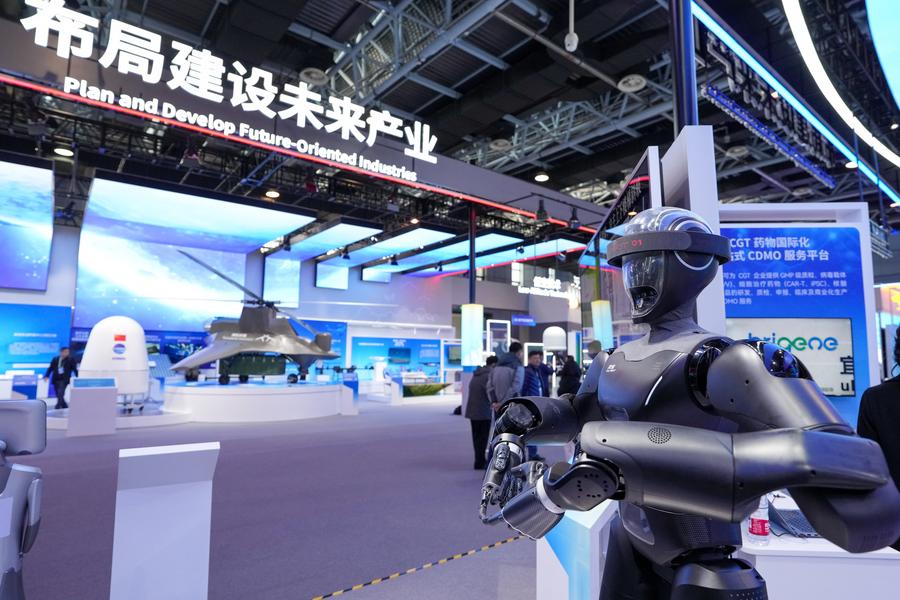
A humanoid robot poses during a permanent exhibition at the Zhongguancun Exhibition Center in Beijing, capital of China, Mar. 28, 2025. [Photo/Xinhua]
This focus on home-grown compute capacity underpins broader adoption across the economy. As Chinese cloud providers and data centers increasingly rely on domestic chips and servers, the cost of deploying high-performance AI is expected to fall. For instance, average GPU hour costs have dropped significantly over the past 18 months, making AI more accessible to businesses of all sizes. Lower costs accelerate AI integration into traditional industries, from factory automation and quality control to logistics scheduling and supply-chain optimization. In 2026, AI's computing power and deployment across various sectors are projected to grow, further establishing AI as a key engine of long-term economic growth.
Capital markets are also reflecting confidence in the sector. Several AI-related firms have recently been listed in Hong Kong, including Zhipu AI, a large language model developer originating from Tsinghua University. Collectively, these listings raised more than HK$9 billion, a substantial capital influx that aligns strategically with national objectives such as enhancing semiconductor self-reliance and technological independence. Funds are earmarked for research, infrastructure, and product development, addressing capability gaps crucial for AI leadership. Other newly listed firms, such as semiconductor developer Shanghai Iluvatar CoreX and surgical robotics company Shenzhen Edge Medical, illustrate the breadth of China's AI ecosystem, spanning software, hardware, and applied technologies. Together, these developments show that AI is no longer in the lab but a significant contributor to capital formation and investor sentiment.
AI deployment across industries and daily life
Beyond chips and financing, AI is increasingly shaping how China's economy functions on a day-to-day basis. The government's "AI+" initiative, reaffirmed in recent policy guidance, calls for large-scale AI integration across industrial and consumer scenarios by the end of the decade. The goal is to embed intelligent systems into manufacturing, healthcare, logistics, agriculture, and public services, making AI a routine productivity tool rather than a specialized capability. In industry, AI-assisted automation is helping factories reduce error rates, improve output consistency, and manage labor shortages. Smart production lines and AI-driven inspection systems are becoming more common, particularly in advanced manufacturing hubs. In ports and logistics centers, autonomous vehicles and scheduling algorithms are improving cargo handling efficiency while enhancing safety. In agriculture, AI tools support precision planting, irrigation and farm management, contributing to higher yields and reduced resource waste—an important consideration for food security and rural development.
AI is also reshaping the service sector. Large language models and intelligent agents are now embedded in customer service platforms, content creation tools, and internal enterprise workflows. These systems allow small businesses to automate repetitive tasks and help large organizations process data more quickly and accurately. Consumer adoption of AI assistants continues to grow, signaling that generative AI is becoming part of everyday digital life rather than a specialized technology. These changes inevitably affect the workforce. While automation reduces demand for certain manual and routine roles, it also increases the need for AI-literate workers capable of managing, deploying, and improving intelligent systems. Consulting and industry studies suggest that AI adoption will drive organizational restructuring rather than outright job displacement, shifting human labor toward higher-value tasks and technical oversight.
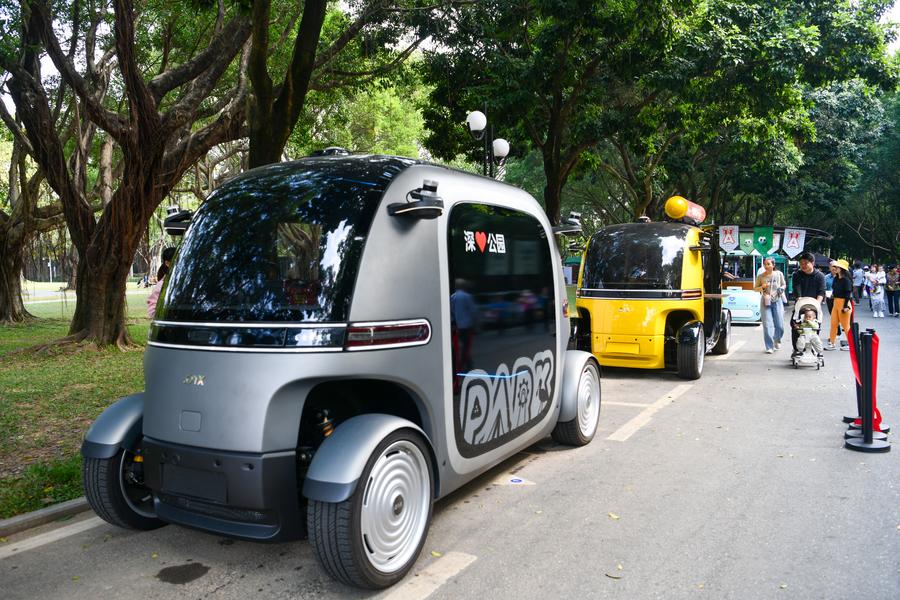
This photo taken on Nov. 11, 2024 shows smart unmanned vehicles at Lianhuashan Park in Shenzhen, south China's Guangdong Province. [Photo/Xinhua]
Global influence, competition, and standards
China's AI acceleration in 2026 is also reshaping the global technology landscape. Domestic AI platforms, hardware, and integrated solutions are increasingly positioned for export and international collaboration, particularly in markets that prioritize affordability, economy of scale and localized deployment. This outward push is visible at global technology events such as CES 2026 in Las Vegas, where Chinese companies are showcasing deployable AI products rather than experimental concepts. Firms including Unitree Robotics, AgiBot, and Noetix Robotics are presenting humanoid and industrial robots designed for logistics and factory tasks, highlighting progress toward commercial viability. Consumer-focused companies such as Rokid and Inmo are introducing AI-powered smart glasses and augmented-reality devices aimed at international markets, signaling growing confidence in global expansion.
Competition is also intensifying at the model level. Industry assessments indicate that Chinese AI models are narrowing performance gaps with leading Western counterparts, often achieving comparable results at lower compute costs. This cost-performance balance makes Chinese solutions attractive to international partners seeking efficient AI deployment. At the same time, China's evolving AI regulatory framework, including data protection and algorithm governance, is influencing global discussions on how to manage large-scale AI systems while balancing innovation and oversight.
The future of Chinese AI
China's AI acceleration in 2026 reflects a shift from experimentation to execution. Artificial intelligence is driving productivity gains, supporting industrial modernization, and attracting sustained investment, while domestic advances in chips, cloud infrastructure, and models strengthen technological autonomy. As Chinese companies commercialize AI solutions globally, their influence will extend beyond national borders, shaping markets, supply chains, and standards. For businesses and technology observers worldwide, the significance of China's AI trajectory lies not only in technical breakthroughs but in how AI is applied at scale. In this sense, China's AI ecosystem now serves as both a pillar of domestic economic growth and a significant player in the evolving global AI landscape. This dual role will continue to shape the AI industry, increasing innovation, competition, and cooperation throughout 2026 and beyond.


 京公网安备 11010802027341号