 Share:

Against the backdrop of growing external uncertainties in 2025, such as unilateralism and protectionism that disrupted the international economic and trade order, China-ASEAN cooperation continued to advance collaborative development and forged a closer community with a shared future working hand in hand.

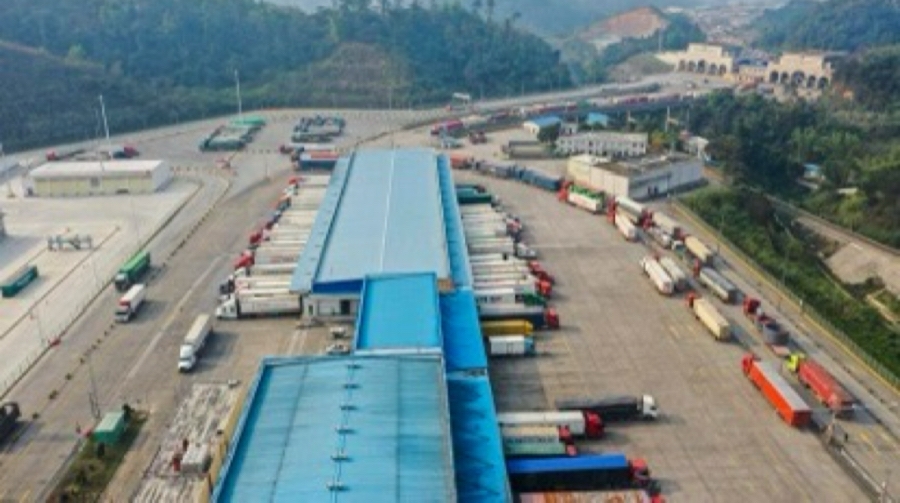
Trucks loaded with agricultural products from China and ASEAN countries at the Friendship Pass Port in Pingxiang, Guangxi Zhuang autonomous region, Mar. 21, 2025. [Photo/Xinhua]
Over the years, China has worked closely with ASEAN member states to safeguard the regional multilateral trading system and ensure the smooth functioning of regional industrial and supply chains. In the first 11 months of 2025, ASEAN remained China's largest trading partner, with bilateral trade volume reaching 6.82 trillion yuan, representing an 8.5% year-on-year growth.
Through high-standard opening up, China has continued to share the opportunities of its supersized market with ASEAN countries. In the first 10 months of 2025, bilateral trade in agricultural and food products reached $51.3 billion, up 8.9% year on year, according to China's General Administration of Customs. Of this total, China's imports of fresh and dried fruits and nuts from ASEAN exceeded $10 billion, accounting for over two-thirds of its global imports in this category.
China has also strengthened cooperation with ASEAN countries such as Indonesia, Vietnam and Malaysia in emerging sectors including AI, digital economy and green economy, unlocking new prospects for innovation-driven development.
The China-Laos Railway's expanding "golden corridor" effect and the stable operation of the China-Indonesia Jakarta-Bandung High-Speed Railway together exemplify how infrastructure connectivity fuels regional prosperity. Steady progress in key projects and industrial parks — such as the "Two Countries, Twin Parks" model between China and Malaysia, the China-Indonesia Regional Comprehensive Economic Corridor, and the China-Singapore Suzhou Industrial Park — has further deepened industrial chain integration and injected vitality into the region's economy and society.
Eight vehicles, including new energy logistics vehicles, golf carts and light trucks, rolled off the production line at the Liuzhou plant of Guangxi Automobile Group in south China's Guangxi Zhuang autonomous region on Oct. 27, 2025, destined for Vietnam. The delivery marked the export of the group's 5,000th complete vehicle to ASEAN, reflecting the development of the China-ASEAN Free Trade Area (CAFTA).
China's minister of commerce Wang Wentao and the then Malaysian minister of investment, trade and industry Tengku Zafrul Aziz, on behalf of China and ASEAN, respectively, signed the CAFTA 3.0 Upgrade Protocol in Kuala Lumpur, Malaysia, on Oct. 28, 2025. The agreement elevated China-ASEAN economic and trade cooperation to a new level, ushering bilateral cooperation into a new institutionalized stage.
The CAFTA 3.0 upgrade expands cooperation in nine areas: digital economy, green economy, supply chain connectivity, standards and technical regulations with conformity assessment procedures, sanitary and phytosanitary measures, customs procedures and trade facilitation, competition and consumer protection, micro, small and medium-sized enterprises, and economic and technical cooperation. The signing signifies that China-ASEAN free trade cooperation and regional economic integration are expanding from traditional areas to emerging fields.
"For ASEAN members like Indonesia, it surely will enhance competitiveness, attract sustainable investment, and strengthen regional integration under an open, rules-based framework," said Garibaldi Thohir, chairman of the Indonesian Chamber of Commerce and Industry's Indonesia-China Committee.
Since its inception, the CAFTA has evolved continuously, and the launch of the 3.0 upgrade stands as a milestone in deepening regional economic integration and pioneering a paradigm for regional economic cooperation.
Yeah Kim Leng, a professor of economics at Malaysia's Sunway University, called the signing "a timely upgrade not only to shield the region from global economic fragmentation and rising uncertainties, but a natural consequence of advancing inclusive development at the regional level."
China launched an "ASEAN visa" for the 10 ASEAN member states and ASEAN observer Timor-Leste in June 2025. From youth exchange programs and educational cooperation to surging two-way tourist arrivals and vibrant cultural festivals, China and ASEAN have continuously expanded channels for connectivity — a trend highlighted by the closing ceremony of the 2024-2025 ASEAN-China Year of People-to-People Exchanges, which was held in Malacca state in December 2025.
Over the past two years, China and ASEAN have jointly staged nearly 200 high-level, high-impact and widely welcomed people-to-people exchange activities. These initiatives have fostered closer cultural and emotional bonds between the peoples of China and ASEAN, generated broad social impact, and laid a solid social foundation for building a peaceful, secure and prosperous Asian home.
Looking ahead to 2026, China and ASEAN will mark the 5th anniversary of the establishment of their comprehensive strategic partnership. The two sides are poised to deepen exchanges and cooperation across political and security affairs, economic and trade relations, and social and people-to-people exchanges.


 京公网安备 11010802027341号