 Share:

More than 100 years ago, the area along Qilou (Sotto Portico) Street in Haikou, capital of Hainan Province, served as the embarkation point for Hainanese setting out on their maritime voyages to seek greener pastures. They would later return with their savings, and built the impressive Chinese-Western-style buildings that now serve as mementos of their experiences overseas.
A century later, with the development of the Hainan Free Trade Port, what was once a place of departure has now become a trendy gathering place. A new generation of Hainan settlers, returned overseas Chinese, and international artists now call the area home. Qilou Street has witnessed the transformations of this era driven by an eclectic mix of locals, artists, and entrepreneurs, who are contributing a new chapter of openness.
Restoring and preserving
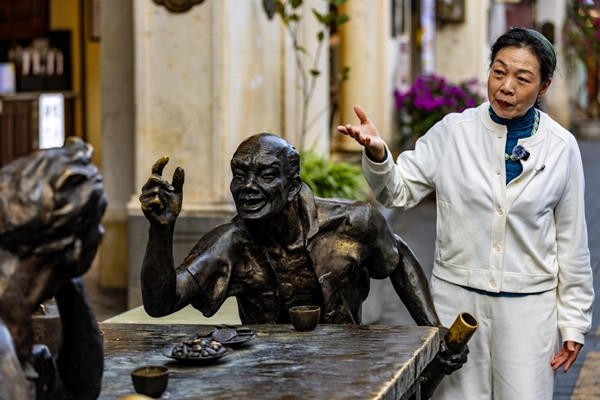
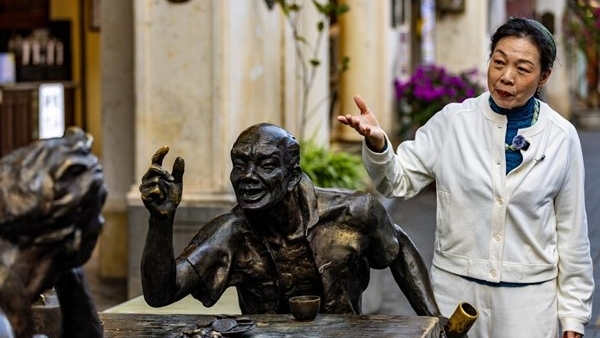
Zhao Aihua at the Qilou Street.
When Zhao Aihua undertook the protection and renovation project of Qilou Street in 2009, she was confronted with a scene of decay. The buildings in the Nanyang architectural style were structurally damaged and dilapidated, and the businesses were dominated by hardware shops, electrical appliances outlets, and convenience stores, falling far short of its designation as a famous historical and cultural street.
"Our philosophy has evolved from 'reconstruction of the old street' to 'protection and restoration,' and then to urban renewal,'" said Zhao, who served as the project leader and later became the chairman of Haikou Qilou Street Investment and Development Co., Ltd. She was well aware that the project's goal was not demolition and reconstruction, but to awaken history.
To restore the authenticity of the buildings, her team carried out meticulous work: testing old construction materials, having manufacturers produce them according to the original specifications; reviewing old photos, and consulting landlords of the older generations, all in an effort to duplicate the buildings' original appearance. "We have preserved the core structure of the north-south oriented communal apartment buildings. Only for badly damaged buildings would we redesign interior spaces for modern commercial on the condition that the exterior remains unchanged," said Zhao.
The challenges of transformation also stem from changes in mindset. Businesspeople worry about making no money, while property owners fear vacancies. Zhao's team communicated with each household, and assured them of the neighborhood's future development prospects. They established a business database to phase out outdated business models and introduce new ones in the cultural, tourism, and creative sectors. Rent subsidies were provided to help businesses transition smoothly.
Today, the street has become the most popular national scenic area in Haikou, with the single-day visitor count on the New Year's day exceeding 110,000. More importantly, the renovation has preserved the original historical features of the area, and mass relocation of original residents was avoided. "If the humanistic sentiment and local culture disappear, the renovation will certainly be a failure," Zhao said, ensuring that the old street retained its authenticity.
Zhao's team has laid a solid foundation for the future of the street. While more than 490 buildings have been restored, a historical space is reshaped to adapt to the modern times. With the construction of the Hainan Free Trade Port and the introduction of visa exemption policies, the region has seen a surge in visitors and international exchanges, art exhibitions from other parts of China such as Hong Kong, Macao and Taiwan, and other countries like Japan, the Republic of Korea, and Italy. Shop space has become highly sought-after, and with many overseas returnees and young entrepreneurs returning to start businesses, the street's commercial landscape has evolved organically.
Empowering cultural industry
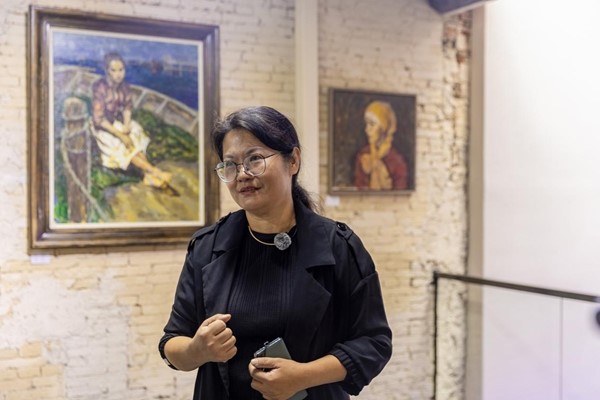
Chen Ru's Qilou Art Gallery has become an important platform for international art exchange.
Artist Chen Ru has built a bridge to the world on Qilou Street. In 2018, attracted by the Hainan Free Trade Port policy, this Qionghai (a city in the east of Hainan Province) native, who had previously studied in the U.S., returned to her hometown. She rented an abandoned building on the street that had been left unused for 15 years and spent over two years transforming it into China's only art gallery in the Qilou architectural style.
"The core appeal of the free trade port lies in the zero tariffs on artworks and the visa-free policies for many countries," Chen said. These policies greatly lower the costs and barriers for international artists to engage, exhibit, and trade in Hainan. "Compared to cities like Beijing and Shanghai, Hainan enjoys policy advantages that make it easier for us to attract international art resources," she added.
The policy benefits have quickly translated into concrete results. Since its opening in 2024, the Qilou Art Gallery has collaborated with artists and institutions from various countries and regions, including Italy, the Republic of Korea, and Japan, rapidly becoming an important platform for international art exchange. Currently, the gallery is planning to establish a residency for young artists in Italy to further deepen international cooperation.
As a private organization, the gallery faces challenges such as funding and operations, but she remains confident about the future. She believes that the Hainan Free Trade Port is a fertile ground for cultural innovation, and hopes to leverage the policy advantages here to transform the street into a genuine international art exchange platform.
Chen's gallery is a prime example of how the Hainan Free Trade Port policies empower the cultural industry. The bridge of art she established introduces the latest international art into the century-old street, injecting an international perspective and contemporary vitality into this historic district.
Revitalizing intangible cultural heritage
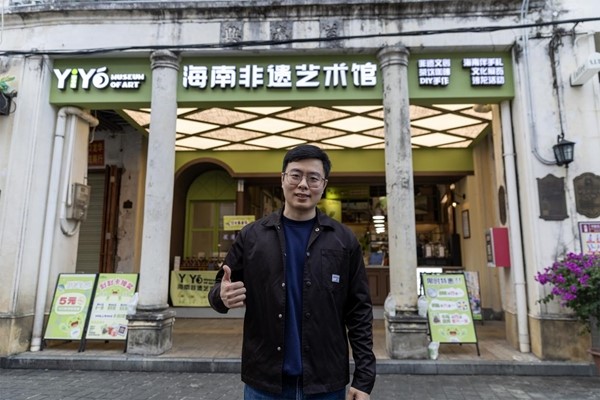
The YiYo Museum of Art, founded by Huang Yaosen, showcases intangible cultural heritage through a unique operational model, attracting visitors.
Hainan is not only eager to attract talent and ideas but also confident in connecting with the global community. As a descendant of earlier migrants to Hainan, Huang Yaosen aims to present Hainan's indigenous culture to the world in an innovative way.
As head of the Haikou Intangible Cultural Heritage Protection and Inheritance Association and the YiYo Museum of Art, Huang has tracked the challenges of aging local intangible cultural heritage practitioners and the low level of industrialization of these old crafts.
"Intangible cultural heritage often gives the impression of being ancient, but I want to make it trendy," Huang said. Having previously worked on cultural and tourism IP projects in Shenzhen, he believes the key to making this shift lies in marketization and igniting consumers' interest. He has therefore focused on getting young people attracted to cultural heritage items. At his museum, exhibitions present a living culture that can be touched, experienced, and consumed.
The Art Supermarket on the museum's first floor embodies his philosophy: the patterns of Li (an ethnic minority group) brocade are applied to modern jewelry; the usually bitter herbal drinks from Guangdong Province are transformed into a sweet taste; local Hainan tea is combined with fruit-flavored freeze-dried ingredients to create trendy new beverages.
"Intangible cultural heritage can connect all industries without being separated from daily life," Huang said.
Looking further ahead, he has brought intangible cultural heritage into vegetable markets, organized a cultural week, and established a night school that offers more than 20 courses on cloisonné enamel, tie-dyeing, coconut carving, and other old arts and crafts. These events provide urban youth with a social space to learn traditional skills. His team consists entirely of individuals born in the 1990s, skilled at exploring the appeal of intangible cultural heritage from a young perspective, thereby promoting the integration of traditional crafts into modern life. From a youthful perspective and through a market-driven approach, Huang brings out new of ancient cultural heritage, allowing it to flourish in contemporary society.
From safeguarding and revitalizing, to connecting with the world, Zhao Aihua preserves the fundamental essence of the old street, Chen Ru opens a window for it to be seen by the world, and Huang Yaosen cultivates new growth from the ground up. Their stories, like pieces of a puzzle, come together in a modern renaissance to form today's image of Qilou Street, where a more open and confident Hainan is clearly emerging.


 京公网安备 11010802027341号