

 Share:

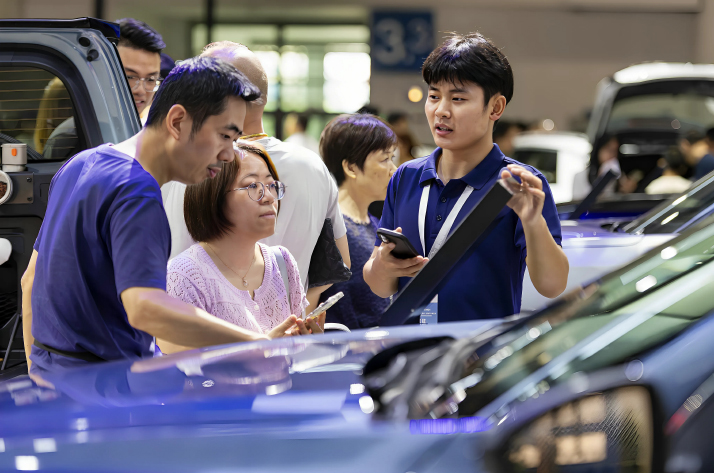
Visitors consult a salesman (right) at the 46th China (Fuzhou) International Automobile Expo in Fuzhou, Fujian Province, on October 1, 2025. [Photo/Xinhua]
The national consumer goods trade-in subsidy program has been a focal point for discussion among Chinese consumers in recent years. The program, which covers home appliances, digital products and vehicles, is part of China's stimulus package launched in 2024, which also includes incentives for large-scale equipment upgrades.
During the 2024-25 period, the subsidy program benefited 494 million consumers and generated consumer goods sales of 3.92 trillion yuan ($549 billion), said Vice Minister of Commerce Sheng Qiuping at a press conference on January 6. During the same period, 192 million home appliances and 18.3 million vehicles were traded in, with new-energy vehicles accounting for nearly 60 percent of new vehicles purchased.
Additionally, according to data released by the National Development and Reform Commission in August 2025, the country had allocated 188 billion yuan ($26.3 billion) in ultra-long special treasury bond funds within the year for the implementation of large-scale equipment upgrades across key sectors. The funds will support approximately 8,400 projects spanning fields such as energy, logistics, environmental infrastructure, education and healthcare, leveraging a total investment of over 1 trillion yuan ($140 billion), the commission said. In China, funds from ultra-long special treasury bonds, which have maturities of more than 10 years, are typically used to finance major national strategic projects or address long-term development needs.
Boosting consumption
The government has allocated 62.5 billion yuan ($8.9 billion) in ultra-long-term special treasury bond funds to support the renewal of the trade-in subsidy program for 2026 as part of broader efforts to boost consumption.
The expansion of domestic demand is set to top China's major economic priorities this year, according to the Central Economic Work Conference, the highest-level annual meeting on economic policymaking in China, which took place in early December 2025. The meeting also outlined plans to implement consumption-boosting campaigns, as well as initiatives to increase the incomes of urban and rural residents.
Under the trade-in subsidy program, consumers purchasing smartphones, tablets, smartwatches or wristbands priced below 6,000 yuan ($860) per item are eligible for a subsidy covering 15 percent of the sales price, up to a maximum of 500 yuan ($71.7). Home appliance trade-ins are also eligible for a 15-percent subsidy, with a maximum amount of 1,500 yuan ($215) per item. The products must meet the Grade I energy efficiency standard, and each consumer is entitled to only one subsidy per category. Grade I is the highest level in China's five-tier energy efficiency rating system, signifying the product is among the most energy-saving in its category.
Under the 2026 trade-in subsidy program for vehicles, consumers who scrap old vehicles and purchase new ones can receive subsidies calculated as a proportion of the new vehicle's price, with the maximum subsidy capped at 20,000 yuan ($2,845). According to a notice jointly issued by the Ministry of Commerce and other government departments, consumers will be eligible for the subsidy if the gasoline-powered passenger vehicle they trade in was registered on or before June 30, 2013; if the diesel and other fuel-powered passenger vehicle they trade in was registered on or before June 30, 2015; or if the new-energy passenger vehicle they trade in was registered on or before December 31, 2019.
This year's subsidy program for new digital product purchases has been expanded into a broader subsidy scheme for both digital and smart products, and smart glasses have been added to the list of eligible items.
In addition to central government funding, local authorities will also provide supporting funding and design their own subsidy programs based on their own general requirements, including the eligible product categories and standards.
The program has also gained support from major e-commerce platforms. For example, JD.com, one of China's largest and most influential e-commerce and technology companies, announced it invested nearly 30 billion yuan ($4.3 billion) in 2025 to support the national subsidy program in rural areas and will continue to increase its investment in 2026.
"Subsidies are used to stimulate new consumer demand, while category-specific subsidies help drive industrial transformation and upgrading toward greener, more environmentally friendly and higher-quality development," said Cui Lili, Deputy Director of the School of Digital Economy at Shanghai University of Finance and Economics, to Beijing Review.
"This will also help promote the development of a unified national market," she added.
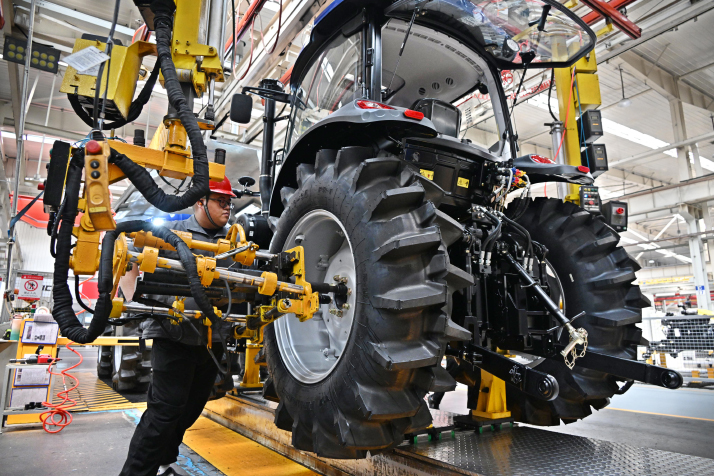
A technician assembles intelligent tractors at the workshop of an agricultural technology company in Weifang City, Shandong Province, on August 21, 2024. [Photo/Xinhua]
Lifestyle uplift
The 2026 extension of the subsidies prioritizes people's livelihoods.
In the area of equipment upgrades, the 2026 version of the program includes new initiatives such as subsidizing the installation of elevators in old residential communities and the updating of equipment in elderly care facilities—practical steps aimed at meeting the demand for enhanced senior care services.
In the home appliance trade-in program, the scope of subsidies has become more targeted, covering six major product categories: refrigerators, washing machines, televisions, air conditioners, computers and water heaters. These six categories account for over 70 percent of household appliance ownership in both urban and rural areas. With the optimization of the policy, resources can be further concentrated, allowing subsidy funds to reach a broader population and deliver a stronger stimulative effect.
"This adheres to a people-centered development approach and addresses the essential needs of a broad segment of the population," Cui said.
Whether by prioritizing subsidies for products with top-tier energy or water efficiency rating or by supporting the replacement of old, polluting trucks—a major source of carbon emissions—with electric vehicles, the program is promoting sustainable and green development.
The program also promotes the development of related sustainability standards by guiding enterprises to carry out technological transformation and equipment upgrades, phasing out outdated production capacity and products, according to Liu Hongsheng, Director General of the Standards Technical Management Department of the State Administration for Market Regulation.
"The newly revised mandatory energy consumption caps for coal-fired power-generating units is expected to reduce the average coal consumption for power supply to below 302 grams of standard coal equivalent per kilowatt-hour by 2030, corresponding to a reduction of approximately 160 million tons of carbon dioxide emissions," Liu said at a press conference on December 26, 2025.


 京公网安备 11010802027341号