

 Share:

China's economy demonstrated remarkable resilience in 2025, with its GDP exceeding RMB 140 trillion for the first time and achieving a 5 percent year-on-year growth. This performance marked the successful conclusion of the 14th Five-Year Plan (2021-2025), during which the country's economy achieved "four consecutive leaps," expanding from RMB 110 trillion, to 120 trillion, 130 trillion, and finally to 140 trillion. As Kang Yi, head of National Bureau of Statistics (NBS), noted, the year was defined by pressure-resistant progress and quality-oriented upgrades, with major economic targets met despite complex global and domestic challenges.
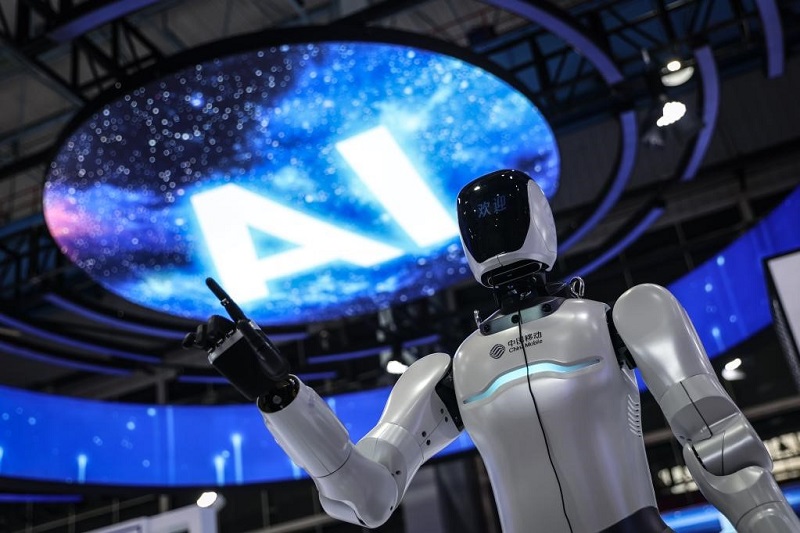
A humanoid robot is pictured at the 2025 Global Industrial Internet Conference on September 6, 2025. [Photo/Xinhua]
The 5 percent growth in 2025 was hard-won against a backdrop of significant headwinds. Externally, rising geopolitical tensions, trade fragmentation, and volatile commodity prices tested China's export-oriented sectors. Domestically, imbalances between robust supply and weaker demand persisted, alongside property market adjustments and local government debt pressures. Yet, proactive macro-policies, including more assertive fiscal support and accommodative monetary measures, helped stabilize the economy. As Kang emphasized, "For a super-large economy like China, achieving such stable development is by no means easy amid intertwined risks and challenges."
International observers acknowledged this resilience. Borge Brende, President of the World Economic Forum (WEF) in an interview with Xinhua, highlighted China's role as a top contributor to global growth, demonstrating strong resilience amid global headwinds. Similarly, the World Bank's lead economist for China Elitza Mileva pointed to proactive policies – such as pension hikes and childcare subsidies – as key to boosting household consumption by strengthening the social safety net and reducing precautionary savings.
A fundamental shift toward innovation-driven growth was central to China's 2025 performance. In 2025, its R&D spending intensity reached 2.8 percent of GDP, surpassing the average of economies in the Organisation for Economic Co-operation and Development (OECD) for the first time, while high-tech manufacturing and equipment manufacturing grew by 9.4 percent and 9.2 percent, respectively, evidently faster than the overall industrial output growth rate of 5.9 percent. Breakthroughs in artificial intelligence, quantum computing, and green technology were exemplified by output jumps in civil drones (37.3 percent), industrial robots (28 percent), and new energy vehicles (29 percent).
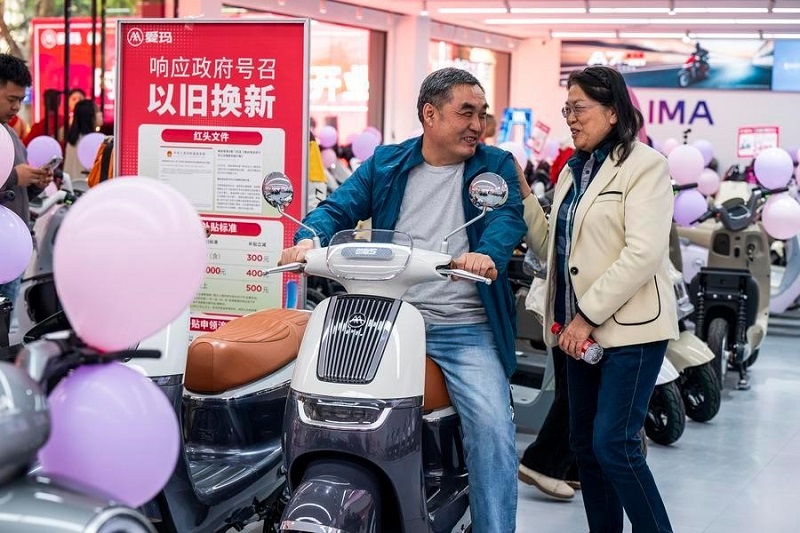
Customers shop scooters in Wuzhou City, south China's Guangxi Zhuang Autonomous Region, March 21, 2025. [Photo/Xinhua]
The integration of artificial intelligence with traditional manufacturing has been particularly transformative. As Tian Xuan, a finance professor at Tsinghua University, observed, its application scenarios are unlimited, able to significantly reduce the cost of repetitive, standardized work, thereby triggering a comprehensive leap in total factor productivity.
This technological advancement is reflected in China's rising global innovation standing. The World Intellectual Property Organization's Global Innovation Index 2025 shows China has entered the global top 10 for the first time, with 24 innovation clusters among the world’s top 100.
Concurrently, consumption emerged as a stabilizing anchor in China's economic rebalancing. Retail sales topped RMB 50 trillion in 2025, with service consumption expanding by 5.5 percent. Final consumption expenditure contributed 52 percent to the country's GDP growth, reflecting the effect of policy-driven initiatives like trade-in programs for consumer goods and urban renewal projects. As Kang Yi, head of the NBS, noted, Chinese residents are shifting from goods-centric consumption to the one featuring a balance of goods and services, with service spending now accounting for 46.1 percent of household expenditure.
Recognizing China's structural advantages, foreign firms are deepening their commitments accordingly. Martin Hofmann, Chairman of the German Chamber of Commerce in China, recently noted that over 5,000 German companies now operate in China, with 93 percent committed to staying despite challenges. "German companies have a long history in the Chinese market... reflecting deep integration into China's economy and continued confidence," he observed, particularly highlighting improvements in intellectual property protection as a positive signal.
Similarly, Tom Simpson of the China-Britain Business Council highlighted opportunities in healthcare, international finance, and professional services of the Chinese market, adding that British businesses remain strongly committed to investing here. The sentiment is echoed by investment patterns: despite global uncertainties, companies like Danfoss, Medtronic, and Maersk have expanded their Chinese operations with significant new investments in 2025.
A notable case is Huber & Ranner Group, a German air-treatment "hidden champion," which recently launched its Asia-Pacific headquarters in Taicang, east China's Jiangsu Province. With a RMB 500 million investment, the facility aims to produce 300,000 air-handling units annually and achieve a yearly output value of RMB 1 billion. Dietmar Huber, the group's president, attributed the decision to Taicang’s enabling business environment, well-established industrial chain, and regional advantages.

An aerial drone photo taken on Jan. 10, 2026 shows a view of the Sanya International Duty Free City in Sanya, south China's Hainan Province. One month into the island-wide special customs operations, Hainan Free Trade Port (FTP) has made initial achievements in trade and logistics efficiency. [Photo/Xinhua]
While some Western countries erect walls, China further advances its high-standard opening-up. Its commitment to institutional opening-up is exemplified by the Hainan Free Trade Port (FTP), which launched island-wide special customs operations on December 18, 2025. In its first month, the policy drove a 46.8 percent surge in duty-free sales to RMB 4.86 billion and attracted over 5,000 new foreign trade enterprises . By allowing "freer access at the first line" (freer trade between Hainan and areas outside China's customs borders) and "regulated access at the second line" (with the Chinese mainland), Hainan aims to become a hub for value-added processing and trade.
China's 2025 economic performance demonstrates a successful balance between stability and transformation. By leveraging macro-policy support, innovation, consumption, and institutional opening-up, the economy has offset external uncertainties while advancing high-quality development. The emerging economic model – characterized by greater technological self-reliance, consumption-driven growth, and high-level opening-up – offers a reference for large economies navigating global uncertainties. While challenges remain, China's diversified economic structure and policy flexibility provide substantial buffering capacity. As WEF President Borge Brende observed, "China has already pivoted toward the fifth industrial revolution," offering a model of resilience to the world.


 京公网安备 11010802027341号