


 Share:

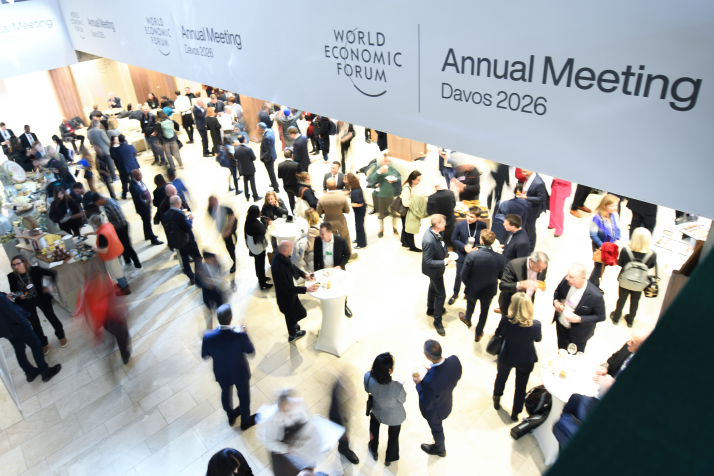
The welcome reception at the 2026 annual meeting of the World Economic Forum in Davos, Switzerland, on January 19. [Photo/Xinhua]
The 2026 annual meeting of the World Economic Forum (WEF) convened from January 19 to 23 in the Swiss Alpine town of Davos, calling for increased dialogue in a complex global landscape.
Themed A Spirit of Dialogue, the five-day event brought together nearly 3,000 representatives from over 130 countries and regions to discuss pressing global challenges, including enhancing cooperation, unlocking new sources of growth and deploying innovation responsibly and at scale.
The meeting highlighted increasing risks and downward pressures on the global economy in an increasingly contested and fragmented world. In an interview with Xinhua News Agency, WEF President and CEO Børge Brende said dialogue is not a luxury, but a necessity for the world today.
Brende warned major escalations of wars have the potential to "kill global growth." If the world can avoid such escalations, global economic growth could reach over 3 percent in 2026, he said.
Wan Zhe, a professor of economics at the Belt and Road School of Beijing Normal University, told Beijing Review that the WEF meeting touched on major contemporary challenges, from geopolitical tensions and conflicting economic interests to information cocoons hindering dialogue in the digital age.
Wan said this year's meeting identified fostering cooperation in an increasingly competitive world as the foremost challenge facing the international community today. "Currently, as dialogue gives way to coercion, building trust and forging common consensus through open exchange have become urgent imperatives for the global community," she said.
Divergent voices
Chinese Vice Premier He Lifeng attended the meeting as part of a visit to Switzerland on January 19-22. While delivering a speech at the event on January 20, he called on the global community to support multilateralism and free trade, and stay committed to win-win cooperation.
China has walked the talk and firmly upheld multilateralism and free trade, He said.
In his address, He told the participants the global community needs to promote inclusive economic globalization, uphold multilateralism and make the international economic and trade order more just and reasonable.
The world should also maximize the results of cooperation, and jointly solve development problems, He added.
He also highlighted mutual respect and equal consultation, and called on all countries to make good use of dialogue to manage differences and resolve issues.
Canadian Prime Minister Mark Carney said during his speech on January 20 that great powers have begun using economic integration as weapons, tariffs as leverage, financial infrastructure as coercion and supply chains as vulnerabilities to be exploited.
Noting that the "old order is not coming back," Carney urged middle powers to work jointly to "build something bigger, better, stronger, more just."
This is the task of the middle powers, the countries that have the most to lose from a world of fortresses and most to gain from genuine cooperation, he said.
Carney stressed that Canada is rapidly diversifying abroad, including recently concluding new strategic partnerships with China and Qatar.
U.S. President Donald Trump also attended the meeting, leading a large delegation including Secretary of State Marco Rubio and Treasury Secretary Scott Bessent. In a special address at the meeting on January 21, he renewed his push for the U.S. acquisition of Greenland and sharpened criticism of Europe and NATO.
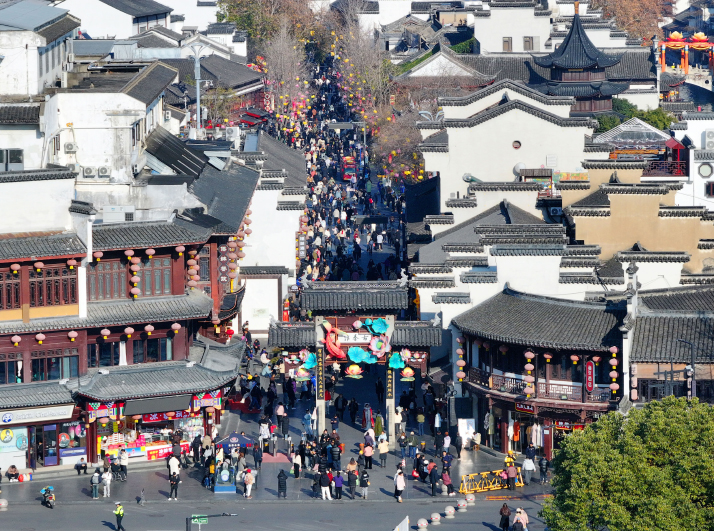
The Confucius Temple scenic area in Nanjing, Jiangsu Province, on January 3. [Photo/Xinhua]
Challenges remain
According to Wan, persistent uncertainty, protectionism, structural imbalances in labor markets and fiscal vulnerabilities in some economies have brought downward pressure on global economic growth.
Trade protectionism has driven businesses to readjust global supply chain layouts. In response to protectionism, businesses are fundamentally restructuring supply chains, prioritizing security and resilience over efficiency, Wan said.
Some major Western economies are weaponizing trade via tariffs, sanctions and tech blockades, which distorts markets and increases costs, Wan said. "Discarding trade rules destroys the mutual respect that makes dialogue possible," she said.
In an update to its World Economic Outlook report, the International Monetary Fund (IMF) forecast global GDP growth to be 3.3 percent in 2026, up 0.2 of a percentage point from its last estimate in October 2025, driven by AI investments and improved financial conditions and despite trade tensions.
Improved performance in major economies such as the United States and China contributed to the revision, according to the IMF. The report said China's growth forecast for 2026 has been upgraded to 4.5 percent, bolstered by stimulus initiatives and reduced tariff impacts, before moderating to 4 percent in 2027.
U.S. research and advisory firm Gartner, Inc. projects global investment in AI-related fields will exceed $2 trillion in 2026.
But the report also warned that the global economy as a whole could easily be disrupted by factors such as diminished expectations for AI-driven productivity gains, geopolitical tensions and new trade wars.
Global South countries still bear the brunt of the economic squeeze, according to a recent World Bank report. By the end of 2025, nearly all advanced economies had seen per-capita incomes rise above their 2019 levels, while about one in four developing economies remained below pre-pandemic income levels, it said.
China's role
The tone-setting Central Economic Work Conference, held in late December 2025, listed expanding domestic demand as one of the top priorities of China's economic policy in 2026.
The Chinese economy still faces challenges of strong supply but weak demand. China will create new demand by providing supportive measures aimed at developing new, diverse and upgraded forms of supply, Wang Changlin, deputy head of the National Development and Reform Commission (NDRC), told a press conference on January 20.
He also highlighted reducing the urban-rural gap, noting that the urbanization rate in China had risen to 67.89 percent as of the end of 2025, up 0.89 of a percentage point from the previous year, meaning an additional 10 million people in China are living in urban areas.
"A large-scale, upgrading and innovation-driven Chinese market provides great opportunities for global businesses," Wan said.
China, as the world's second largest economy, has been advancing high-quality development and expanding its opening up, providing crucial stability amid a turbulent world economy, she said.
China's opening-up efforts have continuously delivered results. The Hainan Free Trade Port's launch of island-wide special customs operations in December 2025 exemplifies this push, with expanded zero-tariff coverage and more market-oriented, business-friendly rules facilitating freer flows of goods.
In 2026, China will upgrade its economic growth drivers and strengthen its development momentum, Zhou Chen, an NDRC official told the January 20 press conference.
Consumption and investment, as well as technology and industry, will unleash great development potential this year, Zhou said.


 京公网安备 11010802027341号