 Share:

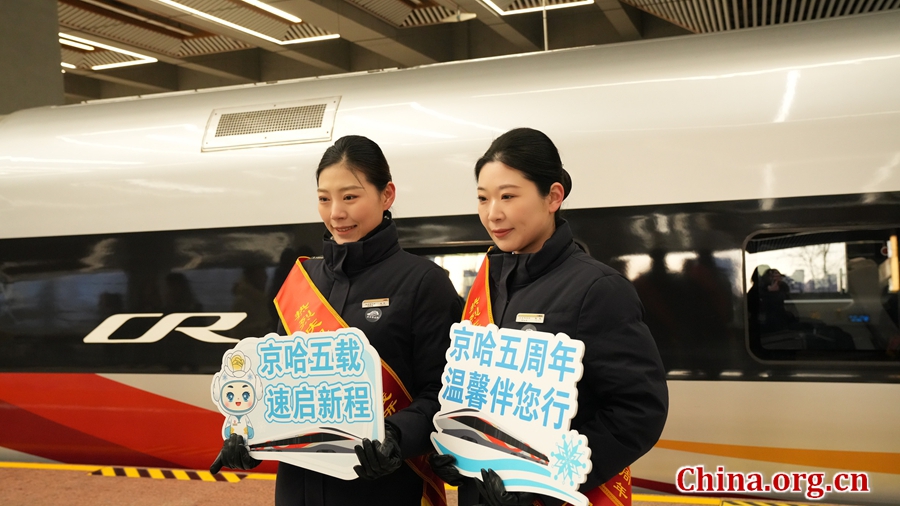
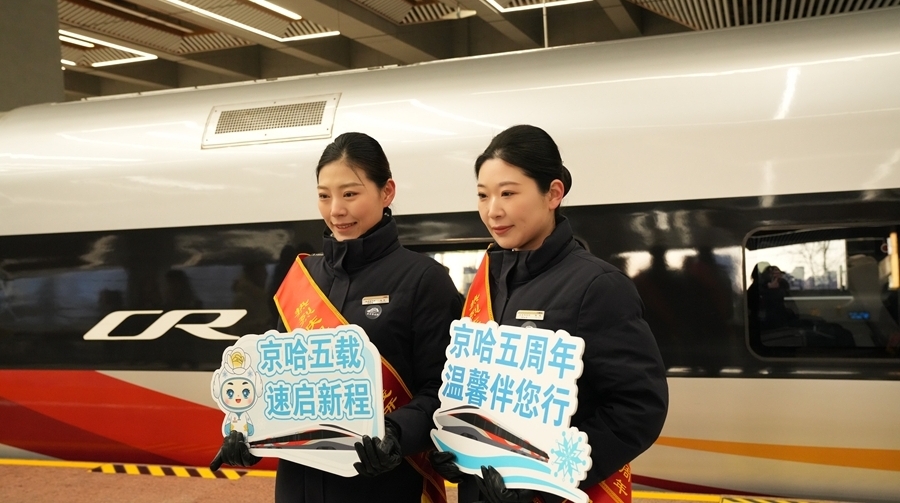
Two train attendants pose for a photo at Chaoyang Railway Station, the starting station of the Beijing-Harbin HSR, Beijing, Jan. 22, 2026. [Photo by Zhang Yuxin/China.org.cn]
"In the past, traveling from downtown Beijing to Miyun (a district located in northeast Beijing) by taxi could take several hours and cost a few hundred yuan. Now, the high-speed train gets me there in just over 20 minutes for a little more than 20 yuan," said Tian Luyao, who works in the construction industry and frequently travels between central Beijing and Miyun district on business.
Tian is not the only one who benefits from the opening of Beijing-Harbin HSR. Since its full operation on Jan. 22, 2021, the 1,198-kilometer rail line, linking Beijing, Hebei province and the northeastern provinces of Liaoning, Jilin, and Heilongjiang, has sent a total of 63.8 million passengers in the BTH region alone as of Dec. 31, 2025, according to China Railway Beijing Group Co., Ltd.
Chengde, a city located in northwestern Hebei, is among the major beneficiaries of this transportation upgrade.
On Jan. 11, 2021, the Beijing-Chengde segment of the Beijing-Harbin HSR was put into operation, bringing Chengde into the "high-speed era" with direct connections to cities such as Beijing and Shijiazhuang, capital of Hebei province.
"Over the past five years, Chengdenan Railway Station has sent over 10 million passengers. The surge in passenger flow has directly driven the expansion and upgrading of tourism consumption," said Han Zhongshan, official of the Chengde Tourism and Culture Broadcasting Bureau. "In 2025 alone, Chengde received more than 100 million tourist visits, with both visitor numbers and total tourism spending rising by over 10% year on year."
Improved transportation links has also promoted the industrial integration between Chengde and Beijing-Tianjin area.
"By leveraging industries such as clean energy and vanadium–titanium new materials, we have jointly built a number of industrial parks, innovation platforms and R&D centers with Beijing and Tianjin," said Shi Shengjie, deputy director of the Coordination Office under Chengde Development and Reform Commission. "More than 100 scientific and research achievements have been successfully applied, effectively realizing a model in which R&D is conducted in Beijing and Tianjin, while industrial transformation and implementation take place in Chengde."
Beyond the BTH region, the Beijing-Harbin HSR has also injected fresh energy into northeast China's economy.
For Liu Shan, a train conductor who has worked on the Beijing-Harbin HSR since its opening, the rail line represents more than a mode of transportation, it is a tangible symbol of regional growth and shared prosperity.
"Since the opening of the Beijing-Harbin HSR, the most noticeable change has been the growing vitality of northeast China's economy and tourism," Liu said. "There has been a clear increase in business travel, as well as more families travelling with children to destinations such as Changbai Mountain and Harbin, and even farther afield, with tourism development becoming increasingly evident."
Spanning China's 14th Five-Year Plan, the Beijing-Harbin HSR has indeed delivered impressive results, connecting lives and economies. As the nation sets its sights on the goals of the 15th Five-Year Plan (2026-2030), this high-speed corridor is set to strengthen its role as a backbone for regional connectivity, driving the next chapter of integrated and prosperous growth for the regions it serves.


 京公网安备 11010802027341号