Share:

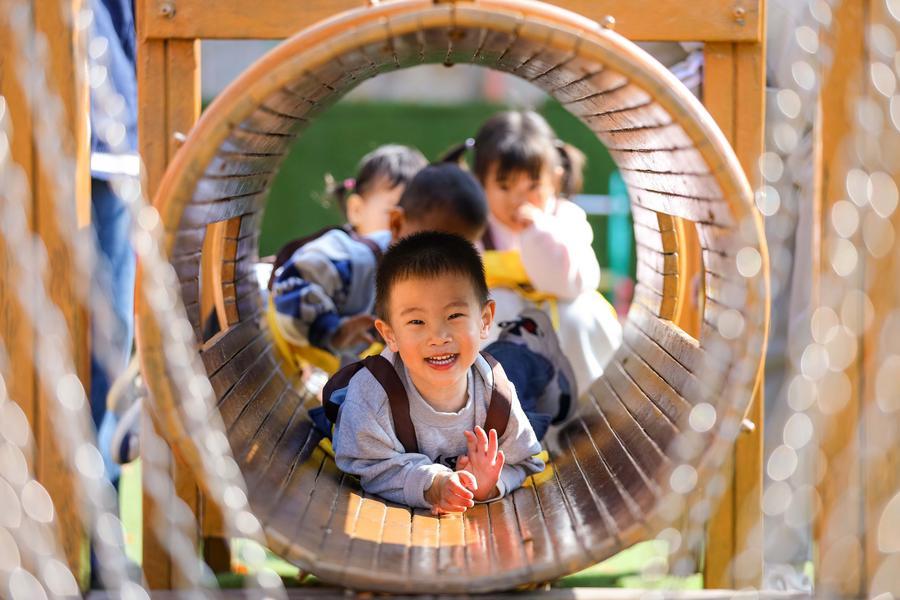
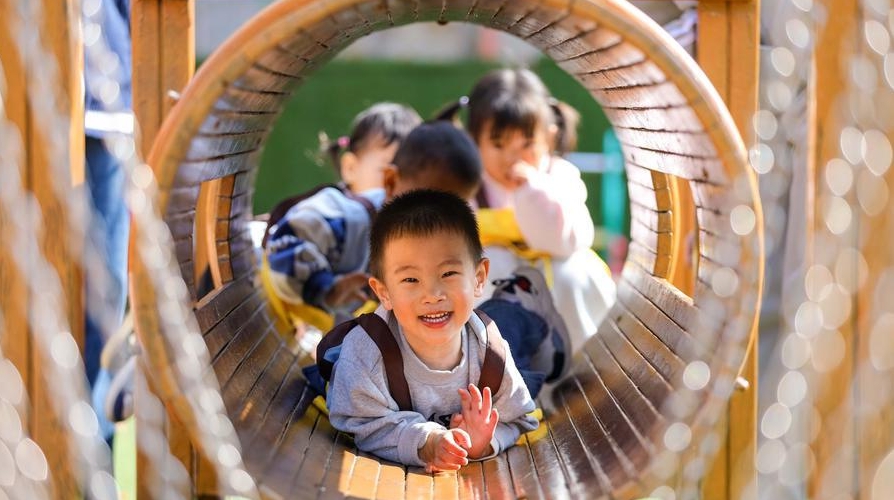
Children have fun at a nursery center in Qingdao City, east China's Shandong Province, Nov. 4, 2025. [Photo/Xinhua]
The Communist Party of China (CPC) Central Committee adopted its recommendations for formulating the 15th Five-Year Plan (2026-2030) at a key Party plenum last October, outlining China's socioeconomic priorities for the coming five years. This pivotal document highlights the need to "combine investment in physical assets (投资于物, tóuzī yú wù) with investment in people (投资于人, tóuzī yú rén)," representing a strategic shift and upgrade in the country's investment philosophy and priorities.
Departing from a traditional emphasis on physical infrastructure, the forward-looking approach attaches greater importance to people, as the ultimate goal of economic development efforts is not only to enhance overall economic well-being and quality of life, but more importantly, to foster well-rounded human development.
"Investment in physical assets" — comprising infrastructure, buildings and equipment — is vital for laying a sound material and technical groundwork essential for socioeconomic development. "Investment in people," meanwhile, refers to policies, expenditures and resources directed toward areas related to people's well-being, including education, vocational training, employment, health care and social security. It aims to improve the knowledge, skills, health, abilities and adaptability of people throughout every stage of life and help them achieve their full potential as productive members of society.
For decades, China's investment has been understandably centered on infrastructure and physical assets, due to the urgent need to build a solid foundation for rapid economic growth. This investment model effectively helped promote technological and industrial advancement, increase production and supplies, create jobs, boost household incomes for consumption, improve public services and bolster the country's development resilience.
However, as China enters a new stage of development, the traditional factor-driven growth model has run into bottlenecks, with structural imbalances between domestic supply and demand and declining marginal returns on investment in physical assets.
Against the backdrop of global industrial competition moving from being capital-intensive to knowledge- and talent-intensive, it is imperative for China to accelerate transition from factor-driven to innovation-driven, demand-led growth. This transformation requires the country to intensify investment in people to cultivate a "talent dividend" on which innovation relies for high-quality development, bolster long-term economic competitiveness, and gain a strategic edge in the new round of technological revolution and industrial change.
China has always put the people front and center, and made their aspirations for a better life its starting point and ultimate goal. That is why the key document called for better coordinating investment in physical assets with investment in people, in order to meet the people's ever-growing needs for a better life, which comprises multiple dimensions — quality education, upskilling, more stable jobs, higher incomes, more reliable social security, better medical services, improved housing conditions, a pleasant ecological environment, and rich cultural services and products.
People are not passive beneficiaries of development, but the driving force and vital contributors to socioeconomic progress. Investments aimed at enhancing people's productive capacities, including knowledge, skills, health and related factors, will catalyze new sources of supply, which in turn will generate additional demand. The investments will lead to robust innovation and creativity, fuel the development of new quality productive forces, increase jobs and incomes, and unleash consumption potential. The dynamic consumption market will, in turn, spur production to shape a virtuous cycle of demand and supply. This is how a strong domestic market can be formed to provide stability and resilience against external headwinds.
Adopting a people-centric approach, China will strive to balance investment and consumption, optimize the investment structure, and tackle the mismatch between supply and demand in various sectors to secure sustainable economic growth, improve people's livelihoods and well-being, and promote well-rounded individual development and all-round social progress.
Looking forward, with long-term mechanisms for people-centered investment in place, additional efforts are expected to improve the income distribution system, ensure more equitable access to basic public services, increase the share of government investment in public well-being, and boost investment in human resources and well-rounded personal development.


 京公网安备 11010802027341号