 Share:

With snow having settled deep across the Alps, blanketing the mountains of northern Italy in white, preparations for the Milan-Cortina 2026 Olympic Winter Games are entering their final stretch.
Four years after Beijing hosted the 2022 Winter Olympics under unprecedented pandemic conditions, Milan-Cortina 2026 will unfold in a very different global landscape.
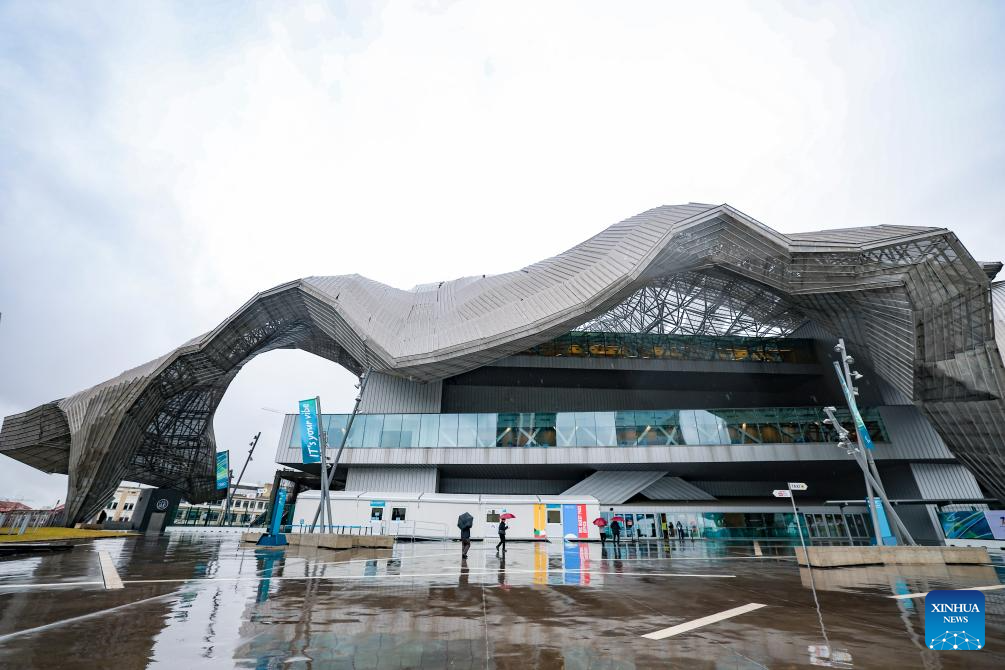
Photo taken on Jan. 28, 2026 shows a view of the main media center (MMC) of the Milan-Cortina 2026 Olympic Winter Games in Milan, Italy. (Xinhua/Hu Xingyu)
Organizers say the challenge now is not simply to host another successful Games, but to define a distinctive Italian approach, rooted in culture, landscape and innovation.
ITALIAN FLAIR
Milan-Cortina 2026 will mark a Winter Games jointly hosted by a global metropolis and an Alpine mountain town. Roughly 2,900 athletes from around the world are expected to compete for 116 gold medals, spread across Italy's cities, valleys and peaks.
The opening ceremony will be held on February 6 at Milan's iconic San Siro stadium. Legendary Italian tenor Andrea Bocelli will lend his voice to the spectacle, joining a lineage of global stars who have helped turn Olympic ceremonies into cultural touchstones.
The Games will conclude on February 22, with the closing ceremony to be staged at the Verona Arena. Built nearly 2,000 years ago, the amphitheater has long hosted operas, concerts and cultural festivals.
Northern Italy itself offers a rare blend of jagged Alpine ridgelines and tranquil lakes, along with medieval towns and modern cities. Skiing and skating are deeply rooted in daily life, forming a local winter culture that spans generations.
Milan-Cortina 2026 will be the most spread-out Winter Olympics ever, spanning two regions - Lombardy and Veneto - and the autonomous provinces of Trento and Bolzano. From Milan, Italy's cultural and financial centre, to the alpine town of Cortina d'Ampezzo, the Games will be staged across a wide range of settings with deep sporting traditions.
"It will showcase an Italian vision of the Winter Olympics - bold, inspiring and beautifully diverse," said organizing committee president Giovanni Malago. "It will weave together majestic Alpine valleys, dynamic metropolitan centers and some of the most breathtaking landscapes our country has to offer."
The Games' mascots are Tina and Milo, a sister-and-brother pair of stoats symbolizing the meeting of nature and city life. Their names draw directly from the host cities - Tina from Cortina, Milo from Milan - while six snowflake companions, known as Flo, represent teamwork, resilience and the pursuit of limits.
BREAKING NEW GROUND
Milan-Cortina 2026 will be the first Winter Olympics fully built on a multi-hub hosting model. Competition venues will be divided into four clusters: the urban hub of Milan, and the mountain venues of Cortina, Valtellina and Val di Fiemme.
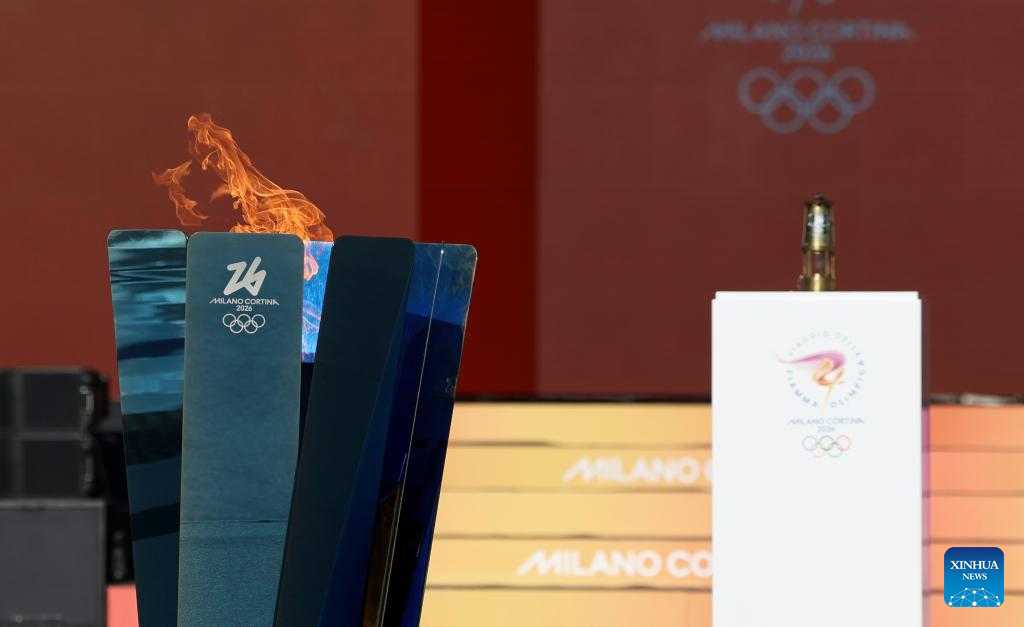
The Olympic flame is seen during the ceremony marking the official start of the torch relay for 2026 Milan-Cortina Winter Olympics in Rome, Italy, Dec. 6, 2025. (Xinhua/Li Jing)
Milan will anchor the Games culturally and ceremonially, serving as the core hub for ice sports, while the mountain clusters will stage snow events.
Tradition will also be reimagined. Organizers say that for the first time, the symbolic lighting and extinguishing of the Olympic flame will be doubled, with two Olympic cauldrons symbolizing unity across distance.
On the field of play, ski mountaineering will make its Olympic debut, blending uphill skiing, climbing and high-speed descents into one of the most physically demanding sports on snow.
The Milan-Cortina Games will also feature more women's events than any Winter Olympics in history. Of the 116 events, 50 are women's competitions and 12 are mixed, meaning women will compete in a record 53.4 percent of events. Female athletes will comprise 47 percent of all participants.
Four women's events will debut, including dual moguls, doubles luge, large hill ski jumping and sprint ski mountaineering. For the first time, men and women will race identical distances in cross-country skiing.
WHERE GLORY AWAITS
Italy has long been fertile ground for winter sports champions, having hosted World Cups, world championships and previous Winter Olympics.
China arrives with momentum of its own. At Beijing 2022, the delegation claimed nine gold medals, its best Winter Olympic performance ever. Now, Chinese athletes are preparing for another push, with strengths concentrated in short track speed skating, freestyle skiing and snowboarding.
Alongside young talents like Gu Ailing and Su Yiming, veterans also remain central to the narrative. Aerials star Xu Mengtao, 35, is set to compete in her fifth Olympic Games and chase new heights with her 40 World Cup wins and seven crystal globes.
Globally, the storylines abound. NHL superstar Sidney Crosby is expected to return to Olympic ice after missing the last two Winter Games, raising the stakes in men's ice hockey.
American icon Mikaela Shiffrin, the most decorated Alpine skier of all time, arrives with a different kind of motivation after leaving Beijing 2022 without a medal after two uncharacteristic failures to finish.
In snowboarding, Chloe Kim is chasing an unprecedented third straight Olympic gold in the halfpipe. On home ice, Italian ice dancers Charlene Guignard and Marco Fabbri - partners for 15 years on and off the rink - will step into their fourth Olympic Games.
LEGACY BEYOND 2026
Away from medals and competition, the IOC says more than 70 projects are underway across Italy to boost physical activity and social inclusion through sport.
"Promoting physical activity, expanding access to sport and inspiring people to be more active are central to the IOC's long-term vision for the legacy and sustainability of the Olympic Games," said IOC Head of Legacy Arram Kim. "Milan-Cortina 2026 is embodying this vision, aiming to leave behind communities that are more active, more connected and more engaged in their daily lives."
Through the GEN26 program, Olympic and Paralympic values have been brought into classrooms nationwide, reaching more than two million students. Another initiative, Go for 30, encourages workers to engage in 30 minutes of daily movement.
Sustainability underpins the infrastructure plan. In Milan, a former rail freight yard at Porta Romana has been transformed into the Olympic and Paralympic Village, which will later become a permanent student housing community.
In Livigno, a freestyle skiing and snowboard hub near the Swiss border, no new athlete housing was built. Traditional Alpine chalets were refurbished and will reintegrate into the local tourism industry after the Games.


 京公网安备 11010802027341号