 Share:

"Dragon-horse spirit" (龙马精神; longma jingshen) is a Chinese idiom frequently used as a blessing, wishing the recipient the endurance of a horse and the divine strength of a dragon — a life full of vitality and the courage to forge ahead.
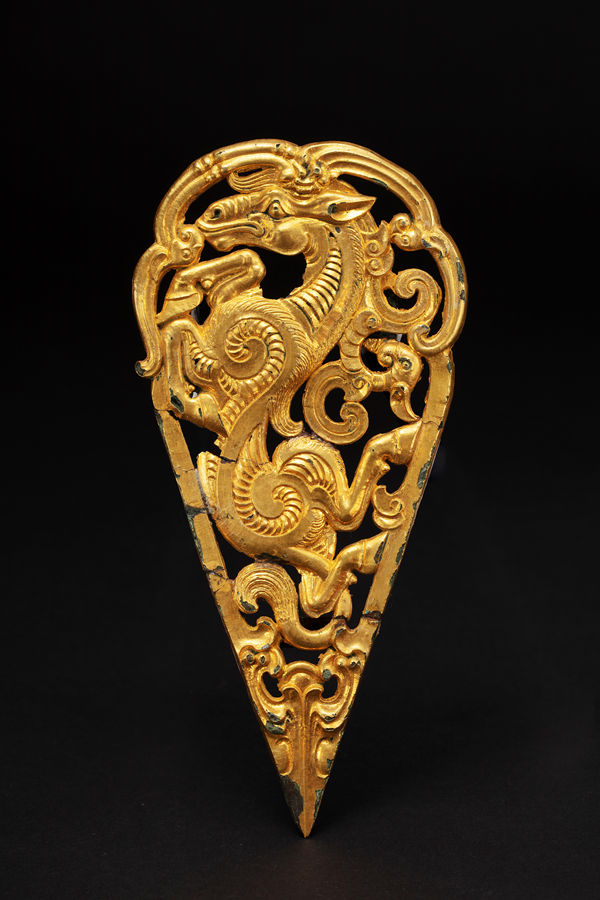
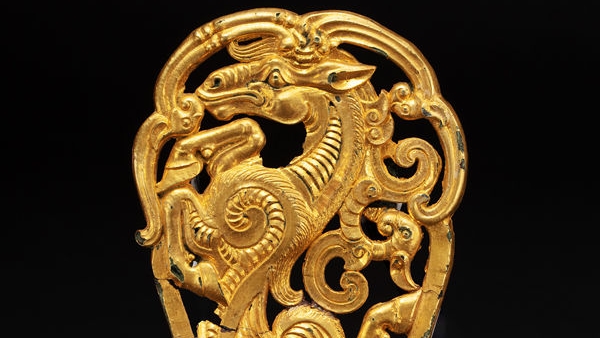
A gilt-bronze dragon-horse "danglu" ornament in Zhangqiu Museum, east China's Shandong province. [Photo/CCTV]
The "dragon-horse" is typically depicted with the body of a horse and the head of a dragon, or sometimes with a horse's body covered in dragon scales, symbolizing an extraordinary ability to traverse both heaven and earth. It is an all-capable, divine creature, much like the White Dragon-Horse in the classic Chinese novel "Journey to the West," who carries the monk Tang Sanzang across mountains and rivers to the Western Heaven to fetch the Buddhist sutras.
The idiom finds its physical expression in an artifact of the Western Han dynasty (202 B.C.-A.D. 8), a gilt-bronze dragon-horse "danglu" ornament; and it is especially fitting with the arrival of the Year of the Horse.
Excavated in east China's Shandong province and displayed in its Zhangqiu Museum, this bronze dragon-horse danglu is a masterpiece, representing the highest level of gilt-bronze craftsmanship from the Han dynasty (202 B.C.-A.D. 220). The relic's dominant design is an S-shaped dragon-horse, surrounded by other decorative motifs such as hook-beaked birds and swirling clouds, creating a celestial atmosphere. Measuring 16.5 centimeters tall and 8 centimeters wide, it features intricate openwork and relief carving techniques, reflecting the artisan's affection for horses and a desire to convey the vibrant "dragon-horse spirit."
A danglu is a harness frontlet which was prevalent in ancient China. Fastened to a horse's forehead, it served as both protection and decoration; its quality and artistry directly reflected the owner's social status. This particular item, unearthed in 1999 at Luozhuang Han Tomb, one of the largest and best-preserved Han dynasty princely tombs, likely belonged to a feudal ruler or a member of the royal family.
Alongside this relic, more than 3,000 other artifacts were excavated, including over 300 pieces of horse equipment and chariots. Archeologists note that Zhangqiu has been famous for horse breeding since the Warring States period (475-221 B.C.), and the discovery of this item underscores the importance of horses and the spirit of vitality they represented during that era.
Notably, several unearthed pieces of horse equipment exhibit a distinct nomadic style, despite Zhangqiu's location in the Central Plains. Historians suggest this reflects the vibrant cultural exchanges between steppe nomads and Central Plains residents. This bond was rooted in a shared admiration of the horse, not only for its practical applications but also for its symbolic endurance and spirit, as reflected in the saying "dragon-horse spirit." Such cross-cultural influence is well-illustrated across a variety of relics from the Han dynasty.
Moreover, with the opening of the Silk Road, the Han dynasty became an era of vibrant exchange, blending the traditions of the Central Plains with those of the northern steppe. This cultural melting pot helps explain the distinctive features of this danglu in Zhangqiu. Beyond its physical beauty, the relic shows the horse's indispensable role in connecting diverse cultures.
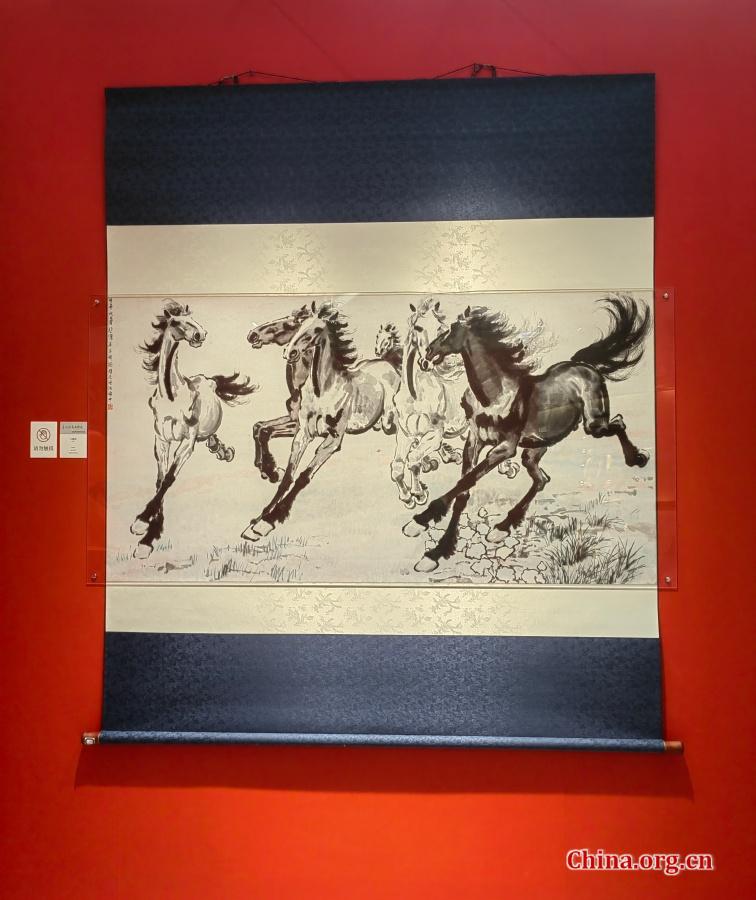
"Six Galloping Horses" by Xu Beihong on display at an exhibition at Financial Street Shopping Center in Beijing, Jan. 5, 2026. [Photo by Liu Sitong/China.org.cn]
In Chinese classics, the dragon symbolizes divinity, vision and wisdom; while the horse represents speed, loyalty and diligence. By combining the two, people express a wish for their enduring spirit, a sentiment most often expressed during New Year greetings.
Standing before this gilt-bronze danglu in the museum, we are not merely looking at a relic, but gazing into a mirror of our own values. It reminds us that the pursuit of excellence and the courage to move forward are enduring cultural inheritances. As the Spring Festival approaches, may we all carry the "dragon-horse spirit" with us, combining the horse's relentless gallop toward a goal with the dragon's soaring vision.


 京公网安备 11010802027341号