 Share:

China's oil and gas industry has maintained steady growth despite intensifying geopolitical tensions and global market volatility, a report by a research arm of China National Petroleum Corporation (CNPC) said on Tuesday.
The report, the 18th annual outlook from the CNPC Economics & Technology Research Institute, was released as China begins its 15th Five-Year Plan (2026-2030) and covers global energy trends, market conditions and the strategic direction of major oil companies.
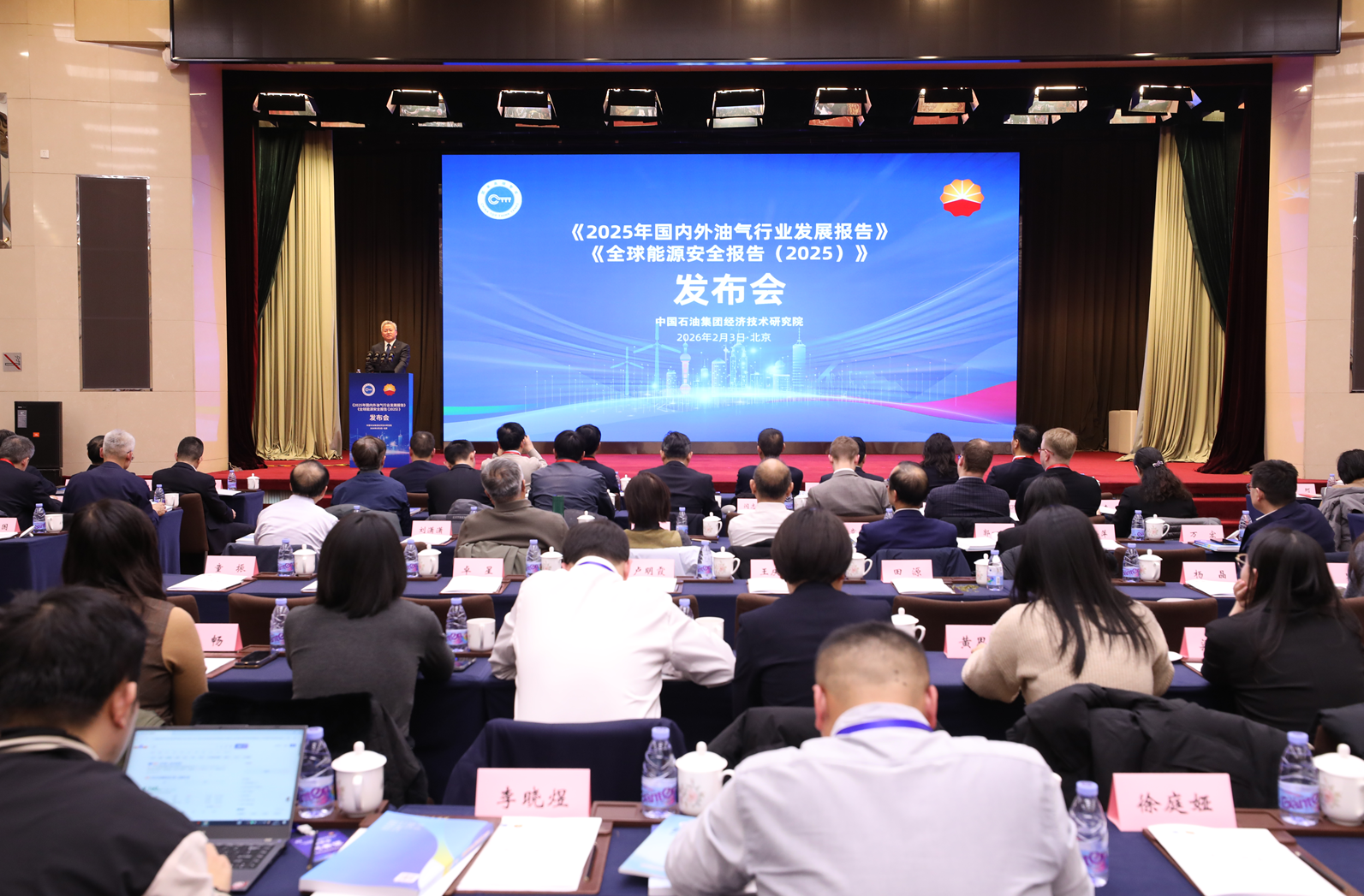
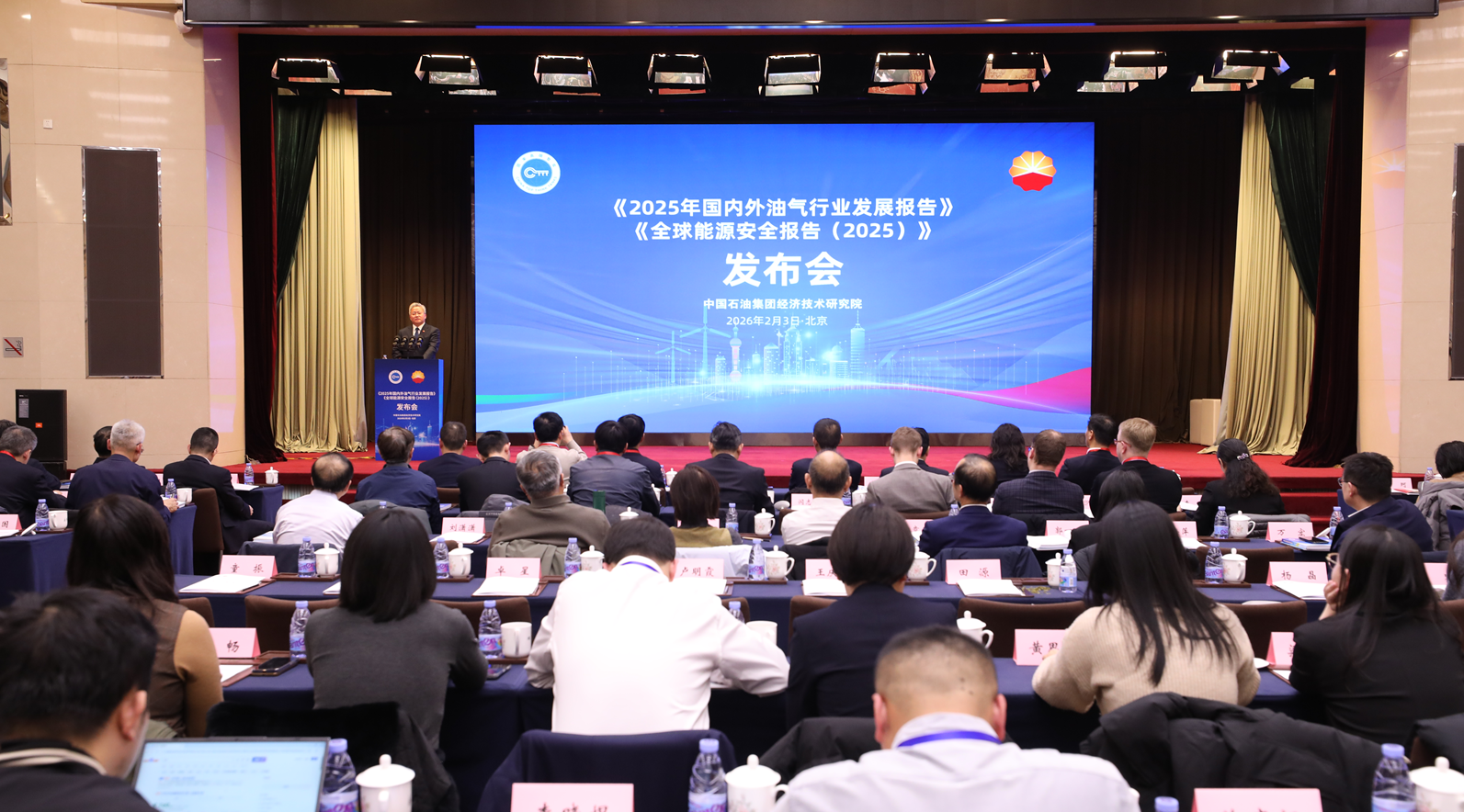
The CNPC Economics & Technology Research Institute releases the 2025 Report on Oil and Gas Industry Development and the Global Energy Security Report (2025) in Beijing, Feb. 3, 2026. [Photo provided to China.org.cn]
The report notes that 2025 was a year of profound global transformation, as geopolitical conflicts, economic restructuring and the energy transition intersected. Looking ahead to 2026, geopolitical shifts are reshaping industry rules as strategic competition among major powers intensifies and supply chains are reconfigured, said Wu Mouyuan, vice president of the institute.
Economic growth is shifting from cyclical recovery to structural growth, featuring emerging drivers like artificial intelligence and green investment, the report found. Energy paths are also diverging — fossil and non-fossil consumption are rising in parallel, and peak oil and gas demand is likely to be delayed, Wu added.
The report expects the global oil market in 2026 to oscillate between oversupply and geopolitical risk. Brent crude will likely trade at $60-65 per barrel under calmer conditions, rising to $70-75 if tensions dominate. Global natural gas markets should loosen, with prices entering a downward cycle, while refining and petrochemical capacity continues to shift eastward, it said.
Against this backdrop, China's oil and gas sector has demonstrated resilience, injecting stability into global energy markets, Wu said. China's steady economic growth and high-quality energy development are increasingly seen as sources of certainty amid global volatility.
China's energy self-sufficiency rate rose to 84.4% in 2025, while non-fossil energy accounted for 21.8% of total consumption, the report found. With wind and solar now the main contributors to new electricity generation, the non-fossil share is expected to exceed 23% in 2026.
China's oil and gas supply continued to expand, with total output reaching a record 420 million metric tons of oil equivalent in 2025. Crude production is expected to hold steady at around 200 million metric tons in 2026, while natural gas output will continue to grow. Oil consumption totaled 762 million metric tons in 2025, up 1.1% year on year, with declining gasoline and diesel use offset by rising jet fuel and naphtha demand. Natural gas consumption reached 432 billion cubic meters and is projected to rise to 450-455 billion cubic meters in 2026.
The report highlights progress in refining and petrochemicals, where greater integration and a shift toward high-end specialty chemicals are accelerating. China's three major oil companies posted record oil and gas output, while expanding into low-carbon energy, new materials and digital technologies. Overseas activity also deepened, with equity oil and gas production abroad reaching 196 million metric tons in 2025 — expected to surpass 200 million metric tons in 2026.
The institute also released its Global Energy Security Report (2025) on Tuesday, the fourth edition of its annual assessment. Despite mounting challenges, the report calls for a more inclusive and cooperative approach to energy security, urging countries to uphold multilateralism, balance development with security priorities, and strengthen cooperation on investment, market development, supply chain resilience and climate governance.


 京公网安备 11010802027341号