 Share:

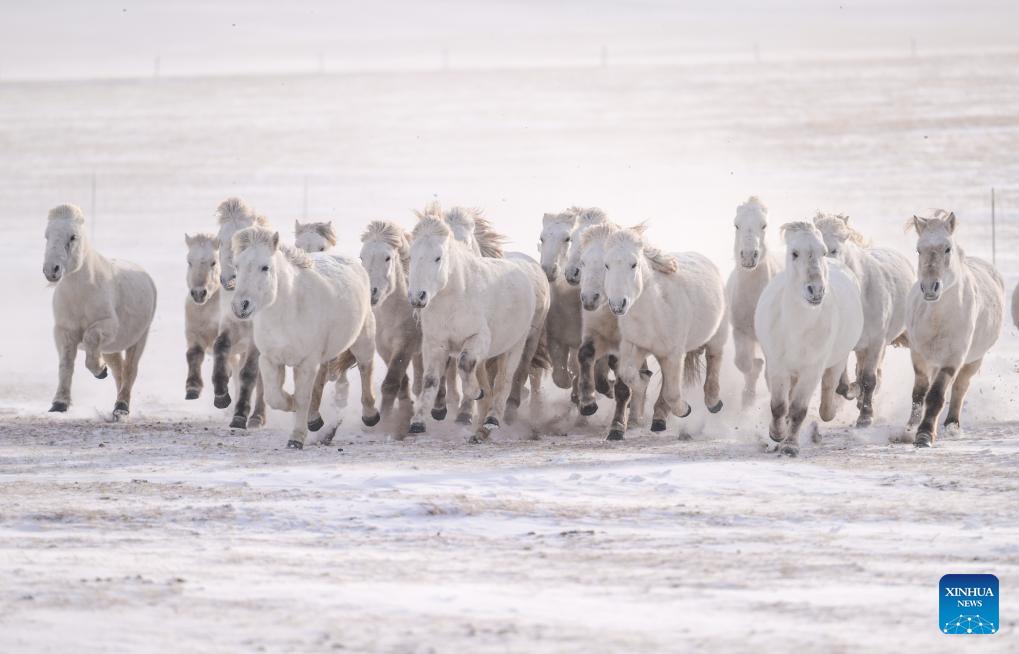
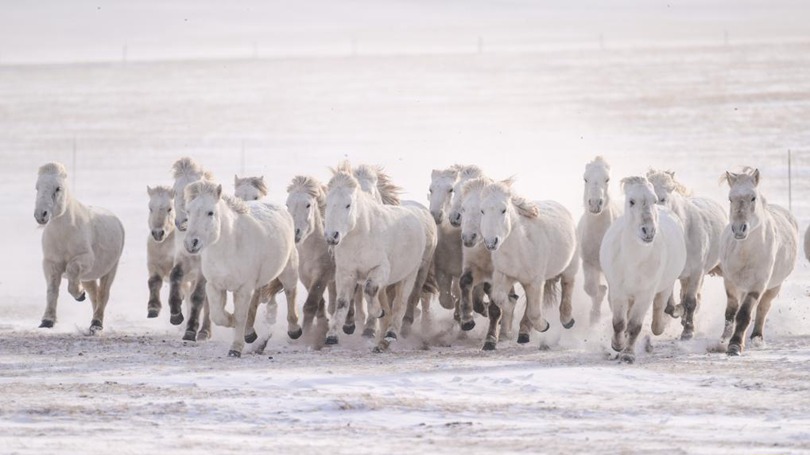
Horses run on the snow-covered grassland in West Ujimqin Banner of Xilingol League, Inner Mongolia Autonomous Region. [Photo/Xinhua]
As the Year of the Horse arrives in February 2026, China has been preparing to launch its 15th Five-Year Plan (2026-2030). In his New Year message, President Xi Jinping called on the nation to charge ahead "like horses with courage, vitality and energy," infusing this new journey with profound cultural resonance and forward momentum. A millennia-old spiritual totem of the Chinese nation, the horse today intertwines with the contemporary national narrative, reflecting a unique historical depth and modern-day significance.
The horse has always held a special place in the hearts of the Chinese people, revered not only as loyal companions but as a symbol of self-improvement and pioneering spirit. From the dynamism of the "Bronze Galloping Horse" statue from the Han dynasty (202 B.C.-A.D. 220) to the loyalty and bravery epitomized by the "Six Steeds of Zhaoling" stone reliefs from the Tang dynasty (618-907), the image of the horse has long transcended its biological form. Through the pursuit of the "dragon-horse spirit" — a metaphor for vigorous progress — the image of the horse has become a symbol of the national character. Its essence can be summarized in three dimensions: a courageous pioneering spirit, the collective strength of unity, and the resilience of practical hard work.
The arrival of the Year of the Horse coincides with a critical juncture as China embarks on its next phase of development. Throughout history, horses facilitated China in carrying out civilizational exchanges and building national unity. Today, the country must draw upon the virtues of the horse to overcome modern challenges. From achieving greater self-reliance and strength in science and technology to promoting common prosperity, and from green transition to global governance, every endeavor requires courage, vitality and energy that the horse represents.
Standing at the starting line of the 15th Five-Year Plan, the task now is to translate the cultural symbolism into tangible action. Only by merging individual efforts into the broader current of national development, and by utilizing the pioneering spirit of a front-runner, the collective force of ten thousand galloping horses and the unyielding resilience of a tireless steed, can the country ensure a strong start to the coming five years, and gallop forward on the journey toward national rejuvenation.


 京公网安备 11010802027341号