 Share:

The music video "Wu Ai-Hua." [Video courtesy of Warner Music China]
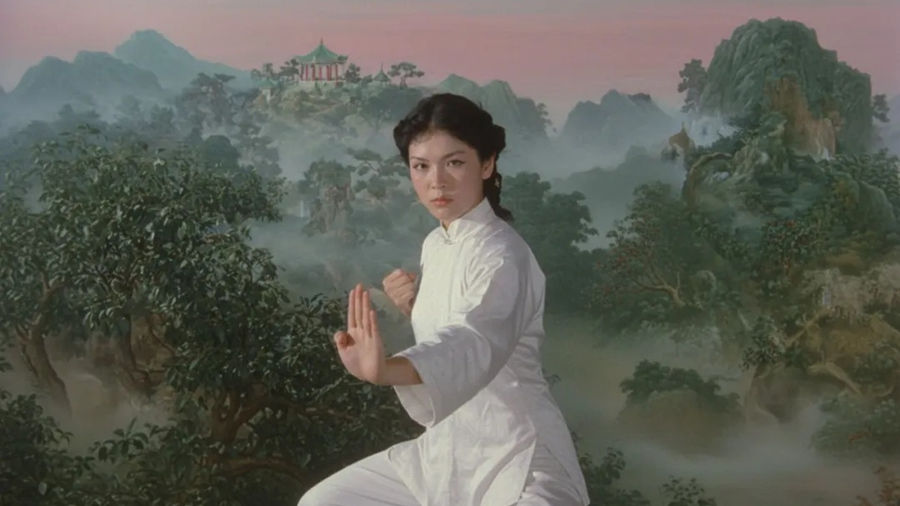
Before her official debut, Wu Ai-Hua had already amassed more than 1 million social media views. Now, the computer-generated artist — billed as the world's first virtual "martial arts singer-dancer" — is releasing her debut single and AI-generated music video, backed by Warner Music China.
The project, directed by Wu Zhichi, is as much a cultural critique as a pop act. Her creators are asking a pointed question: why do younger generations embrace Hollywood superheroes while China's own martial arts heroes risk fading into nostalgia?
"Martial arts culture does not need repetitive nostalgia; it needs a forward-looking vision and integration," Wu told China.org.cn. "These reflections led me to undertake this project."
Wu grew up in Guangdong, near Hong Kong, the cradle of kung fu cinema's golden age. Shaw Brothers Studios, the Hong Kong studio whose martial arts films defined the genre in the 1970s, left a deep impression.
"Shaw Brothers films are a collective memory for our parents' generation," he said. "But no matter your age, there is a moment when you can connect with your own Shaw Brothers memory."
Ai-Hua blends that aesthetic with something deliberately new — a character free from the bloodlines, sectarian loyalties and gender constraints that define traditional martial arts heroes. Wu drew on films by Stephen Chow, Sammo Hung and Jackie Chan during development, but wanted to push beyond nostalgia.
"She is not simply a cosplay that overlays a martial arts filter on pop music," Wu said. "She deconstructs chivalry from old constraints of schools, bloodlines, mentorship and gender norms, and reinterprets it within the dilemmas of modern life — courage, algorithms and the self. She does not carry the tragedy of traditional martial arts characters, yet retains their rebellious spirit."
The debut single pairs traditional Chinese instruments with electronic music and English-language rap. Wu said the choice of English was deliberate.
"Using a global language lowers the barrier for overseas audiences," he said. "I chose electronic dance music and hip-hop because, in my view, martial arts is about precise movement, while singing and dancing are about hitting the beat — both require discipline in breath, center of gravity, and emotion."
The track took about three to four weeks to develop from concept to final version, centered on the theme of "Eastern retro." The vocals were created using synthesizer technology, with composition, arrangement, mixing and mastering handled by a team of local artists. The video, which is officially called an AIMV (AI music video), was generated entirely using AI, a choice Wu sees as a statement in itself.
"The biggest misunderstanding about AI content generation is treating it only as an 'image-generating tool,'" he said. "Its real strength emerges when you do not use it like a traditional camera. Your sense of storyboarding, editing rhythm, and pacing — these classic skills do not lose value in the AI era."
Rather than chasing the hyper-realistic visuals common in contemporary music videos, Wu embraced a grainy, textured aesthetic drawn from 1970s Hong Kong cinema.
"When the entire industry chases high-definition realism, realism can suffocate imagination," Wu observed. "I wanted that rawness to serve as a deliberate cinematic language, drawing audiences back into the feeling of watching a myth."
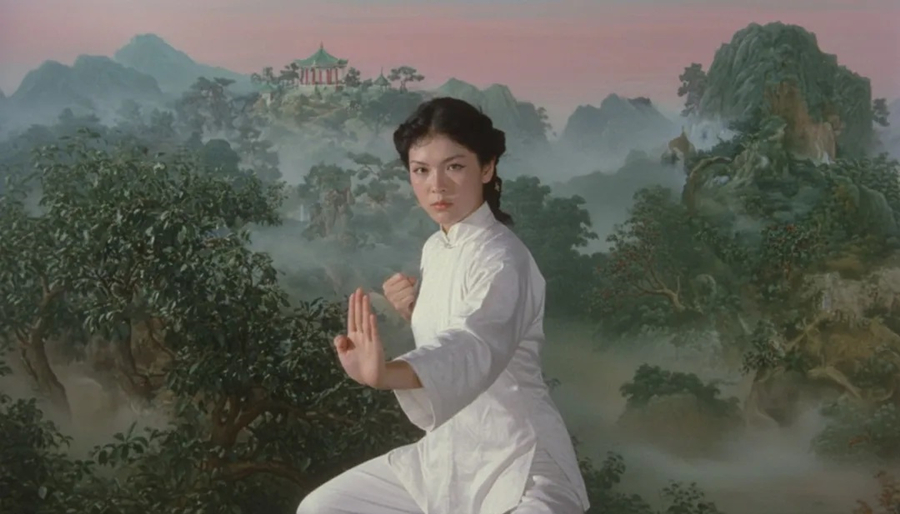
A still from the music video "Wu Ai-Hua." [Image courtesy of Warner Music China]
One of the video's most striking moments comes at the end, when a martial arts manual reveals the line: "Passed down to both male and female kung fu heirs."
"That scene means a great deal to me," Wu admitted. "It breaks gender stereotypes in traditional martial arts and conveys the modern idea that the spirit of chivalry transcends gender."
The release comes as AI video tools advance rapidly. ByteDance released its Seedance 2.0 AI video model on Feb. 7, which some industry observers described as a "singularity moment" for AI-generated cinema. Wu said he does not see the technology as a threat to filmmaking.
"The essence of AI is not replacement — it is the return of creative sovereignty," he argued. "For too long, top-tier audiovisual storytelling was locked behind high industrial barriers. AI delivers true technological equity. It frees ordinary people from tedious labor like pixel-level rendering and repetitive choreography, restoring artistic judgment as the only true moat of creativity."
He cautioned, however, that AI remains a tool, not a creator.
"AI is essentially a probability synthesizer. It offers infinite possibilities, but it cannot deliver inevitability. That inevitability comes from the artist's intuition, and that intuition springs from knowledge and experience."
Warner Music China is backing the project with support for multilingual production and international distribution. Wu said the partnership allows his team to bring Chinese martial arts culture to international audiences.
The music video has garnered more than 100 million views across social media platforms since its release, according to Wu's team.
"I'm relieved by the response," he said. "It shows a real hunger for audiovisual languages that carry the Eastern spirit while feeling thoroughly modern."
Wu said he plans to release two more singles with Warner Music China in 2026, completing a trilogy, with songs in multiple languages blending Chinese musical elements with global pop styles.
"I did not create Wu Ai-Hua to be another hollow Eastern symbol," said Wu. "I hope some will preserve traditional Chinese culture, while others drive cultural innovation. I want global audiences to discover the beauty of Chinese culture through a new lens — that is the fusion I aim to achieve. Ai-Hua is 'rooted in China, facing the world.'"


 京公网安备 11010802027341号