 Share:

Ten years ago, Gianni Infantino pledged to "put football back at the center stage of all that FIFA does" when he was elected FIFA president in Zurich on February 26, 2016, as the world football governing body sought to recover from a major corruption crisis.
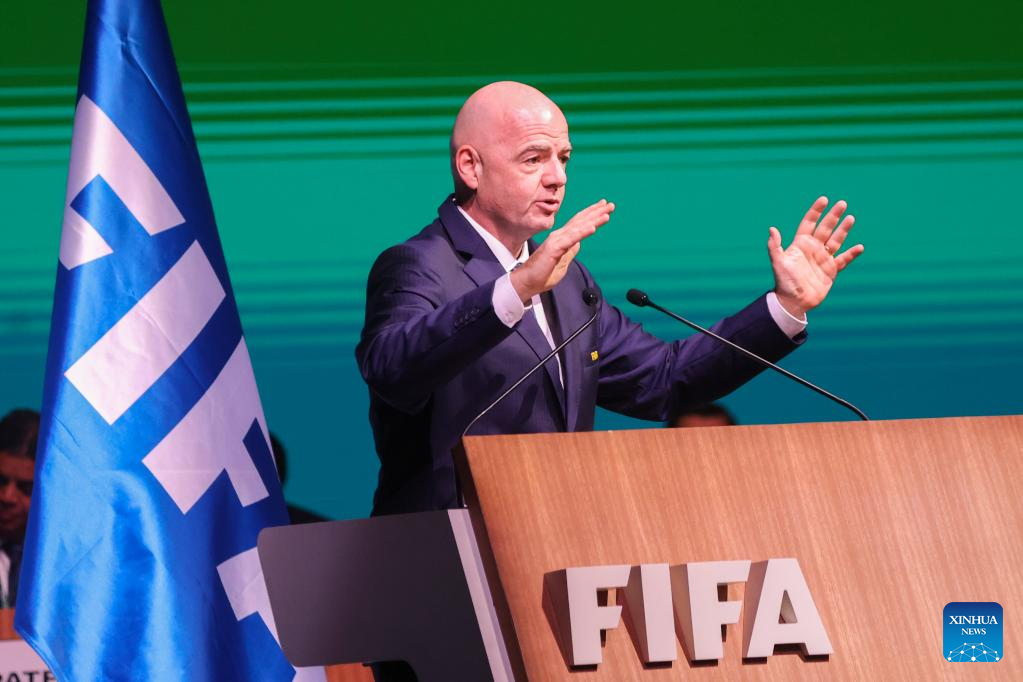
Gianni Infantino gives his speech at the 73rd FIFA Congress held in Kigali, Rwanda, March 16, 2023. Gianni Infantino was re-elected president of the International Federation of Football Association (FIFA) for the term of 2023-2027 at the congress on Thursday. (Photo by Cyril Ndegeya/Xinhua)
Ten years later, FIFA released a review summarizing reforms and development achievements over the past decade.
During this period, under the presidency of the Swiss, the world football governing body expanded its flagship competitions while investing more than five billion U.S. dollars in football development across all 211 member associations worldwide.
EXPANSION: MAJOR COMPETITIONS GROW IN SCALE
Over the past decade, FIFA has implemented sweeping reforms to expand global competitions.
In January 2017, the FIFA World Cup was confirmed to expand to 48 teams starting from the 2026 edition, giving more countries and regions "the opportunity to realize their dream" and triggering development at local level. FIFA said ticket demand for the 2026 tournament has already reached unprecedented levels, with 500 million requests received during the latest sales phase.
The newly expanded 32-team FIFA Club World Cup in 2025 also proved a major success, attracting almost 2.5 million spectators, while an estimated 2.7 billion fans viewed tournament content across all forms of media.
Women's football has witnessed similar expansion. The FIFA Women's World Cup increased to 32 teams in 2023 and is set to grow further to 48 teams from 2031. Participation in qualifying competitions for the 2027 edition has risen to 179 teams, compared with 134 in 2015, reflecting growing competitiveness worldwide.
At the youth level, FIFA has enlarged both the FIFA U17 World Cup and the FIFA U17 Women's World Cup, which are now held annually, with the men's tournament expanded to 48 teams.
FIFA Chief Global Football Development Officer Arsene Wenger said annual youth World Cups would help transform global football by allowing more nations to unlock their potential. "Every country deserves a chance," he noted, emphasizing education and academy-based player development worldwide.
INVESTMENT SPURS GLOBAL DEVELOPMENT
According to FIFA, the FIFA Forward program has contributed over five billion U.S. dollars to football development since 2016 - a sevenfold increase compared to the pre-2016 period.
FIFA said a much greater proportion of its revenues is now reinvested into football, made possible by improved efficiency, governance and financial management reforms.
Funding supports operational costs of member associations as well as infrastructure projects such as pitches, technical centers and competitions. Assistance also covers travel, accommodation and equipment expenses for national teams most in need.
FIFA has also launched the Talent Development Scheme led by Wenger, aiming to establish 75 FIFA Talent Academies worldwide by the end of 2027. FIFA has created an online training center with free access for coaches globally and established around 60 academies across different countries and regions.
Beyond elite football, FIFA's Football for Schools program has been adopted by more than 150 member associations, using football as an educational tool, while the FIFA Arenas initiative aims to build at least 1,000 mini-pitches worldwide to benefit young players.
REFORM: GOVERNANCE AND TECHNOLOGICAL INNOVATION
FIFA said governance and financial reforms over the past decade have helped rebuild transparency and credibility following the 2015 corruption scandal.
Improved governance enabled FIFA to respond swiftly during the COVID-19 pandemic, making 1.5 billion U.S. dollars available through a relief plan to support member associations and safeguard global football activities.
In transfer system reform, FIFA introduced the FIFA Clearing House, through which more than 500 million U.S. dollars in training rewards have been allocated, including over 300 million dollars distributed to 7,000 clubs worldwide to ensure compensation for youth player development.
Technological innovation has also played an increasing role in improving fairness in the game. Video assistant referee (VAR) systems have been implemented in more than 200 competitions across over 70 countries, while FIFA has promoted semi-automated offside technology to further support officiating.
At the same time, FIFA introduced Football Video Support, a simplified and cost-effective video replay system designed to help competitions with limited resources access video-assisted decision-making tools.
FIFA said the reforms undertaken over the past decade have transformed the organization into a governing body focused on developing football globally, while strengthening transparency, inclusiveness and sustainability across the sport.


 京公网安备 11010802027341号