 Share:

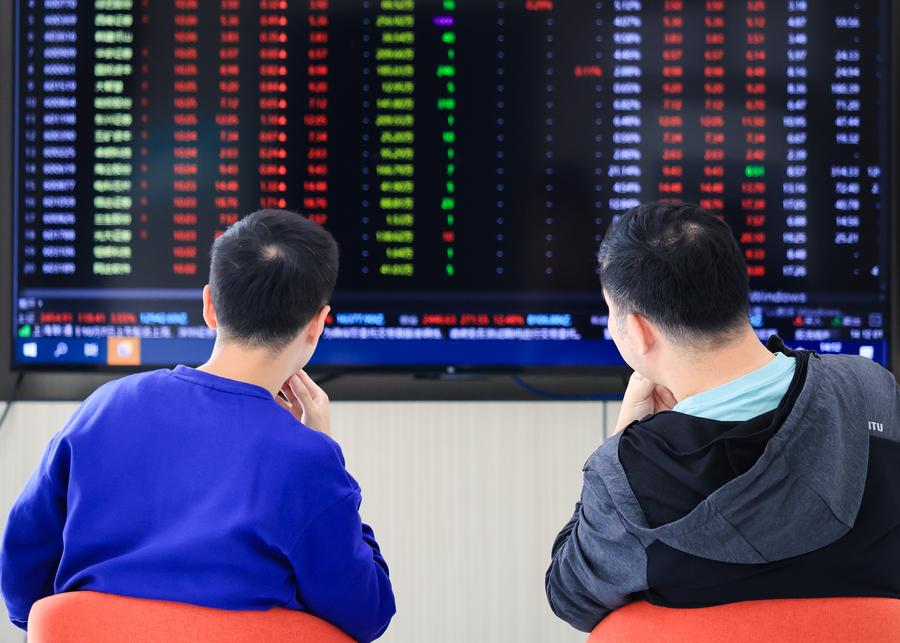
File photo shows investors pay attention to the stock market trends at a securities firm in Nanjing, east China's Jiangsu Province. [Photo/Xinhua]
The Chinese A-share market, supported by companies' improved profits and the country's solid economic fundamentals, remains resilient despite global market jitters amid escalating geopolitical tensions, experts said on Monday.
On the first trading day for local stock markets after early Saturday's attacks on Iran by the United States and Israel, the benchmark Shanghai Composite Index closed 0.47 percent higher.
Meanwhile, Japan's Nikkei 225 shed 1.35 percent and South Korea's Kospi Index fell 1 percent from its 52-week-high registered only one trading day earlier.
The CSI 300 Index, which tracks the 300 A-share market heavyweights, gained 0.38 percent. Listed oil and gas extraction companies reported the strongest daily price increase of 10.96 percent on average, followed by an average 10.69 percent surge in precious metal companies.
According to Zhou Junzhi, chief macroeconomic analyst of China Securities, the Strait of Hormuz, which is controlled by Iran, carries about 30 percent of the world's seaborne oil trade and 20 percent of the liquefied natural gas transport. The closure of the strait would mean a risk of disruption in the global energy supply chain.
Qiu Xiang, chief A-share strategist at CITIC Securities, said sentiment played a role in driving the price increase in precious metals and commodity chemicals amid the geopolitical conflict.
Looking forward, A-share companies will see their profits gradually accelerate through this year, mainly supported by Chinese manufacturers' higher pricing capabilities, companies' competitive edge in the global market, continued technology advancements and recovery of domestic demand, Qiu said.
Lu Zhe, chief economist of Soochow Securities, said global stock markets typically face downward pressure during the early stages of a geopolitical conflict. China's A-share market may not be immune from such widespread panic. However, the impact will not last long and will not constitute a systemic turning point in the bullish momentum prevailing in the A-share market, he added.
The medium — to long-term performance of the Chinese stock market is mainly determined by the country's economic fundamentals and policies, especially the highly anticipated 15th Five-Year Plan (2026-30) scheduled to be released this month.
The A-share market is mainly underpinned by the country's industrial foundation, which is large, complete and capable of absorbing overseas impact, he said.
As a stabilizer of the global industrial chain and a massive economy far from the core conflict zone, the Chinese market has, to some extent, met the global asset allocation demand brought on by a spillover of the risk-averse sentiment, Lu added.
Analysts from UBS Global Asset Management's Chief Investment Office wrote in a note on Monday that investors need to rebalance their portfolio to diversify and hedge against risks to prepare for drastic market volatility as geopolitical conflicts continue.
While resilient portfolios should include gold and quality bonds at a time of rising uncertainties, investors need to look for opportunities in China, which can be one of the economic drivers in the Asia-Pacific region, they said.


 京公网安备 11010802027341号