 Share:

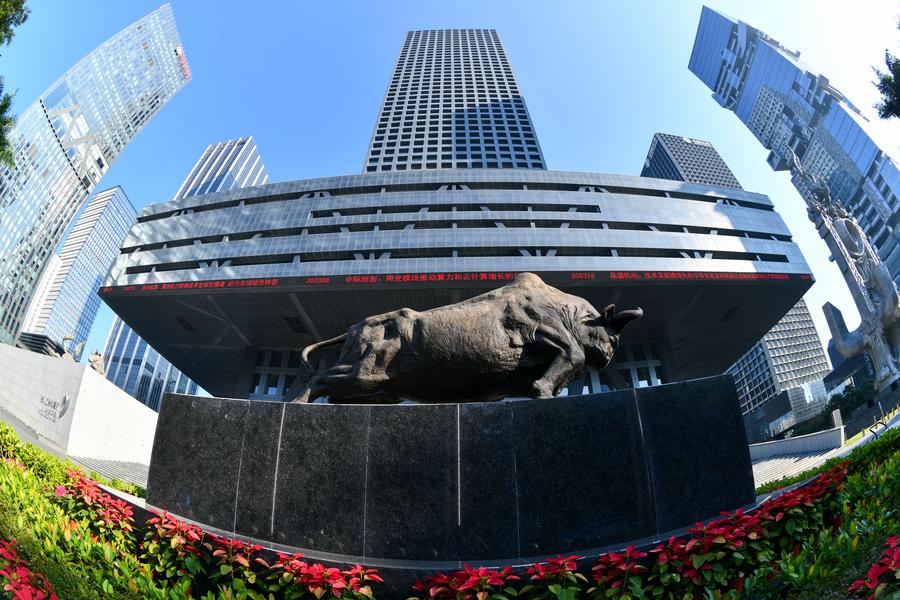
This photo taken on Oct. 8, 2024 shows the Shenzhen Stock Exchange in Shenzhen, south China's Guangdong Province. [Photo/Xinhua]
China's A-share market has seen heightened volatility recently, driven mainly by geopolitical shocks, structural divergence within the market, and intensified capital positioning.
However, the fluctuations do not signal a trend reversal, but rather a concentrated short-term release of sentiment amid external pressures while the medium- to long-term upward trajectory remains intact, China Galaxy Securities said.
On Wednesday, the Shanghai Composite Index ended at 4,082.47, slipping by 0.98 percent. The Shenzhen Component Index declined by 0.75 percent, closing at 13,917.75, while the ChiNext Index, which tracks China's Nasdaq-style board of growth enterprises, fell 1.41 percent to 3,164.37.
The market is expected to gradually shift from sentiment-driven movements back to fundamentals-driven performance.
In a research note, Yang Chao and Wang Xueying, analysts at China Galaxy Securities, said during the ongoing annual meetings of China's top legislature and top political advisory body, known as the two sessions, policy dividends are likely to be rolled out in a concentrated manner, providing the A-share market with clear thematic direction.
As the foundation of China's domestic economic recovery continues to strengthen, corporate earnings are expected to improve steadily, offering fundamental support to equities.
With long-term capital gradually entering the market, the medium- to long-term outlook remains positive, CGS analysts said.
Against the backdrop of global order reshaping, international capital is seeking "safe-haven anchors".
Coupled with the relatively firm performance of the renminbi, the appeal of Chinese equity assets is increasing, they said.
Huaxi Securities noted that the A-share market is entering the typical two sessions trading window in March, characterized primarily by stability. Expanding domestic demand and fostering new quality productive forces are likely to become key priorities for the year.
Historical reviews show that the market tends to remain stable during the two sessions, with the probability of gains in the broader index rising after the meetings conclude.
Moreover, industries highlighted in policy priorities during the two sessions often see repeated market outperformance throughout the year, Huaxi Securities said.


 京公网安备 11010802027341号