 Share:

Fu Ruoqing, a national political advisor, told China.org.cn that he would recommend creating a specialized overseas theater network based on China Cultural Centers abroad to promote Chinese films worldwide.
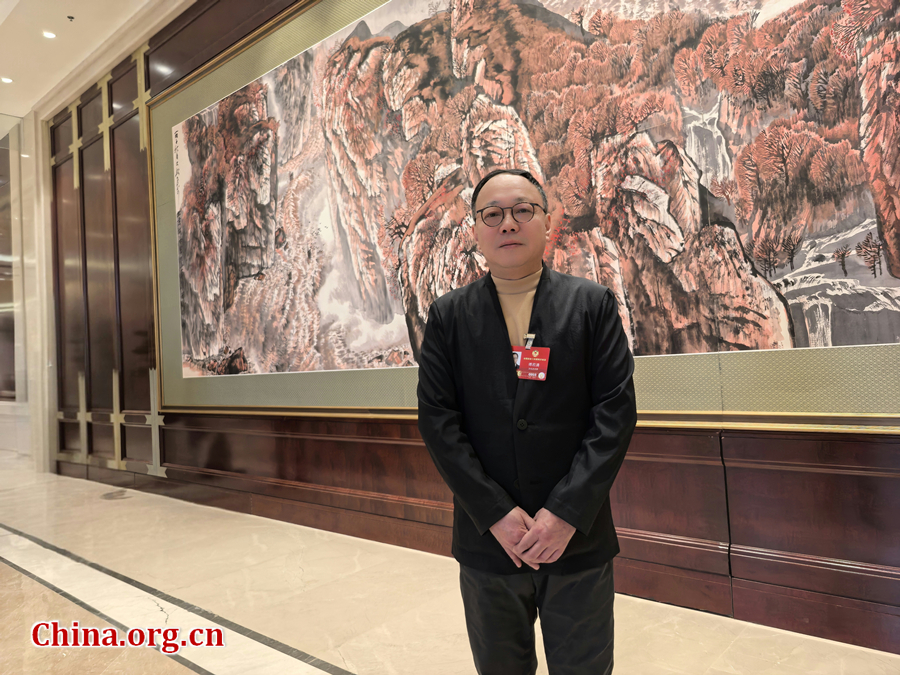
Fu Ruoqing, chairman of the China Film Group and a member of the National Committee of the Chinese People's Political Consultative Conference, poses for a photo during a break from a panel discussion at the fourth session of the 14th CPPCC National Committee in Beijing, March 5, 2026. [Photo/China.org.cn]
"As the most visually and acoustically captivating and deeply moving cultural form, films serve as a vivid vehicle for China's outstanding traditional culture and the spirit of contemporary China. Using cinematic storytelling to bridge cultural gaps can better enhance the international community's understanding and recognition of China, and effectively increase the communication power and influence of Chinese civilization," he said.
Fu, chairman of the China Film Group and a member of the National Committee of the Chinese People's Political Consultative Conference (CPPCC), is in Beijing to attend the fourth session of the 14th CPPCC National Committee, which is being held from March 4 to 11.
He noted that overseas China Cultural Centers serve as bridges and windows for cultural diplomacy, and are highly compatible with films. Combining the two can leverage the immersive power of cinema to overcome cultural barriers, while using the centers' local presence to deepen understanding. This action will form a front position for telling China's stories effectively. Some of China's Cultural Centers have piloted "film + cultural exchange" initiatives with success already, including centers in Paris, Singapore, Cairo and Seoul.
China has 50 cultural centers in major countries and regions, forming a global network for sharing Chinese culture. However, most centers focus on annual film festivals rather than year-round screenings. Film supply relies on temporary selection, lacking a stable library and an update mechanism. Activities are limited in form and diversity, resulting in single channels for reaching audiences and weak brand communication.
Fu suggested establishing an overseas Chinese cinema chain based in China Cultural Centers, featuring a compliant, rich-content film library and simultaneous domestic and overseas releases. This will enhance the timeliness of communication. To address outdated facilities, he proposed a high-format cinema upgrade plan prioritizing Belt and Road partner countries with Chinese-made high-format theaters, allowing foreign audiences to experience China's cultural innovation firsthand. He also called for strengthened promotional planning and exchange activities, combining screenings with trade and exhibitions to jointly showcase Chinese culture and shape the national image through a coordinated international push.
"Enhancing the communication power and influence of Chinese civilization is an important national strategy, which requires injecting new momentum into international communication through innovation in cultural vehicles," he said. "To this end, it is suggested to fully leverage the functions and roles of overseas China Cultural Centers, allowing Chinese stories to reach the hearts of audiences of all nations and ethnicities directly through the silver screen."
Fu also noticed another realm: popular science documentaries and sci-fi films. "Surveys show that 72% of adolescents and children rank watching science-themed films and television programs as their preferred science activity," he said. "These works integrate scientific principles with humanistic narratives and visual spectacles, awakening in audiences a sense of awe for science and a desire for exploration. They serve as an irreplaceable 'spiritual gateway' in the national effort to promote scientific literacy."
However, based on research findings, the current supply mechanism for science films in China remains inadequate and fails to meet the public's growing demand for high-quality science popularization.
Therefore, he suggested integrating cinemas in science venues with the commercial market to establish a domestic science cinema chain featuring dedicated science film channels, a high-quality film library, unified supply and year-round screenings. The chain should organize screening events tied to science themes and festivals, with research institutions and enterprises invited to participate and scientists invited to give lectures.
He also suggested that the country should increase support for original domestic science films, and appealed for high-quality domestic science films to gain more support in going global and participating in international promotion and exchange activities.


 京公网安备 11010802027341号