 Share:

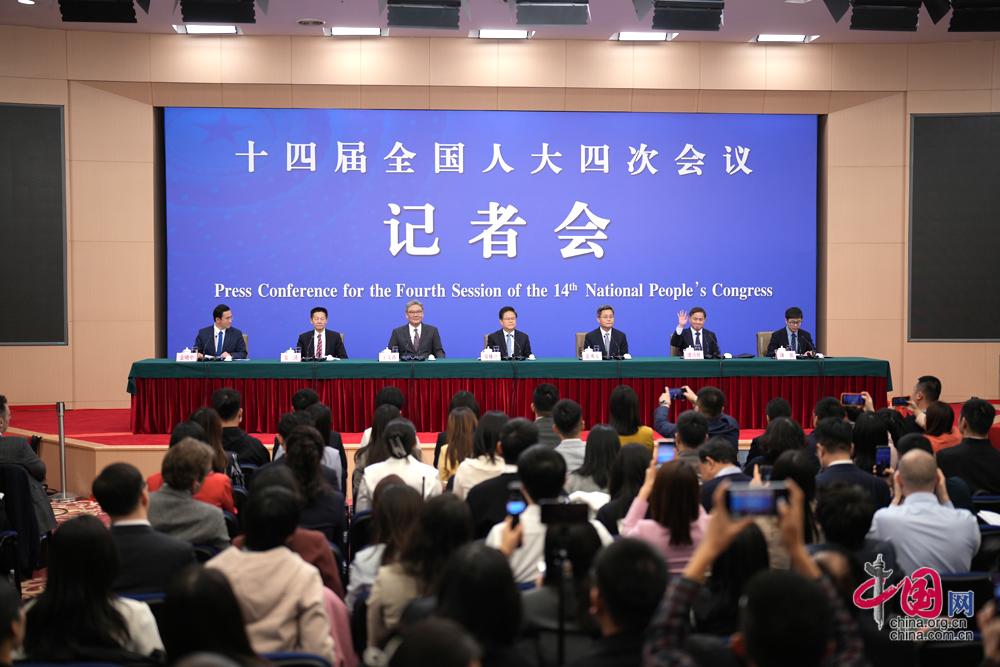
A press conference for the fourth session of the 14th National People's Congress is held in Beijing, March 6, 2026. [Photo/China.org.cn]
China will further expand domestic demand by boosting consumption and expanding investment, and build a modernized industrial system in 2026, Zheng Shanjie, head of the National Development and Reform Commission, said at a press conference on the economy held Friday on the sidelines of the fourth session of the 14th National People's Congress.
China has set this year's GDP growth target at 4.5% to 5%, while striving for better results. GDP is expected to grow by over 6 trillion yuan ($869.6 billion) this year, Zheng said.
Officials outlined measures focused on consumption, investment and new growth drivers.
During the 14th Five-Year Plan period (2021-2025), China's consumer market, already the world's second largest, became the world's largest when measured by purchasing power parity, said Wang Wentao, minister of commerce.
China will earmark 250 billion yuan in ultra-long special treasury bonds for consumer goods trade-in programs this year. So far, the program has generated 4.16 trillion yuan in sales, driving over 531 million consumer transactions, Wang said.
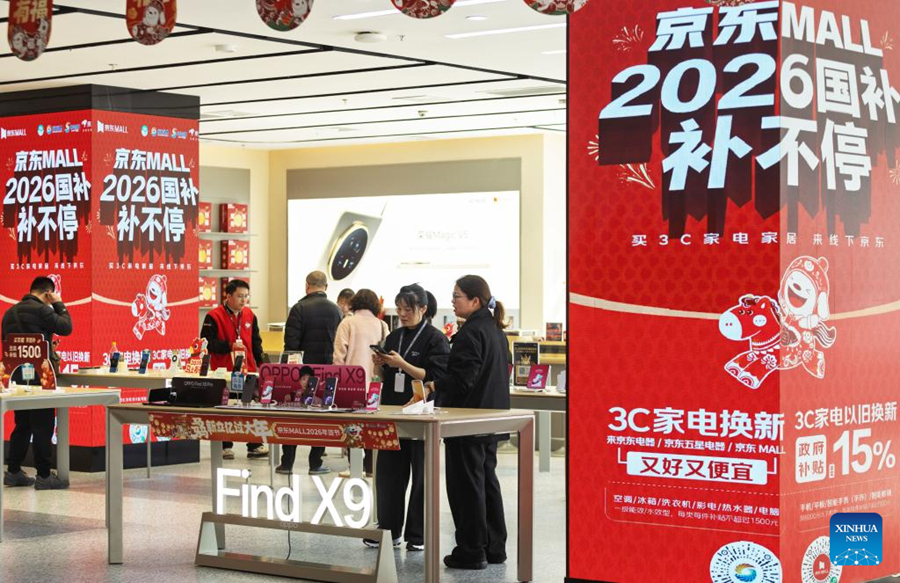
Customers browse consumer electronics at a shopping mall in Nanjing, east China's Jiangsu province, Feb. 21, 2026. [Photo/Xinhua]
The program will be expanded to cover greener and smarter products, support brick-and-mortar retail, and foster new industries and growth areas. China will also develop high-profile consumption scenarios with broad appeal through pilot programs in 50 cities, Wang added.
The country will step up support for service consumption in sectors such as transport, household services, online entertainment, tourism, auto after-sales services and inbound spending, while targeting live performances, sporting events, and experience-based services as further sources of growth.
China will also widen market access and expand opening trials in areas such as value-added telecom services, biotechnology and wholly foreign-owned hospitals.
Lower-tier markets, mainly third- and fourth-tier cities and county-level areas, will be further tapped, with targeted measures tailored to local population size and economic strength, the commerce minister said.
On investment, the government will further increase public investment while spurring private investment, Zheng said. It will support 109 major projects across six areas set out in the draft outline of the 15th Five-Year Plan, and advance the development of six major networks and key sectors.
The six major networks refer to water, power, computing capacity, next-generation communication, urban underground pipeline and logistics networks. Key sectors include integrated multi-level transportation infrastructure, as well as infrastructure and public services related to consumption, the low-altitude economy, AI Plus, education and health care. Investment in these areas is estimated to exceed 7 trillion yuan this year.
Another priority is building a modernized industrial system. Deeper integration between technological and industrial innovation, as well as between advanced manufacturing and modern services, will help foster new growth drivers, Zheng added.
More measures will be rolled out to support the high-quality development of the services sector, with output expected to exceed 100 trillion yuan during the 15th Five-Year Plan period (2026-2030).
Support for emerging industries and industries of the future will also be strengthened. For example, the BeiDou Navigation Satellite System is expected to generate over 1 trillion yuan in industry value over the next five years, spanning navigation, emergency response and offshore operations.
Further initiatives will be launched to deepen the application of AI across industries and in daily life, with the scale of AI-related industries projected to surpass 10 trillion yuan by the end of 2030, Zheng said.


 京公网安备 11010802027341号