Share:

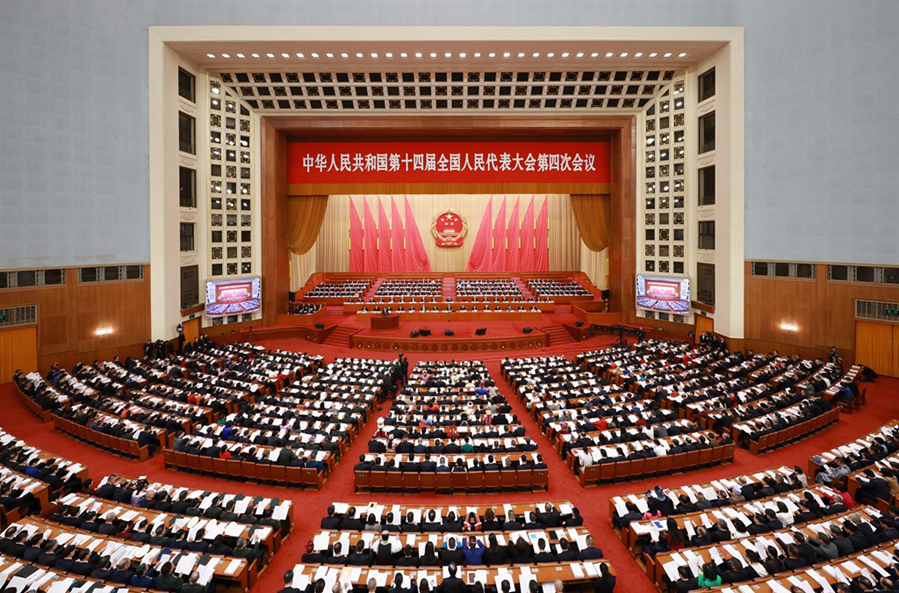
The opening meeting of the fourth session of the 14th National People's Congress (NPC) is held at the Great Hall of the People in Beijing, capital of China, March 5, 2026. [Photo/Xinhua]
The unveiling of China's 2026 growth target at a government work report submitted on March 5 to the fourth session of the 14th National People's Congress (NPC) for deliberation has prompted close examination from global media.
International observers say China is moving away from a "growth-at-all-costs" approach toward a roadmap defined by "quality and resilience."
A proactive and pragmatic vision for growth
The government work report said the targets would help China achieve its goal of doubling 2020 per capita GDP by 2035 and reaching the level of a moderately developed economy. The Guardian's coverage echoed this view, with an expert confirming that China "has likely become more confident in setting and delivering on its growth target."
International observers see this as a sign of strategic evolution. Singapore's CNA quoted Xu Tianchen, a senior economist at the Economist Intelligence Unit in Beijing, as saying the growth target is "realistic and fully within expectations" and reflects "a continued shift from a 'number-first' mindset to a 'quality-first' one."

A robot is displayed at the 2025 Global Industrial Internet Conference in Shenyang, northeast China's Liaoning province, Sept. 6, 2025. [Photo/Xinhua]
Innovation takes center stage in 15th Five-Year Plan
On the same day, the draft outline of the 15th Five-Year Plan (2026-2030) for national economic and social development was also submitted to the fourth session of the 14th NPC for review. The draft plan places innovation and technological self-reliance at the core of its strategy. The plan projects an average annual increase of at least 7% in nationwide R&D spending and aims to raise the value added of core digital economy industries to 12.5% of GDP by 2030.
International media have taken keen notice of China's technological momentum and the strategic clarity of its vision. Singapore's The Straits Times reported that "a key theme is boosting technological self-reliance," highlighting the plan's call for "extraordinary measures" to achieve breakthroughs in core technologies such as chips and high-end equipment, while also strengthening China's advantage in sectors including rare earths and advanced materials.
This technological surge is part of a carefully calibrated long-term strategy. In an analysis of China's new blueprint, CNN emphasized that "China spent the last five years cultivating innovation and new technology at home. The next half decade will be dedicated to deploying the fruits of its labor to transform its economy and its place in the world."
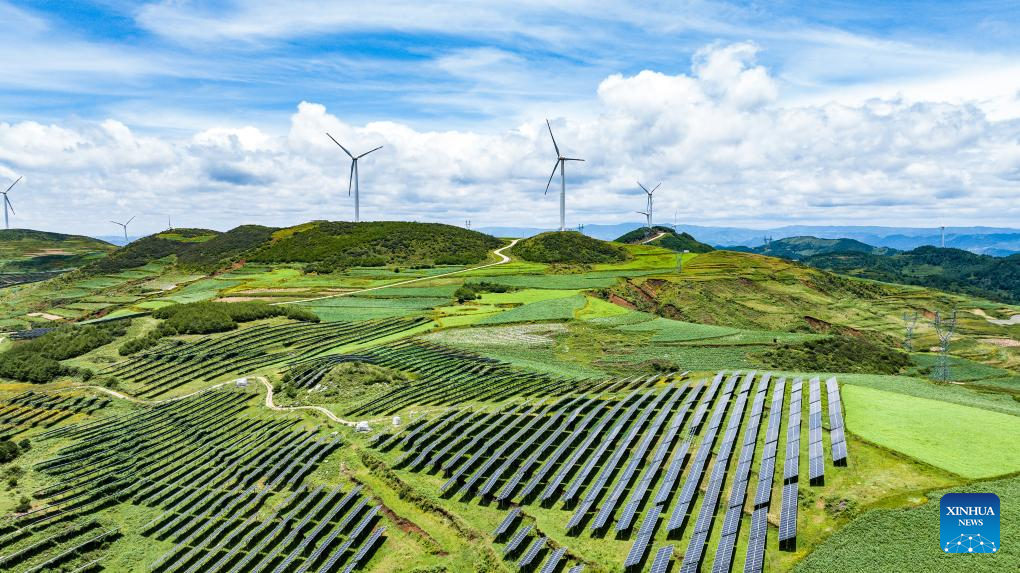
An aerial drone photo taken on July 3, 2025 shows a solar power station for agricultural use in the Yi-Hui-Miao Autonomous County of Weining, southwest China's Guizhou province. [Photo/Xinhua]
Driving green and sustainable development
China's commitment to a greener future is clearly articulated in the new plan, demonstrating the country's dedication to balancing economic growth with environmental responsibility. The draft plan envisages a total reduction of 17% in carbon dioxide emissions per unit of GDP between 2026 and 2030.
Modern Diplomacy offered strategic context, noting that China's new approach places greater emphasis on directly reducing carbon emissions associated with economic output rather than focusing mainly on improving energy efficiency. The outlet described this as "a more targeted effort to align economic development with climate commitments while maintaining growth momentum."


 京公网安备 11010802027341号