 Share:

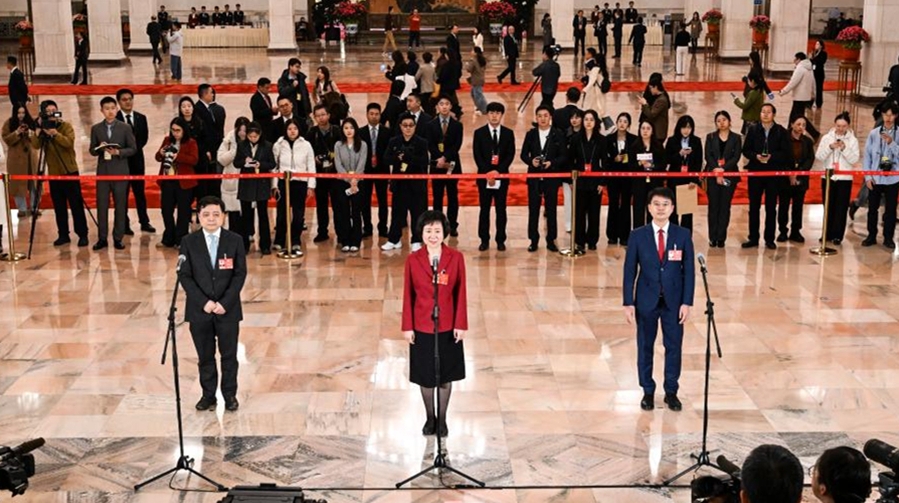
Members of the 14th National Committee of the Chinese People's Political Consultative Conference (CPPCC) discussed how technological innovation is driving China's industrial upgrading and high-quality development during a group interview at the fourth session of the 14th CPPCC National Committee in Beijing on Saturday.
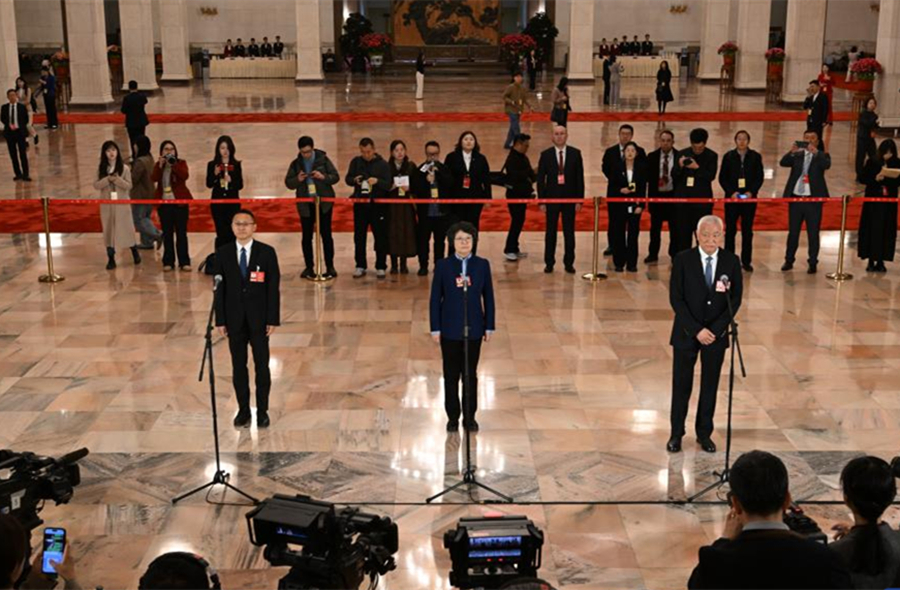
Members of the 14th National Committee of the Chinese People's Political Consultative Conference (CPPCC) attend a group interview ahead of the second plenary meeting of the fourth session of the 14th CPPCC National Committee at the Great Hall of the People in Beijing, March 7, 2026. [Photo/Xinhua]
"Strengthening openness and cooperation in science and technology is essential to drive high-quality development, foster new quality productive forces, and enhance sustainable development and competitiveness," said Wang Zhigang, a national political advisor and former minister of science and technology. "Achieving high-level scientific and technological self-reliance and strength will remain a top priority in Chinese modernization during the 15th Five-Year Plan period (2026-2030)."
Wang noted that China achieved strong results in scientific and technological innovation during the 14th Five-Year Plan period (2021-2025). High-speed rail reached a test speed of 450 kph, and new breakthroughs were made in artificial intelligence and quantum technology. Progress was also recorded in integrated circuits, new energy and drug development.
"The number of scientific researchers in China is not only growing, but their capability and proficiency are also improving," Wang said. He added that China has formed a complete innovation chain spanning basic research, applied research, technological innovation, achievement transformation, industrialization and engineering.
"Achieving high-level scientific and technological self-reliance and strength during the 15th Five-Year Plan period will require deep integration of technological and industrial innovation," Wang said. "I believe China will forge a path of independent innovation with Chinese characteristics — one where science, technology and a skilled workforce drive strong industries, a strong economy and a strong nation."
Liu Zheng, a CPPCC member and senior engineer with China Aerospace Science and Technology Corp., said innovation and self-reliance are key to the space industry's success. "With no ready path to follow, only independent innovation can secure the initiative in international competition," Liu said.
He highlighted the development of China's first special compound processing machine tool for rocket barrel sections, equipped with a domestically developed numerical control system. The innovation has doubled processing efficiency and precision while keeping core technologies in Chinese hands.
Liu said he will continue focusing on core technologies for reusable space vehicles and intelligent manufacturing, contributing to making China a space power.
In recent years, domestically produced high-end machine tools have been used in the manufacturing of aircraft, aero engines and large-scale equipment, with the localization rate of five-axis machine tools continuing to rise.
Wang Xiaolong, a CPPCC member and general manager of Ningxia Fusitai Intelligent Equipment Co. and Ston Robot Yinchuan Co., attributed these advances to China's complete industrial system, immense market demand and sustained technological innovation — and most importantly, to the self-reliance and determination of industry professionals. Machine tools, he said, are the foundation of manufacturing.
"Our machine tools have reached a level where they can compete with top-tier international equipment in ultraprecision machining," Wang said. "We will continue to innovate and accelerate breakthroughs in bottleneck areas, aiming to achieve independent control over core technologies."
Nan Cunhui, a CPPCC member and chairman of Chint Group, said the transformation of China's manufacturing sector relies on deeper integration of digital and intelligent technologies and sustained innovation.
Nan noted that explosive demand for transformers, driven by AI computing expansion, has made them increasingly hard to secure. Last year, his company's transformer exports surged 71.4%, with factory orders scheduled through 2027 — growth he attributed to continuous innovation. In Chint's factories, data and algorithms now drive the entire process, reducing operating costs by 20% and improving efficiency by 50%.
The company is also leveraging AI to develop industry-specific large models and encouraging supply chain partners to pursue digital upgrades. China's strong industrial and supply chain ecosystem has played an important role in supporting these upgrades, Nan said.
"With the guidance of national strategies and the advantages of China's vast domestic market, the country's manufacturing transformation has broad prospects," he said.
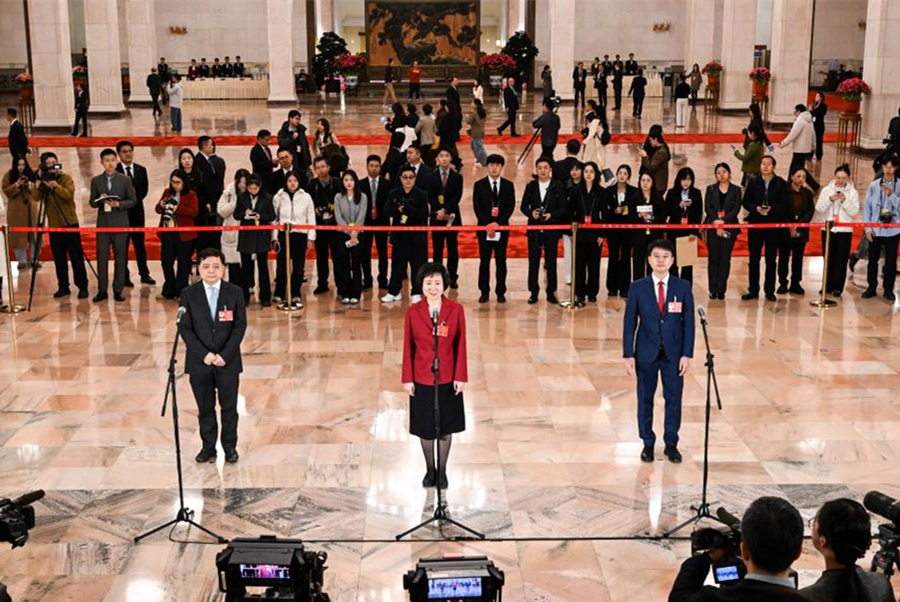
Members of the 14th National Committee of the Chinese People's Political Consultative Conference (CPPCC) attend a group interview ahead of the second plenary meeting of the fourth session of the 14th CPPCC National Committee at the Great Hall of the People in Beijing, March 7, 2026. [Photo/Xinhua]
Zhang Qiao, a CPPCC member and president of Soochow University, said universities must do more than generate ideas.
"We must not only become innovation parks that provide inspiration but also engines that drive development," Zhang said. He added that his university is building corporate labs on campus and moving classrooms into companies, helping students apply knowledge to real-world problems.


 京公网安备 11010802027341号