Share:

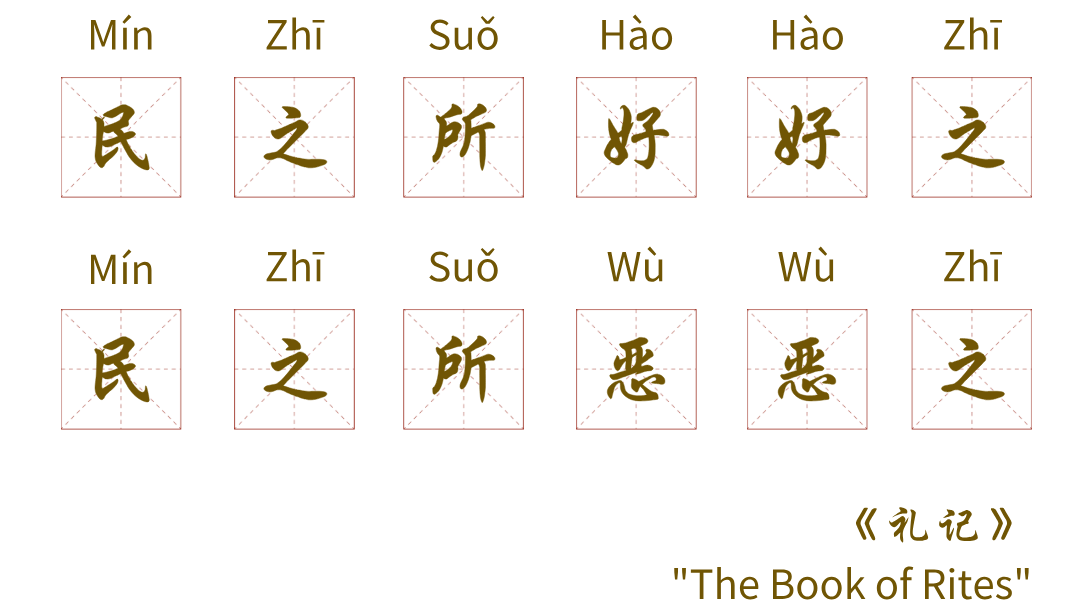
On Jan. 12, 2015, when delivering a speech at a meeting with a class of county Party secretaries at the Central Party School, General Secretary Xi Jinping quoted an ancient Chinese aphorism that "Choose to do the things that the people want to be done, and avoid doing things that the people disapprove of," as he urged the grassroots officials to have a correct understanding of what one can achieve in office.
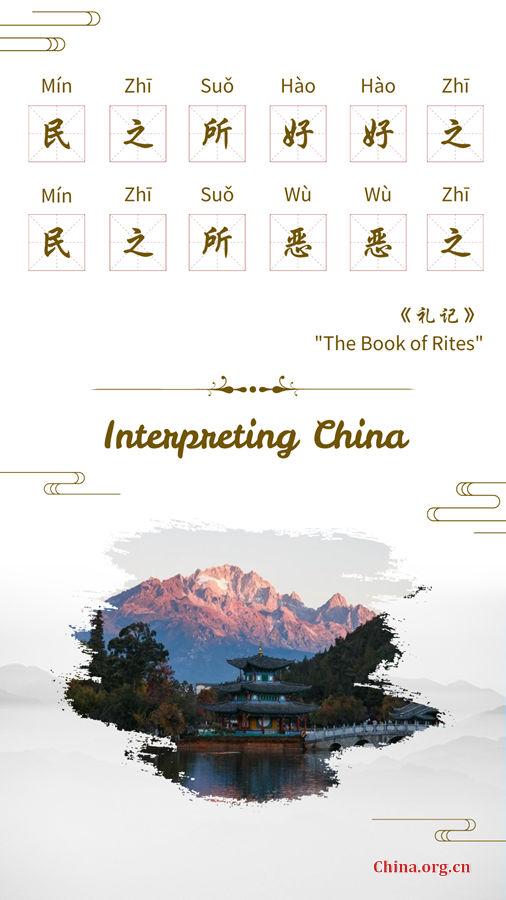
The saying, "Choose to do the things that the people want to be done, and avoid doing things that the people disapprove of," (民之所好好之,民之所恶恶之 mín zhī suǒ hào hào zhī, mín zhī suǒ wù wù zhī), originates from the Confucian classic "The Book of Rites," dating back some 2,000 years ago. It reveals an enduring truth — the essence of governance is aligned with the will of the people. By cultivating a proper understanding of governance performance, officials should further make improving the people's well-being the most important political achievement and take their satisfaction as a key benchmark for success.
Choosing to do the things that the people want to be done means that officials should actively listen to the people's voices and turn their aspirations for a better life — better education, more stable employment, more reliable social security, higher-quality healthcare, and a pleasant ecological environment — into the goal of one's efforts. On the other hand, avoiding doing things that the people disapprove of means officials must take resolute action against the prominent issues that cause grave public concern, crack down on corruption, and fight against formalism, bureaucracy, hedonism and extravagance.
"The Communist Party of China (CPC) regards serving the people and improving their well-being as the most important measure of performance, and uses the extent to which officials deliver tangible benefits for the people as an important benchmark in evaluating their performance," Xi has said.
Back in the 1960s, Jiao Yulu, the Party secretary of Lankao county in Henan province, dedicated his life to promoting local development by leading people to combat sandstorms, waterlogging, and saline-alkali soil, disasters that had been plaguing the county for many years.
Gu Wenchang, who served as the Party chief of Dongshan county, Fujian province, from the 1950s to the early 1960s, is praised for leading the construction of a coastal shelterbelt that still shields the island county, which was once barren and ravaged by sandstorms and poverty.
The reason why Jiao and Gu are long remembered by the people is that they aligned their work with people's aspirations for a better life and delivered real outcomes for the people through solid efforts. Their down-to-earth, practical work transformed both the landscape and the lives of those they served.
In the new era, millions of CPC members and grassroots officials have responded to the call of the CPC Central Committee, and stepped forward to lead in major tasks such as poverty alleviation, rural revitalization, scientific and technological innovation, disaster relief, and pollution prevention and control.
Throughout eight years of poverty alleviation efforts, more than 250,000 resident working teams and over 3 million first Party secretaries and team members prioritized the public good over personal interests. Working tirelessly alongside nearly 2 million grassroots officials on the front lines, they dedicated themselves to the cause. More than 1,800 individuals sacrificed their lives during this endeavor, fulfilling their mission with a strong sense of responsibility and unwavering commitment.
This year marks the opening of China's 15th Five-Year Plan period. This is a pivotal phase for consolidating the foundations of socialist modernization and making a comprehensive push forward. A strong start is vital to the whole, and these first steps will determine the path ahead.
"Chinese modernization puts people's well-being first. All the work of the Party and the government is aimed at ensuring the people a happier life," Xi has said.
Governance performance must never be a vanity project, a short-sighted "quick fix," or a manipulative "numbers game." Officials should establish a correct understanding of what it means to perform well, and prioritize solving tough problems, delivering real results and ultimately enhancing public well-being through solid work. Real achievements should be able to stand the test of time and win the people's recognition.


 京公网安备 11010802027341号