Share:

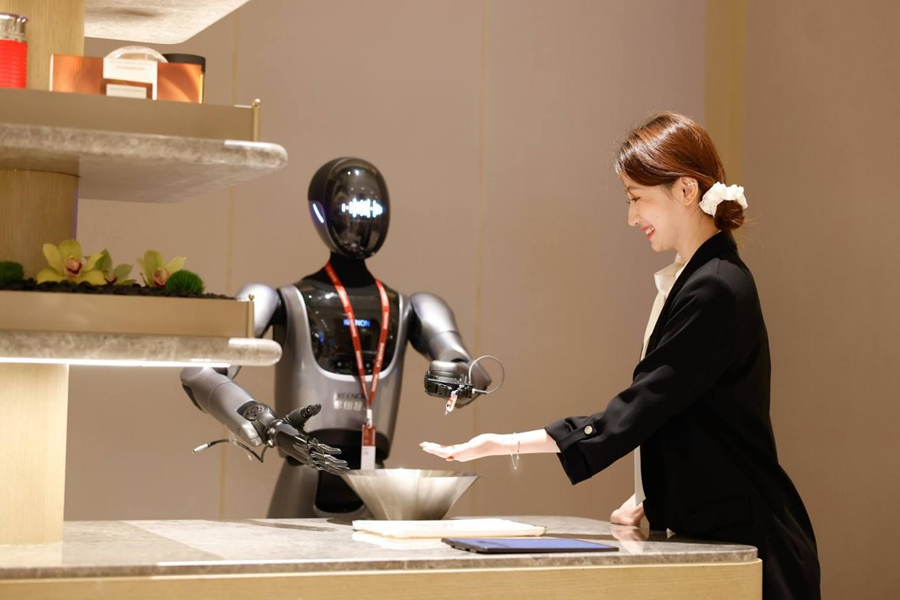
The Qinglong humanoid robot makes its debut at the eighth China International Import Expo in Shanghai. [Photo/Xinhua]
The government work report delivered at this year's annual session of the National People's Congress (NPC) said China will nurture emerging industries and industries of the future — including future energy, quantum technology, embodied AI, brain-computer interfaces and 6G technology — with mechanisms to be put in place to increase funding and share risks.
The draft outline of the country's 15th Five-Year Plan also highlights efforts to develop new growth drivers, including quantum technology, biomanufacturing, hydrogen and nuclear fusion energy, brain-computer interfaces, embodied AI and 6G mobile communications.
National lawmakers and industry experts say these technologies are expected to play a key role in shaping the next generation of digital infrastructure and industrial transformation.
Rise of embodied AI
Artificial intelligence is entering a new stage of development, lawmakers said.
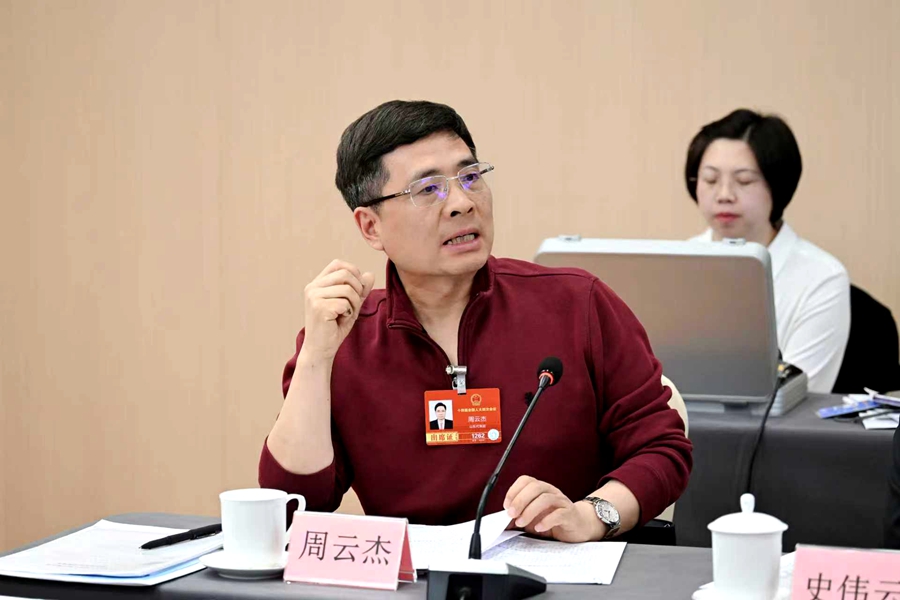
Zhou Yunjie, a national lawmaker and CEO of Haier Group, addresses a Shandong delegation deliberation during the fourth session of the 14th National People's Congress in Beijing, March 9, 2026. [Photo provided to China.org.cn]
"AI is evolving from the stages of perception and cognition toward embodied intelligence," said Zhou Yunjie, a national lawmaker and CEO of Haier Group.
Embodied AI, which combines artificial intelligence with robotics, is strategically important for upgrading manufacturing and driving new quality productive forces, he said.
Zhou proposed establishing a national research program dedicated to embodied AI, along with supporting infrastructure and industry standards for robots, to accelerate large-scale factory deployment.
He also called for demonstration projects to promote real-world deployment led by industry leaders.
"The ultimate value of embodied intelligence is not simple replacement, but deep collaboration and value reconstruction," Zhou said.
Machines excel at repetitive, dangerous and high-precision tasks, while humans are better at emotional communication, creativity and complex decision-making, he said.
Zhou envisions a future of "human-machine symbiosis," where intelligent robots and humans work together to improve efficiency and quality of life.
Domestic service robots capable of handling household chores, caregiving and emotional companionship could eventually become as common as automobiles, he said.
Quantum technology push
Quantum technology is also emerging as a strategic frontier.
Guo Guoping, chief scientist of Origin Quantum and an NPC deputy, said the inclusion of quantum technology in the government work report has boosted confidence within the research community.
"As a scientist working on the front lines of quantum computing research, I have witnessed the country's steadily deepening strategic investment in this field," Guo said.
He described quantum technology as central to China's industrial upgrading ambitions and stressed that homegrown innovation will be critical as global competition in the field intensifies.
China has already made progress in the field. Origin Wukong, China's superconducting quantum computer launched in 2024, has been operating stably since then.
According to Guo, the system has served users in 163 countries and regions and recorded more than 46 million visits, demonstrating China's growing capability in quantum innovation.
Guo said further efforts should focus on expanding applications in sectors such as finance, pharmaceuticals, power systems and telecommunications.
"Only when cutting-edge technologies are applied in real industries can they truly empower industrial upgrading and support the country's high-quality development," he said.
China's push to develop future industries reflects a broader strategy of strengthening innovation capacity and building new growth drivers. By advancing frontier technologies and accelerating their real-world applications, the country aims to power the next stage of high-quality development.


 京公网安备 11010802027341号