 Share:

Artificial intelligence has once again taken center stage in China's government work report. For the first time, the report calls for building "new forms of smart economy," while also pledging to "advance and expand the 'AI Plus' initiative."
The report positions AI more explicitly as a driver of new business models and broader economic growth. The focus is no longer only on developing AI capabilities, but on turning those capabilities into scaled, commercial and economy-wide applications.
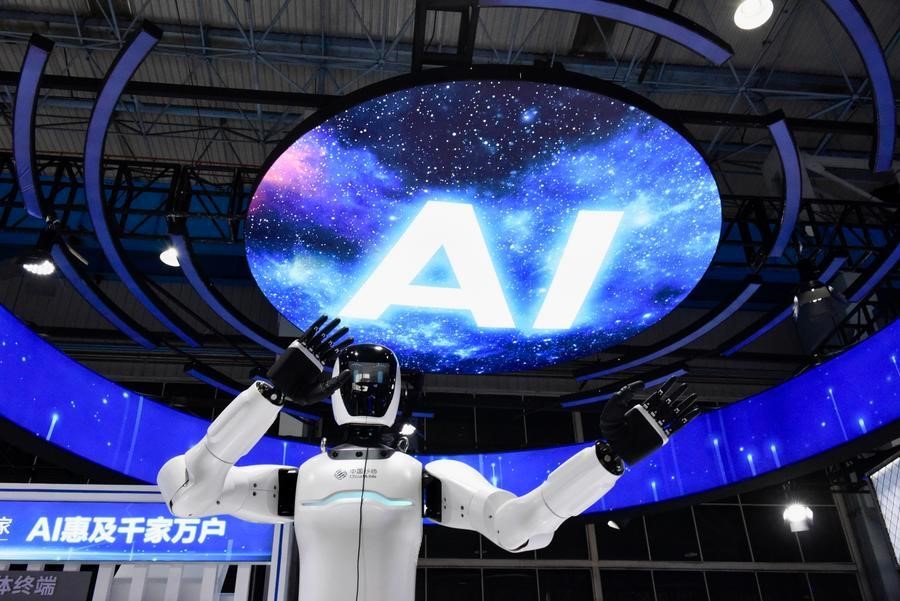
A humanoid robot of China Mobile is pictured at the exhibition area of the 2025 Global Industrial Internet Conference in Shenyang, northeast China's Liaoning province, Sept. 7, 2025. [Photo/Xinhua]
Chen Changsheng, a member of the drafting team and deputy director of the State Council Research Office, underscored that point at a press conference Thursday. The goal, he said, is to further advance the "AI Plus" initiative, with an emphasis on scaling up applications, accelerating the development of AI agents and deepening adoption in vertical sectors such as industry, agriculture, health care, education and scientific research.
Chen said the initiative will also require a stronger underlying infrastructure, calling for the construction of hyperscale intelligent-computing clusters and better coordination between computing capacity and electricity supply.
He also stressed the need to enhance foundation-model capabilities and computing power, develop an ecosystem integrating models, chips, cloud and applications, and attract more AI technologies, talent and other innovation resources.
Beyond industrial application, this year's government work report gives more attention to the social impact of AI. For the first time, it calls for measures to promote employment and entrepreneurship in response to AI development, reflecting expectations of deeper integration of the technology across the economy and society.
Liu Zhi, head of the Artificial Intelligence Division at the National Information Center under the National Development and Reform Commission, said this reflects the principle of "AI for good" and signals efforts to steer AI development toward a beneficial, safe and fair direction.
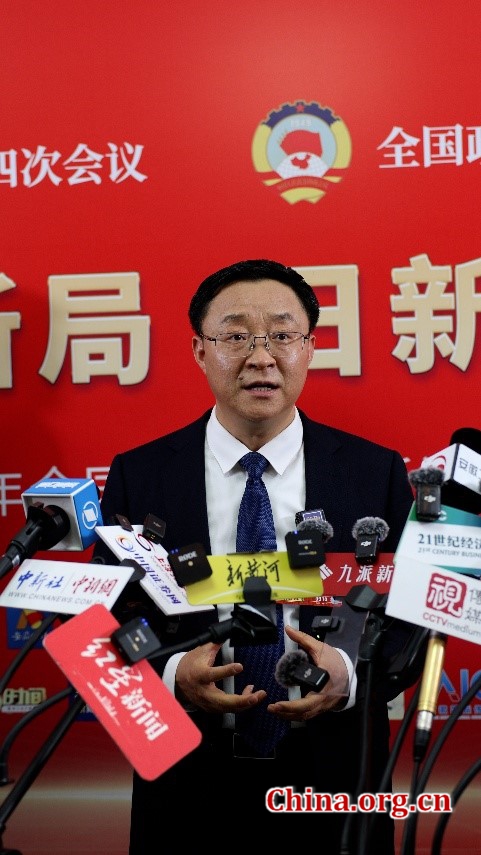
Liu Qingfeng, chairman of iFlytek and a deputy to the National People's Congress, gives an interview on March 6, 2026. [Photo by Niu Fanbing/China.org.cn]
Liu Qingfeng, chairman of iFlytek and a deputy to the National People's Congress, said China's long-term progress in AI hinges on full-stack self-reliance. Real security, he argued, comes not from adapting imported training systems, but from building an end-to-end ecosystem spanning domestic chips, model training, software-hardware coordination and real-world application.
He also highlighted the importance of "chip-model synergy," noting that hardware innovation and model development must advance in tandem if China is to build a secure and sustainable AI future.
Looking ahead, Liu said that strategy is likely to shape the next wave of AI products. Liu expects AI hardware to extend far beyond any single device category, with assistants emerging in the form of glasses, watches, home hubs, desktop devices and robots—all connected to a shared intelligence layer.
These developments suggest that China's AI strategy is moving into a new phase, focused not just on advancing the technology but on scaling its application, strengthening foundational capabilities and shaping a broader smart economy.


 京公网安备 11010802027341号