 Share:

History has no end, it is often said, and the future continues to present new challenges for every nation seeking to position itself on the global investment and development landscape. In today's complex geopolitical and economic environment, understanding China's development strategies is no longer optional.
As China increasingly shapes global trade flows, development corridors and investment patterns, its development model is attracting growing attention. Over the past several decades, China has pursued development with an intensity and consistency rarely witnessed in modern economic history. Once widely recognized as the "factory of the world," China is now transitioning toward leadership in advanced engineering, high-value manufacturing, green development and quality-driven growth.
Behind this economic dynamism lies the pragmatic vision of its leadership. China is today the largest market for industrial robots and one of the world's leading producers by volume. Beyond manufacturing scale, the country is steadily localizing critical components such as semiconductors, actuators, sensors and control systems.
Chinese firms are also integrating artificial intelligence with advanced hardware at scale, accelerating the transition toward intelligent manufacturing and Industry 4.0. The Chinese development model demonstrates that an effective innovation ecosystem does not emerge spontaneously — rather, it is built through long-term strategic commitment and institutional alignment.
Much like the Great Wall, which represents a marvel of interconnected infrastructure built to promote collective resilience, modern China's architecture of development rests on a set of interconnected pillars supporting economic modernization and technological advancement. At the heart of this transformation are China's five-year plans, which constitute a comprehensive, consistent framework for economic change.
Key pillars include continuity of policy, pragmatic long-term planning, sustained R&D funding, strong academia-industry linkages, reliable infrastructure and merit-based institutional governance.
Unlike the often-fluctuating geopolitical environment, China's model of governance emphasizes stability and continuity, coordinated implementation across various tiers of government and a sustained strategic focus on critical sectors such as technological self-reliance, green energy and industrial modernization. This institutional architecture serves as a stabilizing factor that allows China to navigate external shocks while progressing steadily toward its long-term development objectives.
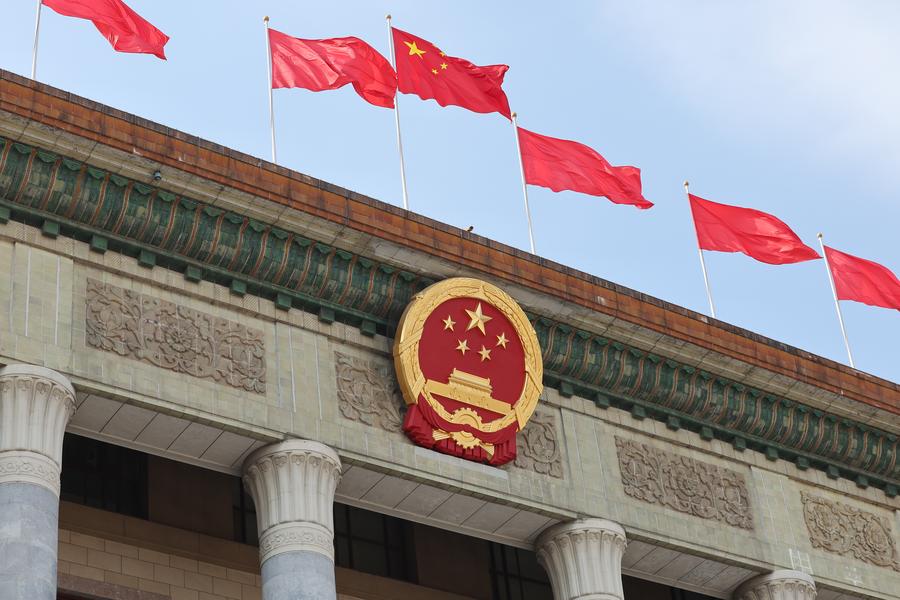
This photo taken on March 4, 2025 shows the Great Hall of the People in Beijing, capital of China. [Photo by Pang Xinglei/Xinhua]
This strategic direction was reinforced by Premier Li Qiang in the government work report, which outlined priorities and tasks for the coming year while laying the groundwork for the 15th Five-Year Plan, covering 2026 to 2030. The plan will chart the course for the world's second-largest economy over the coming five years and marks a vital milestone in the nation's broader modernization drive.
China aims to achieve economic growth of about 4.5% to 5%, though the nation will "strive for better results in practice," according to the report. More importantly, the focus is no longer on the rate of growth but on its quality, strength, resilience and sustainability.
China's economic scale illustrates this transformation. By 2025, China's GDP had already exceeded 140 trillion yuan ($20 trillion). Even at a moderate growth rate of around 5%, that translates to roughly $700 billion to $800 billion in additional output annually — comparable to the GDP of a mid-sized economy. The 15th Five-Year Plan emphasizes policy continuity, technology-driven growth and a gradual shift toward a consumption-led development model.
The work report sets out a pragmatic strategy for high-quality, sustainable growth. In 2025, China remained among the top three sources of foreign direct investment in Southeast Asia, with a focus on infrastructure, power, transportation, technology and data.
The overarching objectives are long-term stability, technological self-sufficiency and innovation-driven growth — in line with the 15th Five-Year Plan's emphasis on new quality productive forces in sectors such as integrated circuits, aerospace, biomedicine, quantum computing, 6G and AI. At the same time, China aims to build domestic demand through consumer stimulus policies and measures to raise incomes, particularly for lower-income groups.
At the global level, China's total import and export trade reached a record high in 2025, with exports rising 6.1%. Trade has also become increasingly diversified, with roughly 85% to 90% now conducted outside the United States, including with ASEAN, the European Union and Belt and Road partner countries.
China's "neighborhood-first" foreign policy continues to focus on regional connectivity, particularly in Southeast Asia, through smaller, high-impact investments in infrastructure, power, transportation, technology and data integration, reinforcing its standing as a key partner in the region and beyond.
Another critical pillar is the integration of education with science and technology, producing nearly 13 million university graduates each year, many in STEM fields. This expanding talent pool supports technological innovation, entrepreneurship and industrial transformation.
Significant national projects have been proposed alongside enhanced support for research and development, with R&D spending targeted to grow by at least 7% annually. Strategic sectors will be expanded to include integrated circuits, aerospace, robotics, advanced materials and next-generation information technology. There is also a focus on developing high-end talent pipelines and promoting exceptional engineers through universities.
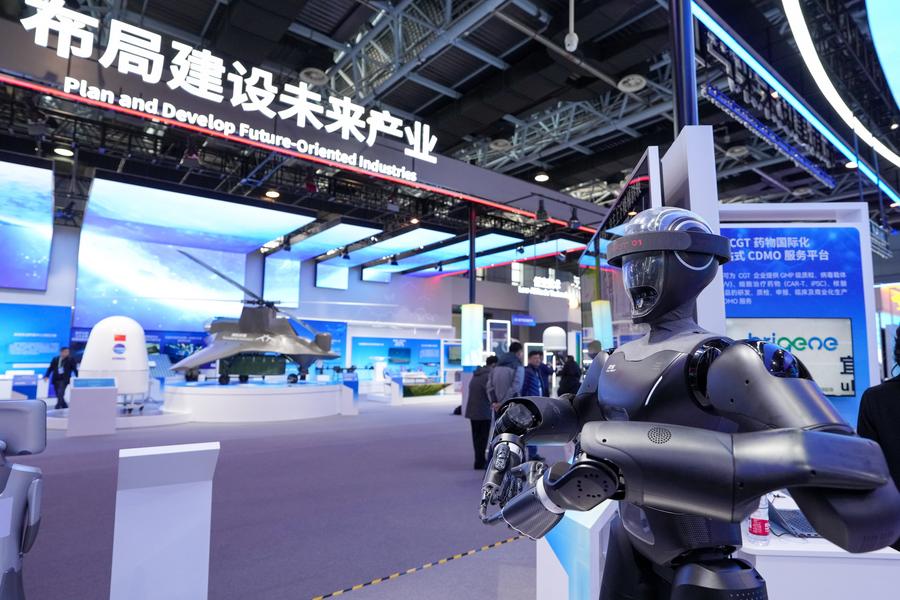
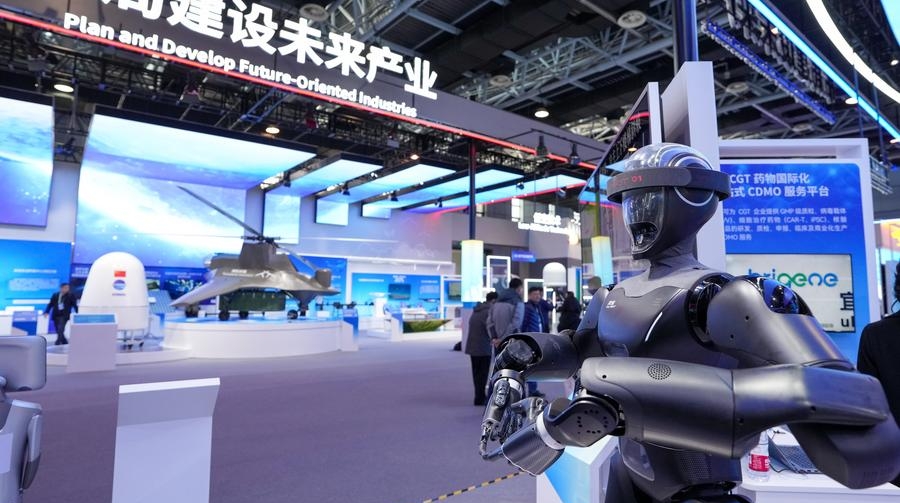
A humanoid robot poses during a permanent exhibition at the Zhongguancun Exhibition Center in Beijing, capital of China, March 28, 2025. [Photo by Ju Huanzong/Xinhua]
At the same time, infrastructure investment aims to strengthen productivity and reduce transaction costs. More than 7 trillion yuan is expected to be spent on priority sectors in 2026, including power grids and digital infrastructure, advancing digital and green transformation. This includes developing ultra-large intelligent computing clusters for the "AI Plus" initiative and building out green energy systems.
At the international level, China's connectivity strategy is also evolving, with digital and green technologies taking on a greater role alongside industrial integration through Belt and Road development corridors.
A country's development never truly ends. New challenges always emerge, and successful nations continuously adapt to remain competitive. China is doing exactly this.
Through its 15th Five-Year Plan, China is pursuing a highly proactive strategy centered on achieving "high-level scientific and technological independence," countering external pressures and solidifying its position as a global leader in advanced manufacturing and new quality productive forces. This is made possible through pragmatic planning, shared vision, long-term clarity and sustained investment in innovation, industrial upgrading and emerging technologies.
The plan also incorporates green development and structural change, including a 17% reduction in carbon emissions per unit of GDP and expansion of the digital economy to 12.5% of GDP. By stimulating domestic demand and advancing technologies such as quantum computing, hydrogen energy and 6G, China aims to shift from a growth model driven by scale and investment to one driven by innovation and high-quality green growth. This aligns with its long-term vision of becoming a "moderately developed economy" by 2035.
The government work report indicates that the country has made substantial progress, though sustaining growth momentum and enhancing economic resilience remain essential priorities. Addressing these will support the green and digital transitions and bolster resilience against external shocks.
All this offers practical lessons for developing countries, demonstrating how long-term strategic planning can guide economic transformation, technological upgrading and social development. Moreover, China’s development not only delivers greater benefits to its own people, but also creates important opportunities for the broader region and the global economy. As the world's second-largest economy and a major engine of trade, investment and infrastructure development, China will serve as a pillar of stability for global supply chains and supports connectivity across continents at a critical time.
Dr. Hassan Daud Butt is a project management and regional connectivity specialist. He is a faculty member and adviser at various universities and enterprises, and has served as a diplomat in China and Vietnam.


 京公网安备 11010802027341号