Share:

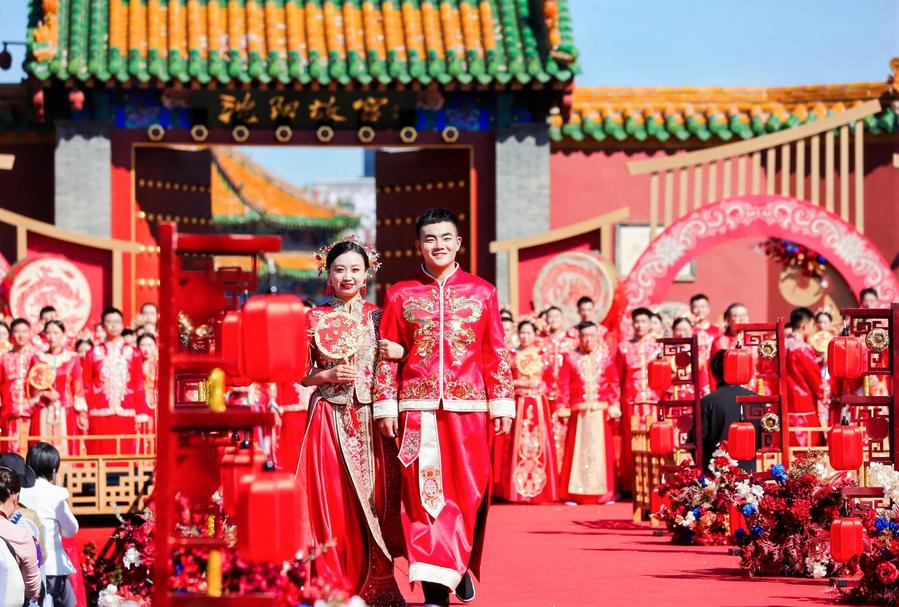
Couples take part in a group wedding ceremony at Shenyang Palace Museum in Shenyang, Liaoning province, May 22, 2024. [Photo/Xinhua]
On March 9, China's Chief Justice Zhang Jun emphasized the need to "continue to rectify exorbitant betrothal gifts" in the work report of the Supreme People's Court. This move followed a similar call in the "No. 1 central document" for 2026. While these official signals target the modern corruption of a custom, a secondary battle is being fought in the realm of international communication: the fight against the translation of the term 彩礼 (cǎilǐ) as "bride price."
By labeling a complex cultural tradition with the language of the marketplace, some media outlets and individuals are inadvertently validating the very "mercenary" distortions that Chinese society is striving to overcome. To understand why "bride price" is a linguistic failure, it is important to return to the origins of the term.
As documented in the "Book of Etiquette and Ritual" and the "Record of Ritual," marriage was a series of sacred steps designed to bind two families. These books, along with the "Rites of Zhou," form the trio of foundational ritual texts that have shaped Chinese social life for millennia.
The matrimonial process involved six distinct rites, from the formal proposal to the final wedding ceremony, which were collectively known as the "six etiquettes" (六礼; liùlǐ). Midway through this process came the presentation of betrothal gifts. Historically, this was never a transaction — it was a ritual of transformation, as can be seen in the "Record of Ritual," which states: "Without receipt of the betrothal gifts there is no contact and no affinity."
According to these traditional rituals, the groom's family would send a goose to the bride's family as a symbol of fidelity. During the next stage, more substantial gifts were presented, with the "Book of Etiquette and Ritual" specifying items like bolts of silk cloth and deer skins. The value of these gifts resided in the ritual act and the symbolic connection, not the material wealth. To translate this as a "price" is to strip the ritual from the practice, leaving only a cold, commercial shell.
The exchanging of betrothal gifts was originally part of a reciprocal cycle. The groom's family would offer gifts to show respect and gratitude to the bride's parents for raising her. This would be met by the dowry provided by the bride's family.
When we use the term "betrothal gifts," we acknowledge this foundation of mutual respect. Conversely, the use of "bride price" implies a one-way transfer of ownership. The danger of this "lazy" translation is evident in the reactions of those outside the culture. As one foreign user on Xiaohongshu noted with astonishment when hearing about the "bride price" in China: "If my family asked for money from my husband in order to marry me, I'd feel like an animal being sold." This reaction is not a critique of Chinese culture, but a critique of the English terminology used to describe it. The term "bride price" conjures up images of chattel and marketplaces. It erases the ritual essence of exchanging betrothal gifts and gives primacy to the abuses that Chinese legal and social policies are actively working to dismantle.
As proposed in recommendations by the CPC Central Committee on formulating the 15th Five-Year Plan, China aims to present an image that is credible, appealing and respectable. Achieving this goal requires linguistic precision.
The modern campaign against exorbitant betrothal gifts is a defense of the tradition's authentic core, seeking to peel away the mercenary elements that turn families into enemies. We must not let a distorted translation become the definitive narrative. By choosing the term "betrothal gifts," we honor the beautiful spirit of Chinese weddings, recognizing that the true value lies not in the price, but in the promise.


 京公网安备 11010802027341号