Share:


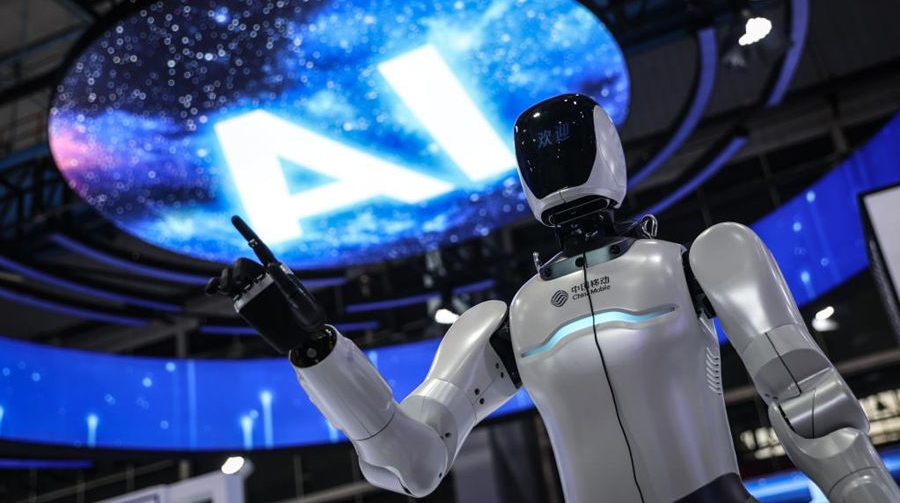
A robot on display at the 2025 Global Industrial Internet Conference in Shenyang, Liaoning province, Sept. 6, 2025. [Photo/Xinhua]
As the Great Hall of the People opened its doors for China's annual "two sessions," global attention converged on a pivotal figure: the nation's economic growth target for 2026. On March 5, Chinese Premier Li Qiang delivered the government work report, setting China's GDP growth target for this year within a range of 4.5% to 5%. These figures soon dominated the headlines of nearly every mainstream media outlet around the world. Interestingly, the linguistic differences between the official wording of the report and its interpretation by Western media were particularly pronounced.
In the official English version, the GDP growth target of 4.5% to 5% represents China's "proactive and pragmatic" shift toward high-quality development, aligning with the goal of maintaining growth within a reasonable range during the 15th Five-Year Plan period (2026-2030) — a critical stage for China to basically realize socialist modernization by 2035. This target clearly conveys the strategic shift in China's economic development: from extensive growth focused on speed and scale to sustainable development that balances quality, efficiency and strategic resilience.
However, at the same time, Western media have largely interpreted these figures through a lens of "economic headwinds" and "managed slowdown." By framing the policy shift as "downgraded ambitions" in the face of "record-low growth floor," their reports often overlook the strategic intent behind the numbers. This stark contrast in terminology highlights the widening narrative gap between China and the West.
Major Western outlets, including the BBC, Bloomberg, The New York Times, CNN and The Guardian, use the wording "lowest economic growth target in decades." By explicitly comparing the 2026 target to the year 1991, they frame it as a "downgraded" ambition or a "softening" of goals, attributing it to a "yearslong property sector slump" and mounting "headwinds" at home and from the external environment.
For quite a long time, some Western media, due to misunderstanding or bias, have repeatedly questioned or even distorted China's economic development, hyping up the "Peak China" rhetoric. Such arguments are not only inconsistent with the facts but also show a lack of respect for the logic of China's economic development.
Growth of between 4.5% and 5% is somehow framed as alarming, especially when characterized as the "the lowest expansion goal since 1991," as the BBC reported. But such reports ignore the sheer scale of the Chinese economy. A 4.5% growth on a $20 trillion economy creates a larger absolute increment than those recorded in the early 1990s. As the world's second-largest economy, China's massive base means that every 1% increase in growth corresponds to a far greater increase than 30 years ago. Comparing these percentages without accounting for the scale of the economic base ignores the basic laws of economic development.
More importantly, Western media often focuses exclusively on the "troubles" facing the Chinese economy, citing the property downturn and the end of its demographic advantage, while ignoring China's reforms to its economic growth model. This "crisis" narrative neglects the fact that China has proactively moved to break its dependence on urbanization-led demand and heavy investment. The current objective aims at "promoting higher-quality economic growth while achieving an appropriate increase in economic output," signifying that the quality and resilience of the economy are now as important as the growth rates.
This linguistic mismatch is not merely a matter of semantics; it represents two fundamentally different ways of perceiving economic growth. China's narrative, based on a scientific assessment of its own development stage, focuses on long-term planning for sustainability and resilience; while the Western media remains largely focused on the numbers as a measure of "strength" or "weakness," framing China's pursuit of high-quality growth as a euphemism for a slowing economy.
Reflecting a broad assessment of domestic conditions and shifts in the external environment, the 2026 target of 4.5%-5% economic growth, while striving to achieve better results in practice, is intended to strike a balance between what is needed and what is feasible, said Shen Danyang, head of the group responsible for drafting this year's government work report, at a press briefing in Beijing last week.
The target leaves room for structural adjustment, risk prevention and reforms while remaining broadly aligned with the country's 2035 vision, Shen said.
In the first year of the 15th Five-Year Plan period, understanding those terms in China's government work report — not as euphemisms, but as functional policy adjustments — is essential for making sound assessments of the world's second-largest economy.


 京公网安备 11010802027341号