Share:

With the adoption of the 15th Five-Year Plan (2026-2030) during the "two sessions" last week, China has sent a clear message to the world that the country's modernization drive will bring tangible opportunities for businesses worldwide, and the nation's focus has shifted toward high-quality development and global industrial leadership.
Reflecting this momentum, a recent piece of news is particularly worth noticing. BYD, one of China's leading new-energy vehicle (NEV) manufacturers, announced on March 11 that it had officially joined the International Automotive Task Force (IATF). The company's membership represents a strong recognition for Chinese automakers from an authoritative international organization, and also marks an important step for Chinese automotive companies in the field of global standards. It means that BYD will participate in the formulation of core international standards alongside international automotive brands such as Volkswagen and General Motors.
In 2025, the auto giant sold over 4.6 million vehicles, with overseas sales of passenger vehicles and pickups surpassing 1 million units, up 145% year on year. Its NEVs are now available in 119 countries and regions, according to data released by the company. Moving forward, China's NEV manufacturers will work with their global partners to break down geographical barriers and jointly promote the automotive industry toward a more sustainable and intelligent direction.
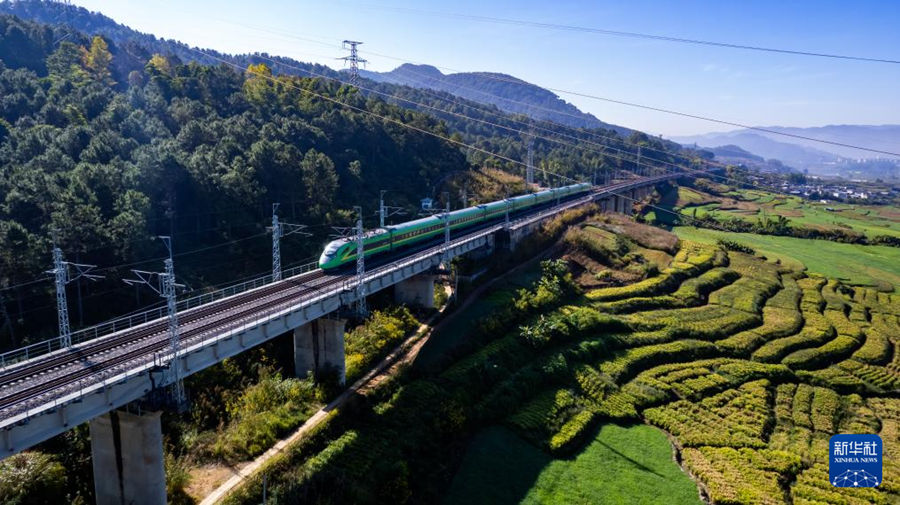
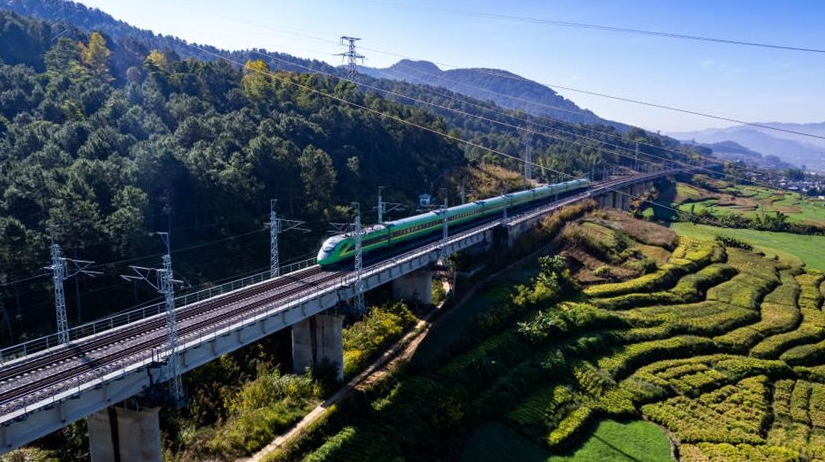
A high-speed train passes over a wheat field on the China-Laos Railway, Pu'er, Yunnan province, Dec. 2, 2025. [Photo/Xinhua]
Beyond the automotive sector, high-speed rail stands as another example of how China's modernization drive and technical standards are affecting other developing countries. Take for example the China-Laos Railway. As a landmark project in the high-quality construction of the Belt and Road Initiative (BRI), the railway has provided new impetus for strengthening economic ties between China and ASEAN.
Stretching 1,035 kilometers from Kunming in southwest China's Yunnan province to the Lao capital of Vientiane, the China-Laos Railway has transported over 18 million metric tons of cross-border freight since opening in December 2021, according to China Railway Kunming Group. It has not only ended the history of rail isolation for once-remote places like Pu'er and Xishuangbanna in Yunnan, but also greatly facilitated travel for people living along the line. The railway's cross-border freight network has now reached 31 provincial-level regions in China and extended to 19 BRI partner countries including Thailand and Vietnam. Notably, freight costs from Kunming city to Thailand via Laos have decreased by 30%-50%.
According to a report by China State Railway Group on the development of the nation's high-speed railway released in July 2025, China has built the largest high-speed rail network in the world, with the most diverse operational scenarios. China has also spearheaded the development of all 13 system-level international standards for high-speed rail set by the International Union of Railways (UIC).
Action speaks louder than words. China's firm commitment to opening its vast market to the world while assisting other developing countries with critical infrastructure such as railways is not the "debt trap" claimed by some Western critics. Instead, these projects deliver tangible results — lifting people out of poverty in these regions while simultaneously boosting domestic economic growth.
Although China has repeatedly emphasized technological self-reliance on many occasions, this is not in conflict with its firm promise of opening up wider to the world, as China has become the leading marketplace where global innovations are tested, applied and turned into profit.
As Chinese philosopher Wei Yuan (1794-1857) once said, "Alone, one falters under the weight; Together, we stride on the road." China's 15th Five-Year Plan reaffirms that engaging with the Chinese market ensures huge opportunities for common prosperity. In a world fractured by conflict and uncertainty, China's modernization and its expanding leadership in global technical standards look set to help nations once again stride forward together.


 京公网安备 11010802027341号