Share:

During the Milano Cortina 2026 Winter Olympics, the Mars Olympics Digital Art Exhibition was staged in parallel at Beijing's National Stadium. The exhibition was curated by science fiction writer Lucia Luo Xu and guided by the International Cooperation Center of China Aerospace.
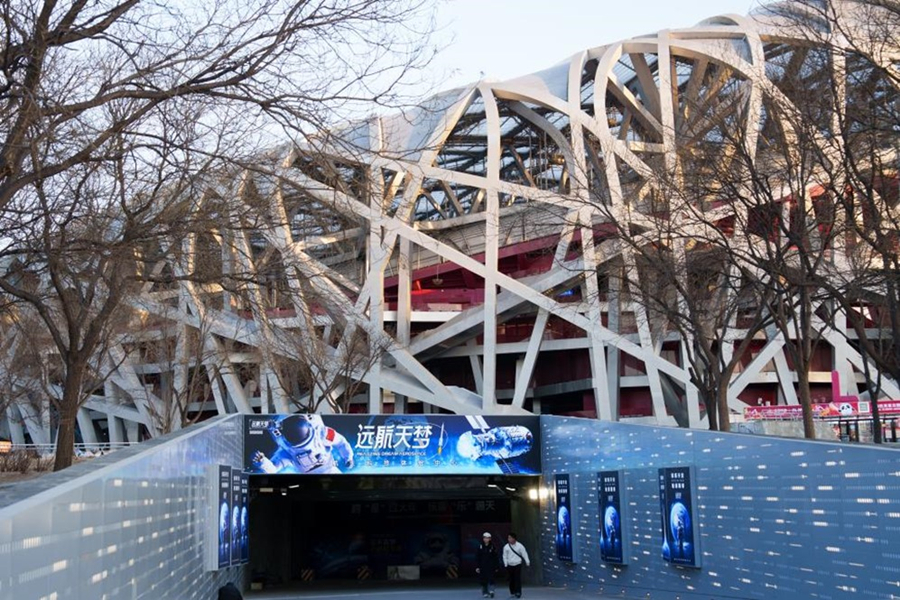
The entrance to the Mars Olympics Digital Art Exhibition at the National Stadium in Beijing. [Photo provided to China.org.cn]
"It was precisely this spirit of innovation that drew me to the project," Luo told China.org.cn. "Having the opportunity to curate an exhibition at one of China's most iconic landmarks — bringing together Chinese science fiction, technological art, China's aerospace and the Olympic spirit within a visionary narrative framework — was both highly challenging and deeply compelling."
As a multidisciplinary experience, the exhibition gathered contributions from across science, the arts and cultural industries, including the Foundation for the Development of Science and Technology in China, the Cultural Industry Committee of the China Cultural Information Association, and the China Mars Human Settlements Research Institute.
Luo said she wanted to explore a central question through "Mars Olympics": "As humanity steps into interplanetary space, how do we pursue excellence beyond our limits? How might our collective memory and values be preserved and evolve?"
The answer reflects the spirit of the exhibition: the pursuit of excellence. Through the speculative lens of science fiction, it asks how life might be redefined under Martian gravity — only 38% that of Earth — and how humanity might adapt to extreme environments, while imagining a more equitable and sustainable cyclical system and shared space.
A group of young artists from leading institutions including the Central Academy of Fine Arts, China Academy of Art and Beijing Film Academy contributed to the exhibition. With backgrounds in media art, design, film and architecture, they explored Eastern aesthetics and philosophy, translating them into public experiences.
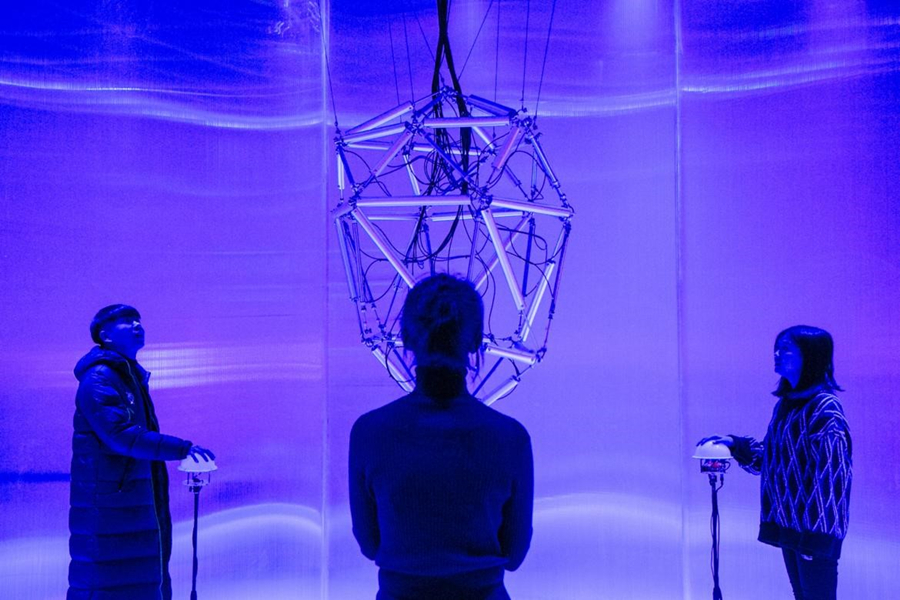
Visitors interact with the artwork "Emotion Alchemist" by Su Yongjian and Lucia Luo Xu displayed at the Mars Olympics Digital Art Exhibition at the National Stadium in Beijing. [Photo provided to China.org.cn]
An AI video and installation, for example, was created by a team from the China Academy of Art led by directors Zhang Gang and Zheng Zhong, based on the Eastern fantasy novels "The Memory Puzzles of Hong Kong Drifters" and "Emotion at Sea." Produced using the latest AI generated content technologies, the work reimagines the mythical Chinese "Guanyue Cha" — literally "Moon-piercing Raft," an ancient UFO — as a metaphor for a modern spacecraft. Through a distributed narrative, visitors move past windows within a “Mars base,” activating interactive devices that illuminate spacecraft portholes and assemble an interstellar star map.
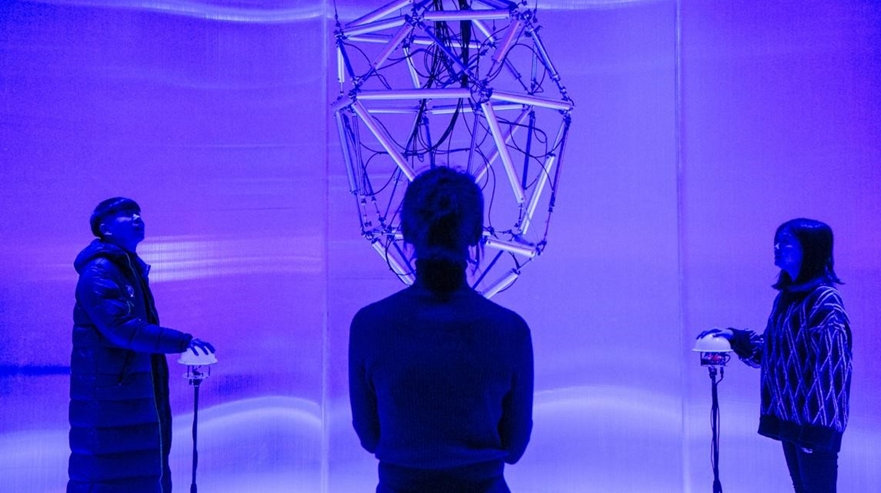
Meanwhile, the artwork "Emotion Alchemist," inspired by the seismic rhythm of the "heartbeat of Mars," imagines a "community of heartbeat" shared by humans, machines and the planet. "Maelstrom," drawing on Edgar Allan Poe's short story "A Descent into the Maelstrom," employs multisensory interaction to explore the dynamic relationship between the individual and the currents of information. In these works, digital technologies are fused with humanistic inquiry.
The event emphasized intermediality, immersion and interaction. Through a range of media — including mechanical installations, digital painting and XR cinema — it articulated a vision of interdependence between technology and people, territories and planets, values and civilization. In doing so, the National Stadium became a shared arena of science fiction, AI, installation and audience participation.
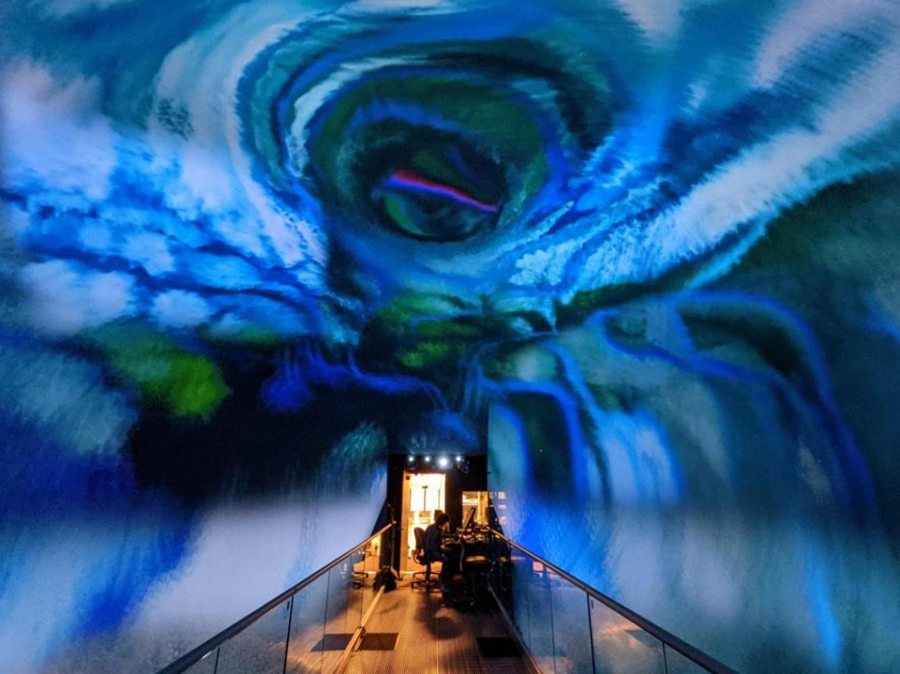
Artwork "Maelstrom" by Xie Yufan, Mel Lewis, Yin Ziqian and Wu Wei displayed at the Mars Olympics Digital Art Exhibition at the National Stadium in Beijing. [Photo provided to China.org.cn]
The exhibition attracted tens of thousands of visitors, including Xu Haifeng, the first Chinese Olympic champion; Li Shaoning, chief engineer of China Rocket; and Zhang Wenquan, the first torchbearer of the Milan leg of the Milano Cortina 2026 Winter Olympics. Through artistic reconfiguration of future scenarios, it connected scientific rationality, artistic sensibility and public curiosity, encouraging visitors to engage with imagined futures not merely as spectators, but as creators.
"Through this convergence of art and technology, aerospace and the Olympic spirit, I came to feel more strongly that sport, art and science fiction are all shared languages of humanity," Luo said. "The encounter of minds — scientists, aerospace engineers, artists and athletes — together with the active participation of the public, allowed me to glimpse the emerging contours of a new future."
She remarked that in an era of rapidly evolving AI and humanity's movement toward the universe, literature and art will increasingly be created jointly by artists and the public. Amid uncertainty, one force remains clear: the power of imagination and the pursuit of dreams.
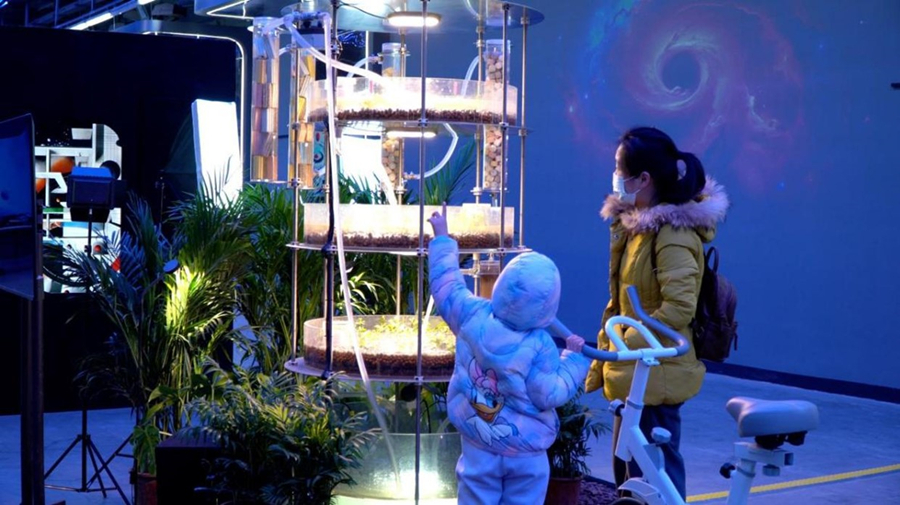
Visitors look at the artwork "Edible Garden" by Xu Chaofan and Ren Qingqi displayed at the Mars Olympics Digital Art Exhibition at the National Stadium in Beijing. [Photo provided to China.org.cn]
Luo envisions literature and art unfolding through an integrated, immersive language of mixed reality. "To keep moving toward that future, we will remain committed to trans-media creation, while continuing to innovate at both formal and conceptual levels," Luo said. "I hope to engage technology as a generative force in both environmental and creative fields, fostering shared forms of connection, understanding and care."


 京公网安备 11010802027341号