Share:

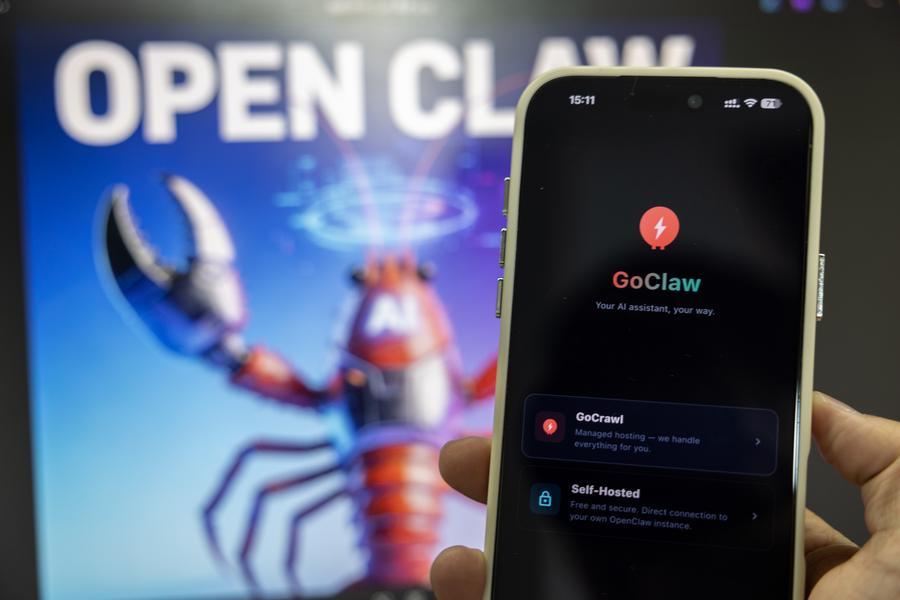
A cellphone running the open-source AI agent OpenClaw, March 11, 2026. [Photo/Xinhua]
In the fast-moving world of artificial intelligence (AI), even familiar words can quietly take on new lives. One such example is "token" — a simple term that has suddenly become central to how AI systems operate and how the industry measures activity.
Much of the recent attention around AI has been focused on the rise of OpenClaw, an open-source AI agent. Systems built on OpenClaw rely on large AI models, and almost every interaction consumes tokens. This has prompted an increasingly common question: what exactly is a token?
OpenAI offers a straightforward explanation on its official website. Tokens, it says, are "the building blocks of text that OpenAI models process. They can be as short as a single character or as long as a full word, depending on the language and context."
Put simply, a token is the smallest unit a large language model uses when processing text. In English, one token corresponds to about four characters, and 100 tokens are roughly equivalent to 75 words.
For Chinese readers, however, another question quickly arose: how should the term be translated?
In January, an article published by the newspaper People's Daily rendered token as "词元" (cíyuán), meaning a "lexical unit." The translation gained further recognition at the China Development Forum 2026 held in March. Liu Liehong, head of the National Data Administration, described such tokens as not only a "value anchor" in the intelligent era but also a "settlement unit" that links technological supply with commercial demand, making it possible to quantify business models.
If the internet era measured the flow of information largely through traffic, the AI era is increasingly being measured through tokens. Every word or character a user enters, as well as every sentence generated or image identified by a model, consumes them. Token usage has therefore become an important indicator of how active AI models are and how much value they create in real-world use.
The scale of growth has been striking. According to Liu, China's daily token usage stood at about 100 billion at the beginning of 2024. By the end of 2025, that number had climbed to 100 trillion. By March this year, it has already exceeded 140 trillion, increasing more than a thousandfold in just two years.
Yet the significance of tokens is not limited to artificial intelligence. The word appears across a variety of fields, often referring to quite different things depending on the context.
In everyday English, a token once simply referred to a sign or symbol — as in a "token of appreciation." It can also describe a voucher or item used in exchange for goods, such as a book token. In some cities, the small discs once used for subway entry were known as metro or subway tokens.
In information security, the term refers to a credential used to verify identity. Some online banking systems, for example, require users to generate codes through hardware tokens. In the world of cryptocurrencies, a token refers to a digital certificate issued on blockchain platforms that represents assets or rights, like NFTs, or non-fungible tokens.
Now, in the context of artificial intelligence, the word has acquired yet another meaning.
Technological change does not just produce new tools; it also reshapes the language used to describe them. Words such as "cloud," "platform" and "ecosystem" have all followed a similar path, moving from everyday usage into the vocabulary of the digital economy.
For translators and international communicators, this creates a familiar challenge. When a word travels across technological domains, its translation cannot rely on a single fixed equivalent. Instead, it has to follow the concept the word is being used to describe.
Seen in that light, the renewed attention to tokens is more than just a technical detail. It reflects the way language evolves alongside technological change. Sometimes the clearest signal that a new technological phase has arrived may not be a new device or model, but a familiar word quietly beginning to mean something else.


 京公网安备 11010802027341号