

 Share:

Tengtou Village in Zhejiang province, once an economic backwater off the beaten track, has been transformed into a prime example of green industry, innovation, and shared prosperity.
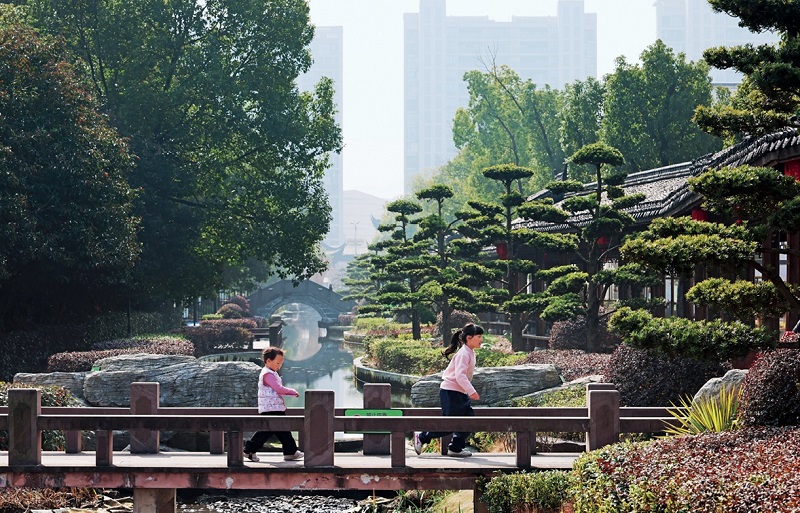
Two children walk across a bridge in a scenic park in Tengtou Village on February 3, 2026.
In coastal Fenghua District, Ningbo City in China's Zhejiang province, a small village called Tengtou has undergone a remarkable transformation over the past few decades. Once a barren, impoverished area, it is now a shining example of China's modern rural development.
This shift is credited to the village's innovative development path for common prosperity. In 2025, this village of two-square-kilometers, with a population of 1,000 people, achieved an incredible gross social production of RMB 13.535 billion, with a per capita income of RMB 89,000. The small village is also now home to a band of businesses that incorporate modern, green manufacturing solutions and offer products to customers worldwide.
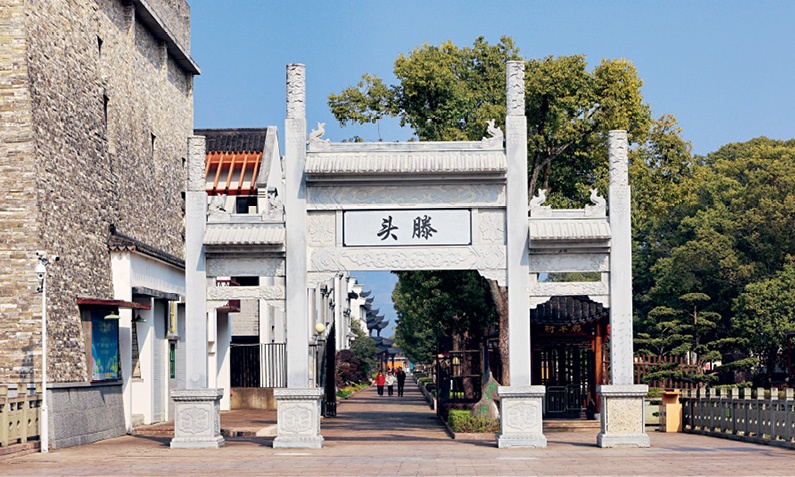
Visitors stroll around Tengtou Village on February 3, the first village in China to cancel admission fees for a national 5A-level scenic area in 2019.
Growth That Benefits All Villagers
China Today spoke to Fu Pingjun, Party secretary of Tengtou Village, this February, prior to the Chinese New Year. Fu had a tight schedule filled with arrangements from attending local "two sessions" and meetings on village projects to visiting elderly people.
He said that to ensure development dividends enjoyed by all villagers, the village adopts a set of community welfare standards, according to which villagers receive a monthly subsidy of RMB 1,500 from birth to death, and a post-retirement subsidy of at least RMB 4,000 per month. Besides, there are also funds for elderly care and talent cultivation, providing strong support for both the elderly and the young.
The village has also cultivated industries that integrate agriculture, culture, and tourism. In 2019, it became the first village in China to eliminate admission fees for a local national 5A-rated tourist attraction – the highest level in the country's tourist sites rating system. This move attracted more visitors and spurred the growth of local industries such as B&Bs and agri-tourism. In 2025, Tengtou generated RMB 131 million in comprehensive tourism revenue and received nearly 900,000 visitors.
To better serve agricultural entrepreneurs, the village launched the Tengtou Agricultural Incubation Industrial Park in early 2025. Fu said that by attracting well-known agricultural enterprises and research institutions to set up a branch, it aims to build a complete ecological agriculture industry chain.
A tradition has also been kept for more than a decade. Every year for the 15 days between the Chinese New Year and the Lantern Festival, villagers who previously started businesses in other places will select a day to come together and exchange entrepreneurial experiences.
"Many entrepreneurs lack professional knowledge and team support in areas such as legal affairs, auditing, and taxation. For enterprises to achieve long-term development, sound operations are essential," Fu explained. The Tengtou Village Economic Cooperative led by the Tengtou Holding Group, with its more than 50 subsidaries and professional corporate management resources, is able to provide practical assistance to entrepreneurs in need.
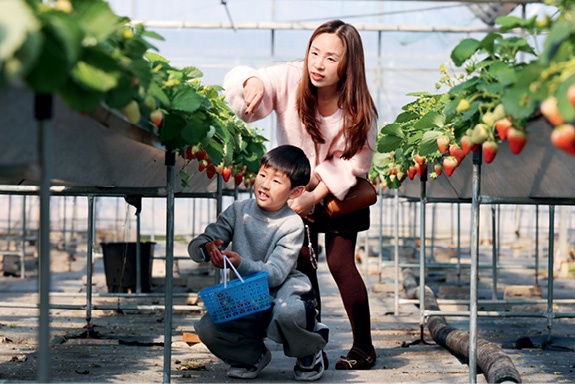
Visitors pick strawberries at the Agricultural Innovation Center in Tengtou Village.
A Leader in New Materials Production
Zhejiang Amerisource New Material Co., Ltd., a subsidiary of Tengtou Holding Group, is a high-tech enterprise specializing in the research, production, and sales of polybutylene terephthalate (PBT), commonly known as polyester resin. Since its establishment in 2019, the company has focused on developing high-end new materials, becoming one of the top three PBT suppliers in the Chinese market.
PBT is a thermoplastic engineering plastic widely used in electronics and electrical appliances, automotive components, and precision instrument parts. In the 2025 edition of Catalogue of Encouraged Industries for Foreign Investment, which took effect on February 1, the development and production of PBT – an important material in the field of new polyester and fibers – has been included in the list of industries encouraged by the Chinese government.
At the Amerisource factory, technicians in overalls moved briskly between automated machines as they carried out the production line's biennial maintenance work. Zhang Xiaodong, the company's general manager, said that, "Our production lines operate around the clock, so periodic shutdowns for maintenance are necessary. We are pushing ahead with all the necessary work and expect to resume operations after the Chinese New Year holiday."
The factory has an annual capacity of 120,000 tons, producing single-set polymerization units designed and built by Chinese engineers. Compared with traditional equipment, this domestically produced system has doubled production capacity with just over 20 operators to manage the entire process.
"Previously, we bought this type of equipment from other countries, which was not only costly but also inconvenient to maintain. Now we are able to develop the core system on our own," Zhang told China Today.
During a period of adjustment in the industry, more than half of the 15 registered PBT producers in China have suspended production. Amerisource, however, has leveraged its advantages in technology, cost control, and market positioning, to achieve an output value of RMB 1.2 billion in 2025, becoming one of the few companies in the sector to remain profitable.
Amerisource has applied the concept of green and low-carbon development throughout its entire production chain. "Each year, the company invests about RMB 38 million in product research and development and environmental protection equipment. We have significantly reduced energy consumption per unit of product and also lowered costs," Zhang said.
The company's factory has incorporated a fully enclosed operating system. Wastewater and exhaust gases are treated to meet discharge standards. The company simultaneously extracts and sells tetrahydrofuran with 99.99 percent purity from wastewater generated during PBT production, achieving efficient utilization of raw materials.
"Ensuring eco-friendly production is one of our top priorities," Zhang said. To that end, the company has not only invested in upgrading environmental equipment but also established a comprehensive emergency response system, effectively preventing potential environmental risks and resource waste that could arise from unexpected production shutdowns. In addition, it has applied for national subsidies for the upgrading and renovation of outdated facilities. With policy support, it is driving a green technological transformation.
Over the past two years, while consolidating its share in domestic market, it has also set its eyes on the international market.
In the finished-product warehouse, workers were busy loading packaged PBT pellets onto trucks. These products will be shipped to both domestic markets and 17 countries and regions, including Turkey, Italy, the Republic of Korea, and Pakistan.
"Currently, about 85 percent of our products are sold domestically and 15 percent are exported. During public holidays, our foreign trade team remains on duty to stay in contact with overseas clients and ensure that orders are delivered on time," Zhang said.
Looking ahead, Amerisource will continue to focus on the PBT sector, according to Zhang. They plan to launch the second phase of their capacity expansion project, increase investment in research and development, and strengthen technological independence. The next generation of polyester materials such as PTT is also being developed, as the company strives to evolve from a "single-PBT" product to a broader "family of polyester new materials, " Zhang said.
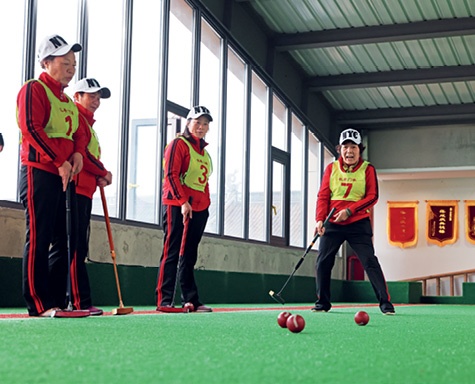
Elderly residents play gateball at the village's gateball center in Tengtou Village.
New Garments from the Village to the World
Tengtou Village is also home to Zhejiang Aiyimei Garment Co., Ltd., one of the country's largest export manufacturing bases for cashmere apparel. Over 46 years of development, the company has evolved from a small factory in a converted chicken shed, into a modern garment manufacturer integrating design, research and development, manufacturing, and sales. Today it operates with intelligent production systems, and its products are sold worldwide.
"I've worked here for more than 20 years. This place feels like home to me," said a company employer surnamed Wang. During this time, she has been able to support her family with a stable income. Over two-thirds of the workers have worked at the garment factory for more than 10 years, with some joining in their youth and even returning after retirement to continue contributing their experience.
As a leading enterprise based in the local community, Aiyimei has always adhered to the ethos of "promoting employment through industry and driving shared prosperity through development." The company currently employs more than 1,000 workers, over 90 percent coming from nearby villages and towns. It not only helps ease local employment pressure but also allows villagers to work close to home. The company has established a salary and welfare system, and skills-training programs.
"What we value most is stability. The company pays all our social insurance and we are always paid on time – it feels far more secure than working away from home," said Li, an employee from a nearby village.
In addition to creating jobs for locals, Aiyimei has built talent cultivation platforms. As a national base for preserving intangible cultural heritage and a training base for university students, the company partners with universities across China to integrate production, study and research. It has established an "Aiyimei Workshop" and a "Master Craftsman Studio," where it trains large numbers of professionals each year. Many nationally and provincially recognized model workers, artisans, and technical specialists have come from this company, forming a talent pool for sustainable industrial development.
"Green development is indispensable to high-quality growth and key to winning international markets," said Zhou Bin, general manager of Aiyimei. The company invested RMB 20 million in 2020 to build a smart factory and adopt advanced quality control systems, enabling circular operations throughout the entire industrial chain to significantly reduce water consumption and pollutant emissions.
The manufacturing execution system (MES) serves as the factory's brain. Integrated with 5G networks, workstation terminals, and production equipment, the system connects every production stage – from design and R&D management to intelligent production scheduling, flexible manufacturing, supply chain management, logistics distribution, and after-sales services. The system collects real-time production data and uploads it to both cloud and local servers, replaces manual statistics, and reduces errors and waste. It also enables intelligent task allocation and real-time monitoring of production progress, making production management more standardized and efficient.
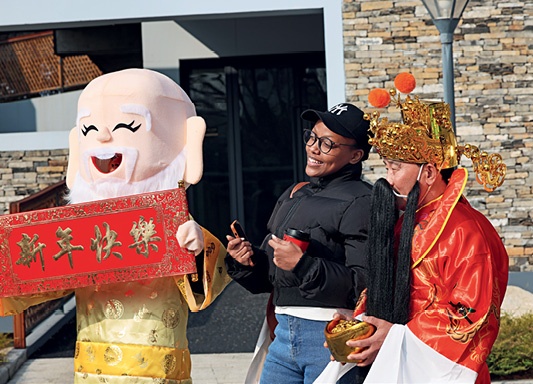
On February 3, as the Chinese New Year approaches, international students experience local customs in Tengtou Village.
"Our green production system gives clients great confidence, which forges our long-term partnerships," Zhou said. Through sustained environmental investment, Aiyimei has gained a firm foothold in international markets, with products exported to more than 30 countries and regions, including the United States, Italy, France, and the Middle East.
Facing rising domestic labor costs and intensifying market competition, Aiyimei has expanded its business through resource integration and cross-regional cooperation. While the company is considering acquiring factories overseas, or transferring part of its production capacity to central and western China to boost local employment, it has also brought altogether five foreign-trade enterprises and one logistics company in Fenghua, to establish Ningbo Fengshang Technology Co., Ltd., a cross-border e-commerce platform, pioneering Fenghua's first collaborative cross-border e-commerce model in the clothing industry.
"In the past, we only handled large bulk orders, and no one wanted to take small ones. Now, through the cross-border e-commerce platform, we can also take small orders of 50 or 100 pieces," Zhou said. The platform mainly serves small and medium-sized overseas clients and independent designer brands, providing full-category customization services. By finding clients through social media platforms such as Facebook and LinkedIn and using 3D modeling and design technology, the platform can respond quickly to customer needs. In just five years, it has secured orders totaling US $33 million for the company.
This innovative model combining cross-regional cooperation and cross-border e-commerce not only integrates the production strengths of local garment enterprises but also leverages overseas warehouse resources from logistics partners. This facilitates a smooth overseas trade path. By investing in and acquiring promising overseas brands, the company helps small clients grow, while cultivating long-term partners for itself.
From its humble beginnings, operating with only RMB 2,000 startup capital and a handful of foot-pedal sewing machines, Aiyimei has evolved into a modern garment powerhouse. By embracing innovation, sustainability, and intelligent manufacturing, the company continues to chart a green and forward-looking path.


 京公网安备 11010802027341号