 Share:

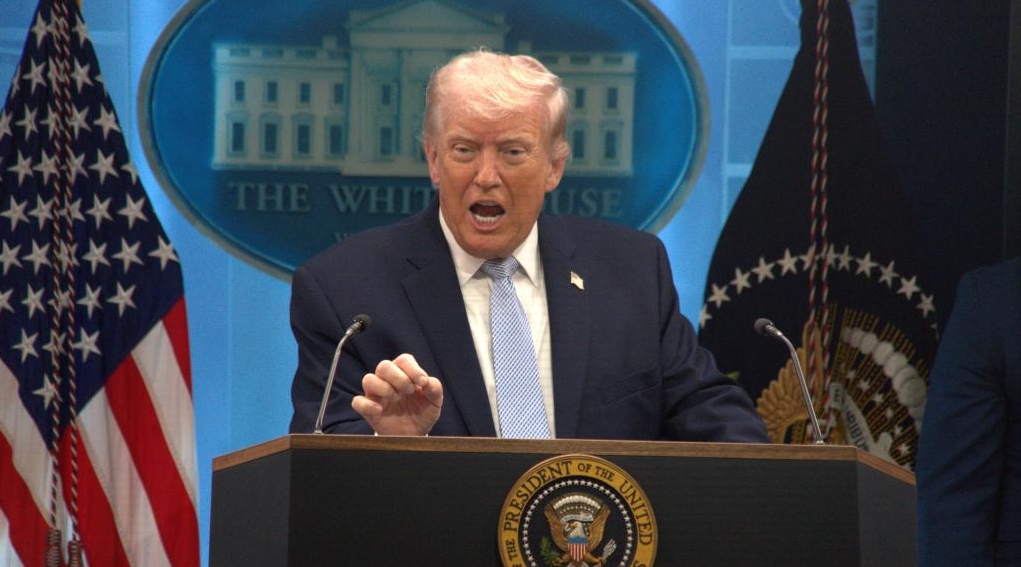
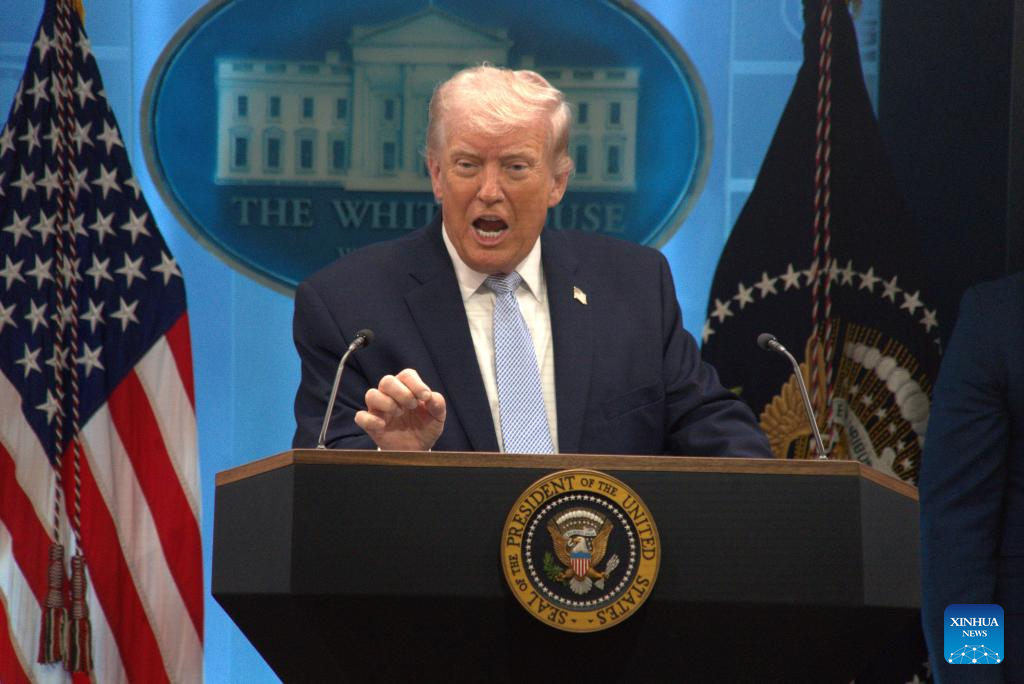 U.S. President Donald Trump speaks during a press conference at the White House in Washington, D.C., the United States, April 6, 2026. [Photo/Xinhua]
U.S. President Donald Trump said Monday that Iran could be "taken out" in one night and that night "might" be Tuesday evening, the deadline Trump set for Iran to make a deal and reopen the Strait of Hormuz, while claiming that negotiations with the Iranian side via intermediaries over the deal are "going well."
Critical period
"The entire country could be taken out in one night, and that night might be tomorrow night," Trump said at a press conference at the White House.
Asked about whether he's winding down or escalating the war with Iran, Trump said, "I can't tell you. Depends what they do."
"This is a critical period," said Trump of his Tuesday deadline. "They have a period of, well, until tomorrow at 8 (p.m.) o'clock."
Trump also said at the press conference that his administration has a plan to strike and destroy bridges and power plants across Iran by midnight Tuesday.
"We have a plan, because of the power of our military, where every bridge in Iran will be decimated by 12 o'clock tomorrow night, where every power plant in Iran will be out of business -- burning, exploding, and never to be used again," Trump claimed. "It will take them 100 years to rebuild."
"I mean complete demolition by 12 o'clock. And it will happen over a period of four hours if we wanted to. We don't want that to happen," Trump added.
The president said Monday that the 8 p.m. Eastern Time Tuesday deadline he has set for Iran is final. However, he had previously repeatedly changed the deadlines he had announced for a ceasefire deal or for reopening the strait.
Earlier on Monday, Trump told reporters at the White House Easter Egg Roll that he was "not worried about" whether the U.S. airstrikes on Iran's power plants and other civil infrastructure could constitute a war crime.
Negotiations
Meanwhile, Trump said at the press conference that Iran is an "active, willing participant" in the negotiations over the deal, claiming the talks via intermediaries are "going well."
"I can't talk about ceasefire, but I can tell you that we have an active, willing participant on the other side. They would like to be able to make a deal. I can't say any more than that," Trump said.
"Essentially they have till 8 p.m. tomorrow night, Eastern Time, but we are dealing with them. I think it's going well," said Trump, adding that his envoy Steve Witkoff and U.S. Vice President JD Vance are "involved in the dealing" of talks via intermediary countries.
Trump said earlier on Monday that his administration has reviewed a proposal for a 45-day ceasefire in the Iran war, describing it as a "very significant step" but "not good enough," while Tehran said "no sane" person would accept it.
"It's a significant proposal, it's a significant step. It's not good enough, but it's a very significant step," Trump told reporters at the White House, referring to the ceasefire proposal, noting that intermediaries "are negotiating now."
The president also reiterated that he is the only person who can determine if there's a ceasefire in the U.S.-Israeli war against Iran.
Iran's Foreign Ministry spokesperson Esmaeil Baghaei said Monday that a ceasefire would only give opponents time to regroup and commit further crimes.
Iran's state-run IRNA reported on Monday that Tehran had sent its response to a U.S.-proposed 15-point plan to end the war to Pakistan. According to the report, Iran rejected a ceasefire and instead called for a permanent end to the conflict, while taking into account the country's considerations.
Toll and oil
Trump also claimed at the press conference that the United States should impose tolls on vessels passing through the Strait of Hormuz, stressing that reopening the key global energy chokepoint must be part of a deal to end the war.
"What about us charging tolls?" Trump said. "I'd rather do that than let them (Iranians) have them."
"We have to have a deal that's acceptable to me, and part of that deal is going to be we want free traffic of oil and everything," the president said.
Shortly after the United States and Israel launched massive attacks on Iran on Feb. 28, Iran effectively closed the critical global energy waterway.
Asked about Iranian oil, Trump suggested again the United States could take control of it, similar to its approach in Venezuela after the United States military raided and forcibly seized Venezuelan President Nicolas Maduro on Jan. 3.
"To the winner belong the spoils," Trump claimed.
"If I had my choice, yeah, because I'm a businessman first," Trump said, noting after removing Maduro by U.S. forces, "we are a partner with Venezuela, and we've taken hundreds of millions of barrels, hundreds of millions."
Earlier on Monday, Trump told reporters at the White House Easter Egg Roll that he would take the oil from Iran, but U.S. citizens do not want U.S. forces to remain in the country.
"If I had my choice, what would I like to do? Take the oil, because it's there for the taking. There's not a thing they can do about it," Trump said. "Unfortunately, the American people would like to see us come home."
Trump has repeatedly claimed that the United States has won the war with Iran, but many U.S. experts say they believe the president is losing the ongoing war despite the overwhelming military advantage of the United States and Israel over Iran.


 京公网安备 11010802027341号