 Share:

"Dawn's Bells and Dusk's Drum" is the first solo exhibition in Beijing by Chinese contemporary artist Ni Youyu. It opened on Apr. 3, 2026 at Galleria Continua in the 798 Art District. The show marks the artist's first collaboration with the gallery.
Organized around the theme of time, the exhibition brings works across painting, installation, and sculpture, together with Ni's vision of deliberately avoiding a prescribed circulation path. "The space has no planned route," he said. "People are free to move around."
"Dawn's Bells and Dusk's Drums" is built on the idea of daily practice from Zen tradition and the idea of time. For Ni, time is not just the passing of years. It is present in the old materials he uses, the different historical fragments he brings together, and the slow and repetitive process of making.
For Ni, the life of an artist is far from glamorous. "Artists are actually quite boring," he said. "It is the state of a craftsman doing their work from morning to night. There is no glamour, no fancy parties. This is the normal state of a labor-intensive worker."
Water washing painting is one of Ni's signature techniques. "The Disappearing Waterfall II," a large work occupying the main wall, consists of twenty-one monumental stone forms that Ni created over a span of roughly six years, using approximately two tons of water to wash its surfaces.
"The water has dried," he said. "The pigment has dried. The water is gone. It has become these twenty-one stones. So it is also a kind of disappearing waterfall."
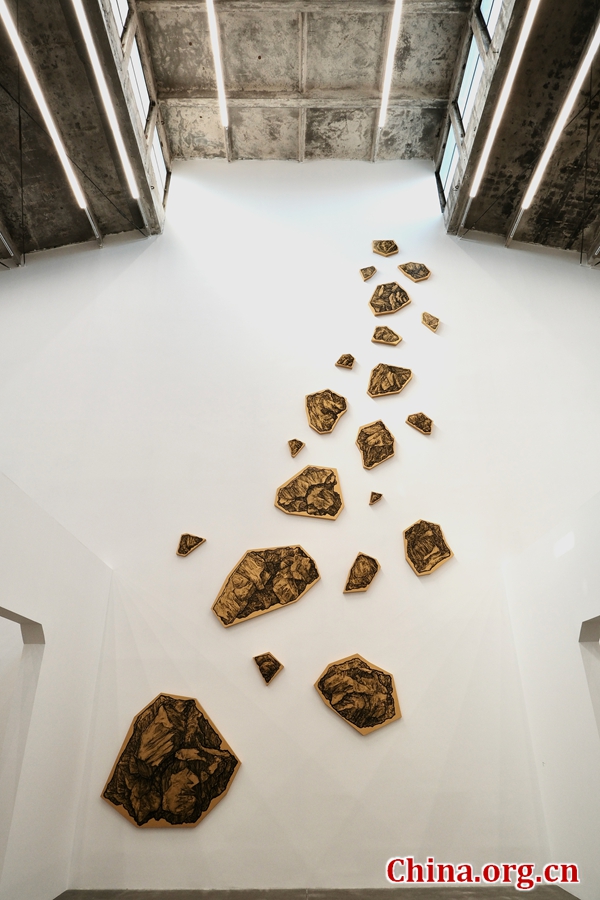
"The Disappearing Waterfall II" on view at Galleria Continua, Beijing, China, Apr. 2, 2026. [Photo by Liao Jiaxin/China.org.cn]
As water is often represented as blank space in the traditional style of Chinese painting, the white wall of the gallery, Ni suggested, can be seen as flowing waters that have become invisible. He also noted that when a waterfall dries up, the riverbed beneath is revealed.
Suspended from the high ceiling are a series of bells titled "Sound of the Void." This marks their first public presentation, each one collected by the artist from traditional folk artisans. Ranging from one to two centuries old, these hand-forged bells, crafted from either copper or gold plating, embody both history and artistry. Hung quietly in the gallery space, they remain largely silent, only releasing a fleeting tone before returning to stillness. This work in particular pays homage to Alexander Calder, a pioneer of kinetic sculpture.
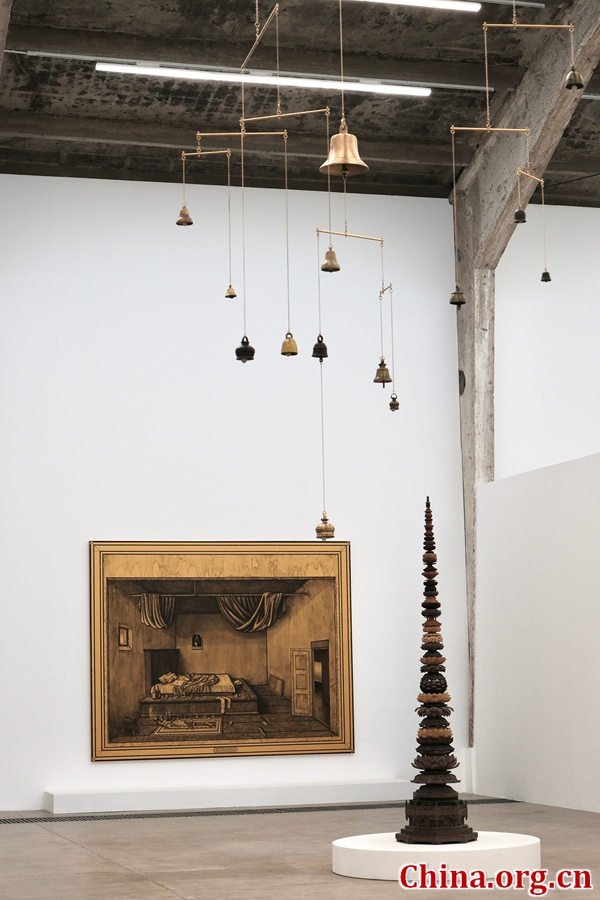
A view of "Dawn's Bells and Dusk's Drums" at Galleria Continua, Beijing, China, Apr. 2, 2026. [Photo by Liao Jiaxin/China.org.cn]
"The core state is one of quiet and lightness," Ni said when speaking on the bells. "The rest of the sound is left to the viewer's imagination." As the bells slowly rotate in the space, he sees a connection to the movement of constellations and the cosmos in his other works.
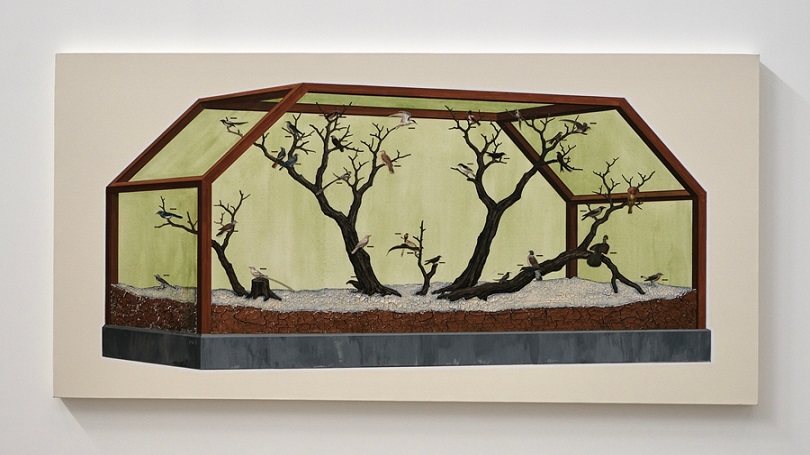
Another piece, "Ancient Archive Specimen" (Transparent Monument XIV), belongs to a series Ni began in 2011 and has continued for 15 years. Inside are original 19th-century copper and steel printing plates. These have been hand-colored and collaged by the artist. Each bird in the painting is marked with a year. "If viewers look up those years online," Ni said, "they will find the names of 32 classical musicians I consider most important, from Mozart to Beethoven." For Ni, these musicians have become like specimens, lifeless, preserved, but also as if they still have voices. The different species of birds correspond subtly to the temperaments of different composers.
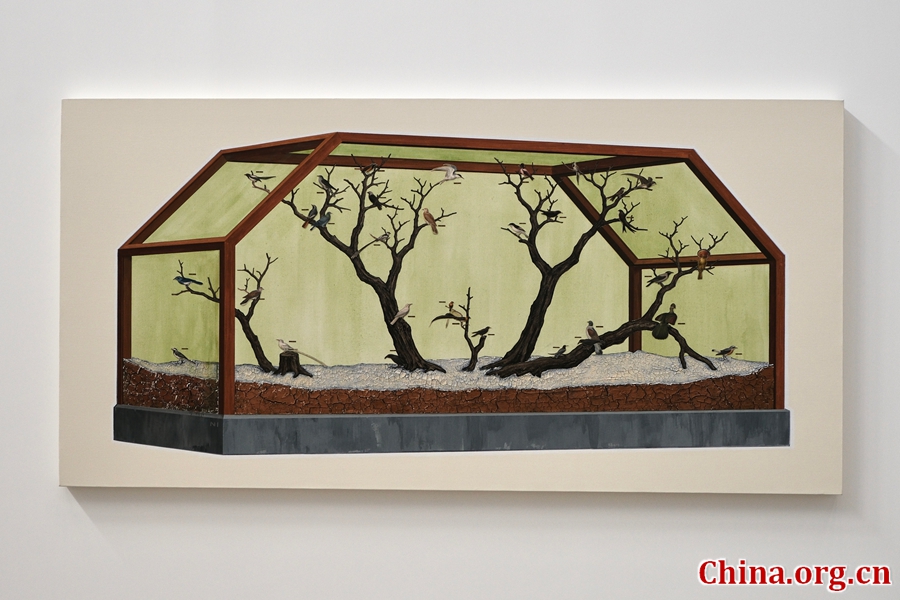
"Ancient Archive Specimen" (Transparent Monument XIV) on display at Galleria Continua, Beijing, China, Apr. 2, 2026. [Photo by Liao Jiaxin/China.org.cn]
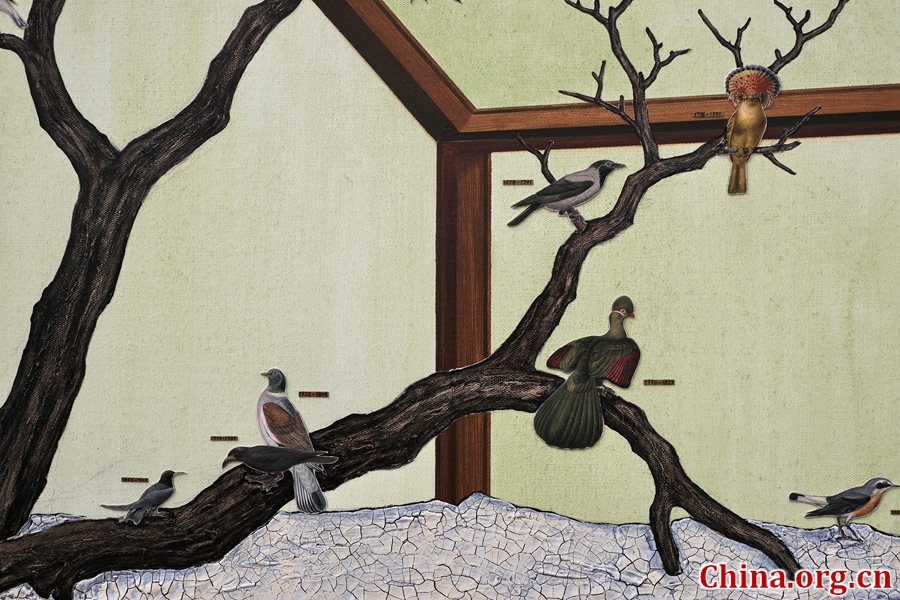
A close-up of "Ancient Archive Specimen" (Transparent Monument XIV) at Galleria Continua, Beijing, China, Apr. 2, 2026. [Photo by Liao Jiaxin/China.org.cn]
Throughout the exhibition, Ni returns to a central concern: the experience of viewing (an artwork). If a work is seen only through social media or in poor reproduction, he said, "all the essential information disappears." His hope is that viewers will come to the physical space, stand before the works, and take their time. "When you stare at something and let yourself sink into it," he said, "that is my core concern."


 京公网安备 11010802027341号