


 Share:

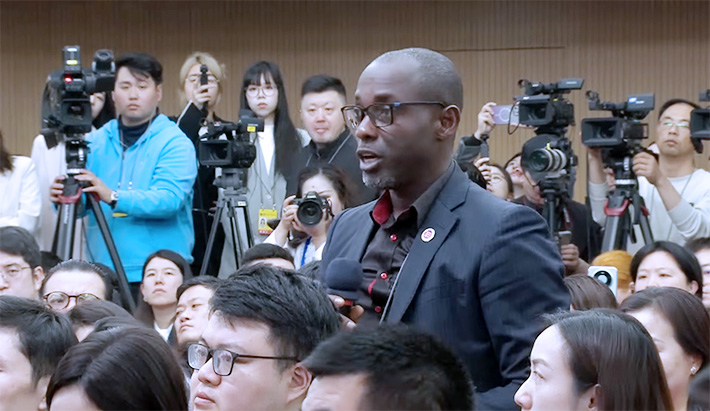
Fortune Abang asks a question to China's foreign minister at a press conference on the sidelines of the fourth session of the 14th National People's Congress in Beijing on 8 March. [Screenshot]
During this year's Two Sessions, Fortune Abang had the opportunity to ask a question to China's foreign minister at a press conference. On behalf of African journalists, the chief correspondent with the News Agency of Nigeria asked about the China-Africa Year of People-to-People Exchanges.
This was not the first high-profile event that Abang has covered. From the Forum on China-Africa Cooperation (FOCAC) to the Two Sessions, and from factories to local communities, he has used his reporting to narrate the real stories of China-Africa friendship and cooperation. Recently, Abang sat down with ChinAfrica for an interview, sharing his observations on Chin and China-Africa relations through the eyes of a journalist with many years of experience in China.
ChinAfrica: The first time you covered China's Two Sessions was in 2022. What was that experience like? This year, you asked a question on behalf of African journalists during the Foreign Minister's press conference, mentioning the 70th anniversary of China-Africa diplomatic relations and the Year of People-to-People Exchanges. Why did you choose this question? What new breakthroughs do you hope to see in China-Africa relations?
Fortune Abang: Covering China's Two Sessions in 2022 was an entirely new experience in my professional career. It offered a rare opportunity to observe how the country consistently implements its Five-Year Plans, not only to drive domestic development but also to strengthen its bilateral engagement with partners around the world.
What stood out was the scale and inclusiveness of the event. Diplomats, international observers and journalists from across continents came together, each playing a role in shaping and conveying the narrative. For the media, in particular, it underscored the responsibility of upholding the public's right to know through balanced and informed reporting.
My question to the Chinese foreign minister this year was informed by two key milestones: the 70th anniversary of China-Africa diplomatic relations and the designation of 2026 as the Year of People-to-People Exchanges. These occasions provide an opportunity to examine the evolution of China-Africa ties, assess existing challenges and explore pathways for strengthening cooperation.
Looking ahead, there is an expectation that China-Africa relations will continue to deepen, with greater emphasis on shared development priorities, cultural exchange and the building of a community with a shared future.
You have been carrying the FOCAC media bag throughout this year's Two Sessions, and you've described your participation in the event as significant. Have you been following and reporting on FOCAC over the years? How do you assess the role and impact of this mechanism in advancing China-Africa relations?
Carrying the FOCAC media bag represents a strong sense of professional pride and identity for me as a media person. It symbolises participation in a platform where key global narratives are shaped - moments that are rare but significant in influencing perceptions and promoting international cooperation. For me, this underscores the need to approach journalism strategically, not only by reflecting on past developments but also by telling accurate, balanced stories that contextualise major events and long-standing relationships.
This commitment has become an important part of my professional practice. At the same time, challenges remain, particularly limited resources, which affect our ability to invest in advanced communication tools and skills needed to effectively reach wider global audiences.
I have consistently followed and reported on FOCAC over the years, and I look forward to participating in future editions, including analysing its broader role in shaping global governance.
In my view, while FOCAC has delivered tangible outcomes, there is still room to deepen its impact. Greater emphasis could be placed on people-to-people exchanges, strengthening diplomatic engagement and building capacity in areas such as artificial intelligence, media collaboration, agriculture, education and technological innovation. These efforts would help to sustain and expand the progress already achieved.
This year, you placed particular focus on topics such as artificial intelligence, ecology and environment, and high-quality Belt and Road cooperation within the framework of the 15th Five-Year Plan. During your interviews, were there any specific examples, moments, or data points that stood out to you and made you think Africa could draw valuable lessons from this?
Several areas stood out to me as particularly relevant for Africa's development. These include advances in robotics manufacturing, smart technologies such as wearable devices, and progress in ecological and environmental protection. Together, they reflect a broader ecosystem of technological innovation that Africa can learn from in practical terms to support sustainable growth and enhance self-reliance.
Equally striking were local community development models, especially in agricultural innovation. For instance, techniques related to oyster farming and pearl production highlighted how niche sectors can be developed into viable economic drivers. Such examples point to opportunities not only for strengthening China-Africa trade relations but also for expanding specialised markets within both economies.
Beyond these observations, there is a clear need to establish more practical educational platforms for Africans to gain hands-on experience in these sectors. Prioritising skills transfer and exposure to best practices would help lay a stronger foundation for start-ups and innovation-driven enterprises across the continent.
This year is designated as the China-Africa Year of People-to-People Exchanges. What role do you think people-to-people exchanges play in China-Africa relations? How can they transcend political and economic cooperation?
China-Africa people-to-people exchanges have helped to correct many misconceptions about Chinese culture that were previously widespread.
Deepening these exchanges has become increasingly important, particularly given the similarities between China and Africa, including their large populations. Strengthened engagement at the people-to-people level can further solidify diplomatic ties, while also opening new avenues for trade, enhancing media collaboration, promoting cultural exchange and advancing economic cooperation across multiple areas of shared interest on the global stage.
How do you view the reception and influence of China-Africa cooperation on the African continent? As an African journalist who knows China well, what are your future plans for telling the China-Africa story?
China-Africa cooperation has been widely well received across the African continent, earning strong appreciation as well as expectations for even deeper collaboration in the years ahead.
One of the key challenges, however, remains the language barrier, alongside the need for Africa to keep pace with China's rapid industrial and technological development, particularly in areas such as artificial intelligence, broader technological advancement and industrialisation.
Looking ahead, my plans for telling the China-Africa story centre on continuous capacity building, especially in key areas related to bilateral relations. I also aim to pursue professional or academic opportunities that will further strengthen my expertise in this field.
Ultimately, this approach will enable me to promote accurate and balanced reporting on issues that matter, from investment and trade to cultural and media exchanges, educational opportunities and technological progress. It will also allow me to highlight lesser-known contributions and milestones within China-Africa cooperation, while exploring new frontiers for strengthening ties between the two sides on the global stage.


 京公网安备 11010802027341号