Share:

The third Macao International Comedy Festival wrapped up on April 12 in Hengqin, south China's Guangdong province, with a closing forum exploring comedy's future in the digital age.
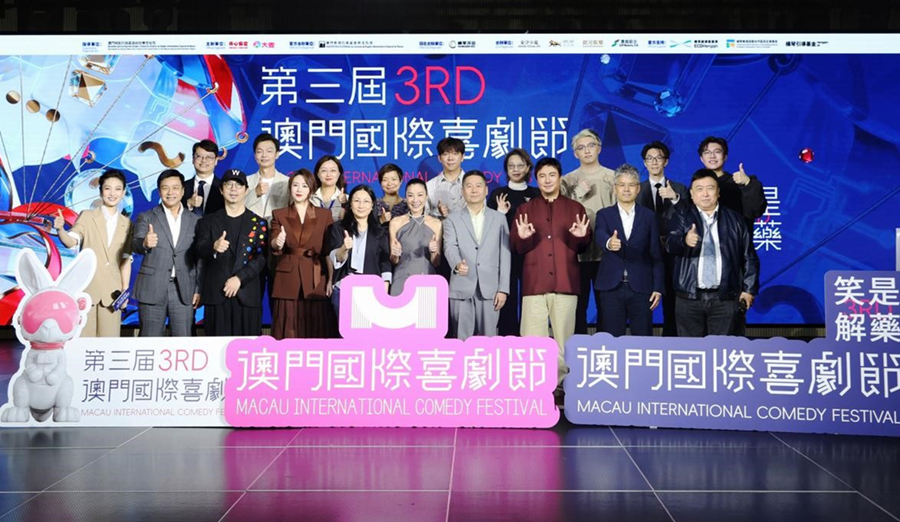
Participants pose for a group photo at the closing forum and closing ceremony of the third Macao International Comedy Festival in Hengqin, south China's Guangdong province, April 12, 2026. [Photo courtesy of Mahua Fun Age]
The forum, themed "Laughter as Our Remedy — Comedy Creation and Expression in the Age of Efficiency," brought together film directors Wong Jing and Stanley Tong, comedian Mark Lee, young creators Liu Tong and Wang Jianhua, actors Michelle Yeoh, Shen Teng and Ma Li, and singer Hu Haiquan.
Discussions centered on whether comedy creators should lead or cater to audiences, the impact of AI on comedy creation, and whether AI can replace human performers.
Drawing on decades of experience in commercial comedy filmmaking, Wong Jing said audiences today have increasingly sophisticated tastes and that pure absurdist humor can no longer meet their expectations. "Creators must find a balance between market demand and content depth," he said.
Stanley Tong outlined his approach to action comedy, emphasizing that physicality and situational context are key vehicles for humor. He also praised the growing nuance in the performances of Shen Teng and Ma Li.
Tong called for the Chinese-language comedy industry to raise its level of industrialization without sacrificing content quality. He suggested that action comedy, suspense comedy and emotion-driven comedy are all worth exploring to enrich the market and avoid genre stagnation.
Mark Lee drew on the grassroots character of Southeast Asian Chinese-language comedy, arguing that "laughter knows no borders" and calling for greater exchange between Chinese-language comedy scenes at home and abroad.
Michelle Yeoh said comedy is the art form best able to convey warmth and strength, and expressed hope that more Chinese-language comedies combining local characteristics with an international vision will reach wider markets.
Shen Teng, one of the festival's co-initiators, said its founding goal was to build a platform for Chinese-language comedy exchange that gives comedians space to discuss the industry's future and support emerging talent.
"Creators today can easily fall into the trap of chasing 'quick-laugh gimmicks,' but the heart of comedy will always be character and emotion, and AI cannot replace a creator's lived experience and emotional expression," he said.
Ma Li addressed the industry challenges faced by female comedians, arguing that comedy should carry no gender labels and that every laugh must be rooted in story logic and character. She also expressed her belief that comedy has become a way to heal people in today's high-pressure environment.
"I hope that comedy will continue to focus on 'content first,' bringing in more creators from different regions and styles, making Macao a hub for Chinese-language comedy exchange and allowing more audiences to see the diverse possibilities of comedy," she said.
Singer Hu Haiquan offered a musical perspective, arguing that quality content is at the core and that popularity metrics cannot replace emotion. Liu Tong and Wang Jianhua called on the industry to invest more in script development and observation of real life, rejecting fast-turnaround production and arguing that contrast and authentic experience are what make comedy work.
The festival ran for four days under its "one festival, two venues" model, linking the Macao Special Administrative Region and neighboring Hengqin with open-air performances, forums, interactive experiences and a closing ceremony. The event is a joint effort by Mahua Fun Age, Damai Entertainment and Macao's Cultural Affairs Bureau, with support from local government departments and enterprises.
Organizers said at the closing ceremony that comedy is not just an emotional outlet but a form of social value, and pledged that the festival will continue to embrace an open, diverse and innovative spirit as it seeks to promote Chinese-language comedy to a broader audience.


 京公网安备 11010802027341号