Share:

China is strengthening its intellectual property rights (IPR) protection system for emerging and future-oriented industries such as artificial intelligence (AI), integrated circuits, and biomedicine, said Guo Wen, spokesperson of the China National Intellectual Property Administration (CNIPA), at a Friday press conference.
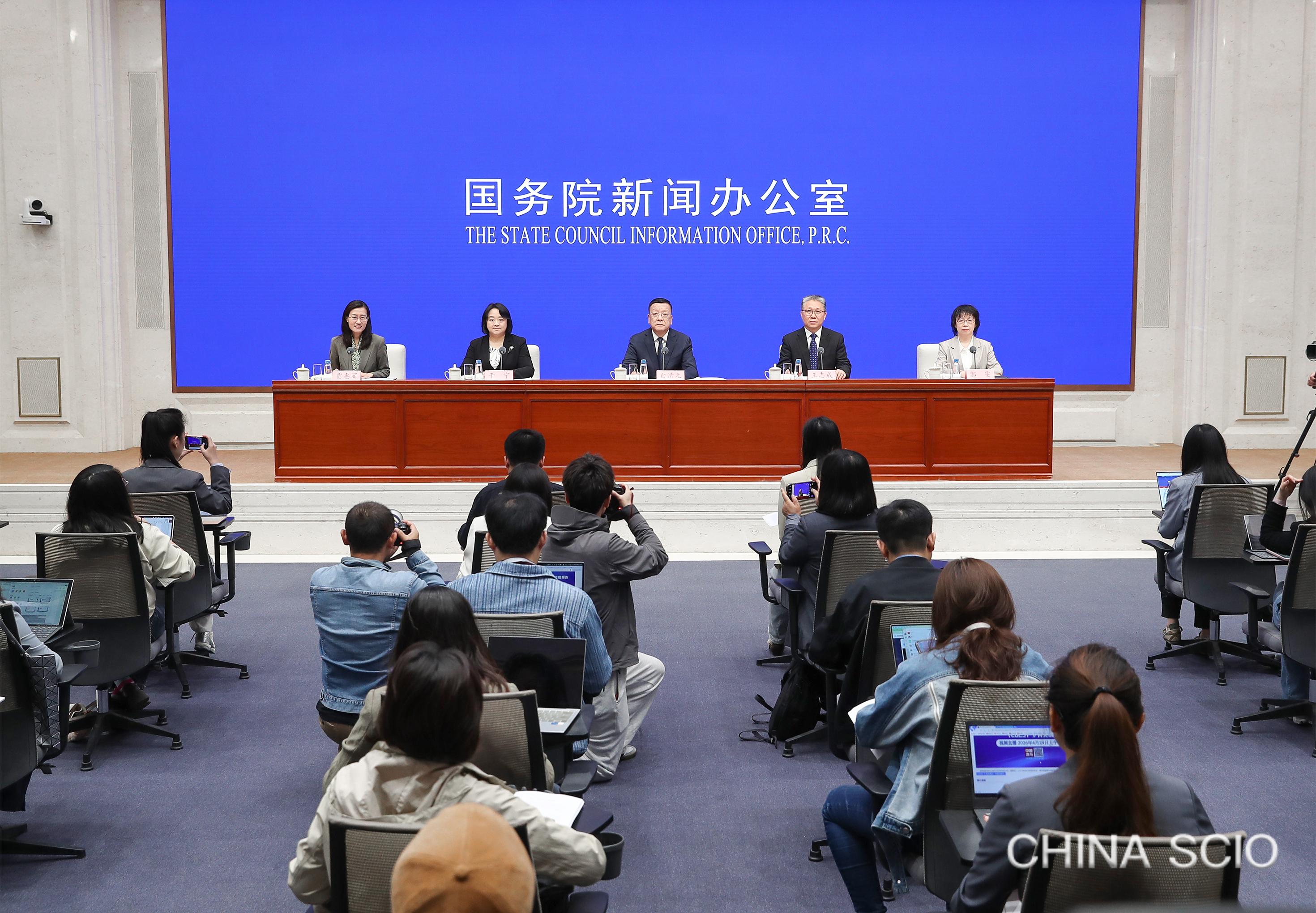
On April 24, 2026, the State Council Information Office holds a press conference in Beijing about the Annual Report on China's Combating of IPR Infringement and Counterfeiting (2025). [Photo by Liu Jian/China SCIO]
The protection system is being reinforced through targeted and continuous updates to laws and guidelines. Revised patent examination guidelines have introduced dedicated standards for areas such as AI and big data, including requirements on data collection and AI ethical review.
Amendments to the trademark law target issues such as malicious registrations and improper use, while revision to the regulations on integrated circuit layout designs are underway to support large-scale development and breakthroughs in core technologies.

Visitors interact with a robot during the sixth China International Consumer Products Expo in Haikou, Hainan province, April 14, 2026. [Photo/Xinhua]
Beyond legislation, China is enhancing its IPR protection service network. A total of 890 goods and service categories related to emerging sectors have been introduced and updated to address classification gaps and clarify protection boundaries.
Meanwhile, 82 national-level IPR protection centers have been established across the country, covering cutting-edge fields including AI, integrated circuits, quantum technology, and brain-computer interfaces, to better meet demand for rapid protection.
Support for overseas rights protection is also expanding, with 116 guidance platforms set up to help companies handle international IPR disputes, strengthen risk monitoring, and safeguard their interests in global markets.
The CNIPA is also boosting patent commercialization and application in emerging industries and providing stronger public services for key technological breakthroughs, Guo said.
Last year, the first batch of industrial IPR operation centers were recognized by the CNIPA, including 48 focused on emerging and future-oriented industries such as integrated circuits, biomedicine, aviation and aerospace, and 6G, accounting for more than 70% of the total.
During the 14th Five-Year Plan period (2021-2025), the CNIPA provided public services including patent search and analysis to more than 50,000 enterprises in emerging sectors, helping improve innovation commercialization and enhance market competitiveness.
Next, the CNIPA will continue to refine the IPR legal framework to better support innovation-driven development in emerging industries, the spokesperson said.


 京公网安备 11010802027341号