 Share:

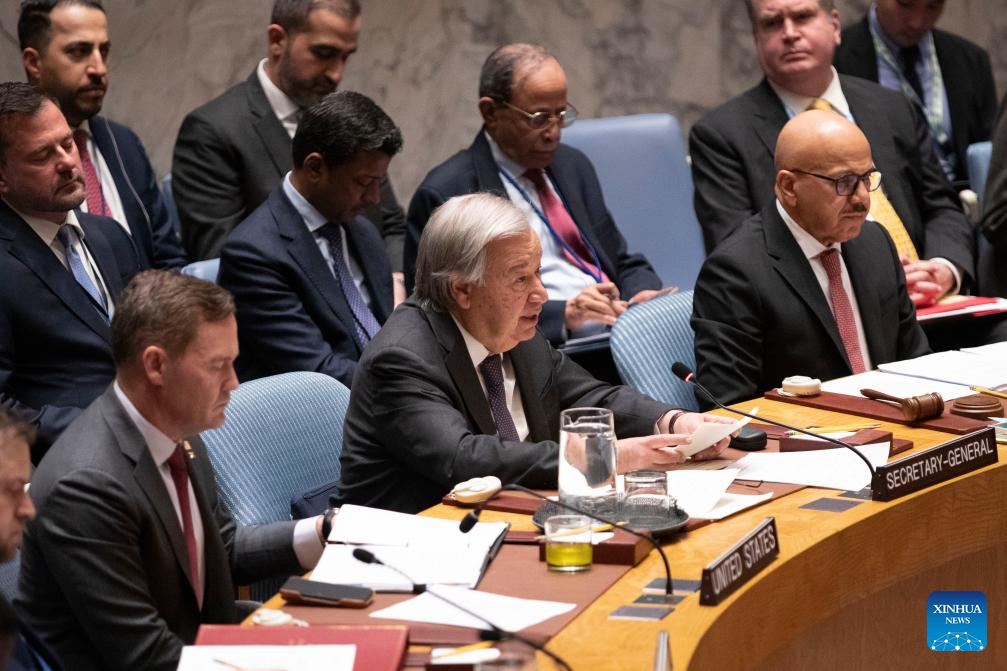 UN Secretary-General Antonio Guterres (C, front) speaks during the UN Security Council open debate on the safety and protection of waterways in the maritime domain, at the UN headquarters in New York, April 27, 2026. [Photo/Xinhua]
UN Secretary-General Antonio Guterres on Monday called for the reopening of the Strait of Hormuz.
"Navigational rights and freedoms through the Strait of Hormuz must be respected ... These principles must be upheld in full, and without delay," he said at a Security Council open debate on the safety and protection of waterways in the maritime domain.
"I appeal to the parties: open the strait, let ships pass, no tolls, no discrimination, let trade resume, let the global economy breathe," said Guterres.
Since early March, the disruption of shipping through the Strait of Hormuz has struck at global energy security, food supplies and trade, he said.
The Strait of Hormuz is one of the world's most critical maritime chokepoints. It carries roughly one-fifth of global oil trade, one-fifth of global liquefied natural gas, and nearly one-third of internationally traded fertilizers. Safe, unimpeded passage is an economic and humanitarian imperative, the UN chief said.
The disruption of shipping through the Strait of Hormuz has brought about immediate economic shock, and everyone is paying the price: acute volatility in energy and commodity markets, surging transport and insurance costs, and the worst supply chain disruption since COVID-19 and the Ukraine crisis, said Guterres.
"These pressures are cascading into empty fuel tanks, empty shelves -- and empty plates. The humanitarian toll is mounting," he said. "This crisis coincides with critical planting seasons. Prolonged disruption risks triggering a global food emergency -- pushing millions, especially in Africa and South Asia, into hunger and poverty."
The burden falls heaviest on least developed countries and small island developing states -- nations most dependent on maritime imports, and least able to absorb a shock they did nothing to cause, he said.
Guterres said this moment called for restraint, dialogue and confidence-building. He offered his good offices to help find common ground.
More broadly, he called for respect for international law, for efforts to address the root causes of maritime insecurity, and for deepening dialogue and cooperation.
"The ocean must be a zone of peace and cooperation -- not confrontation or coercion. This is our moment to choose -- and act," said Guterres.


 京公网安备 11010802027341号