Share:

As the 16th Beijing International Film Festival concluded on Sunday, British composer Simon Franglen spoke to China.org.cn about his duties as a juror for the festival's prestigious Tiantan Award. He also reflected on his decades-long career scoring some of Hollywood's biggest blockbusters, including the "Avatar" films.
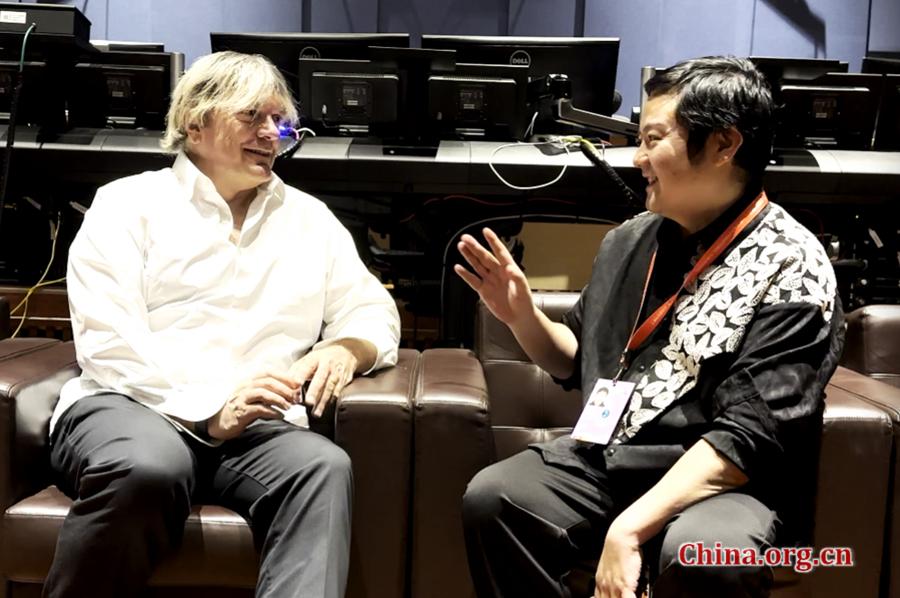
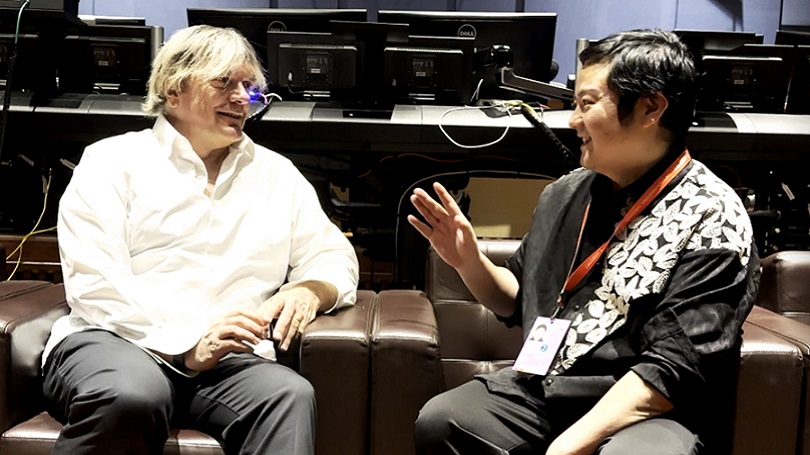
British composer Simon Franglen speaks to a China.org.cn reporter during an interview at the 16th Beijing International Film Festival in Beijing, April 24, 2026. [Photo/China.org.cn]
For Franglen, being in Beijing feels familiar. "This is my 15th trip to China, and probably my eighth trip to Beijing," he said. "I always love coming here." What strikes him most each time is the pace of change. "Everything is changing. It's remarkable the speed at which China is evolving," he noted.
As a juror, Franglen watched nearly 40 hours of films alongside his fellow jury members. "Being on the festival has been exciting. It's also been very hard work," he admitted. "We watched every single one all the way through."
He said he was looking for challenging cinema from across the world, including China — films by young filmmakers or just filmmakers who are trying to push cinema forward and do unique and new things. "And we found some of those. There's some amazing work there."
Awards were handed out Saturday night. The British film "Dragonfly" earned three major awards, those being best actress, best screenplay and best film. Composer Sten Sheripov won best music for "Supporting Roles," a Georgian-Estonian-Turkish co-production.
Besides being a juror, Franglen attended other events during the film festival, including a masterclass on his career and his work on the "Avatar" films, as he has a long history with the franchise. He worked on the first film as lead arranger, spending a year on the project. He has since composed the scores for "Avatar: The Way of Water" and "Avatar: Fire and Ash."
Working with director James Cameron, he said, is a unique privilege. "Jim loves music. He believes that music and sound are half of the experience in the cinema," Franglen explained. "He believes that when you forget about music and sound, you forget about the emotion within a film."
Cameron, he added, allows him to take risks. "But he also cares about what I do. To have a collaborator like Jim, who cares about every note I write — that's a great thing for a composer."
Franglen also paid tribute to James Horner, who composed the score for the original "Avatar" before his death in 2015. "I hope he looks down at the work I've done on the last two films and approves of what I have done," Franglen said.
The musician said he has drawn creative inspiration from his travels in China. For "Avatar: Fire and Ash," he incorporated sounds he discovered during a trip to Inner Mongolia in 2014.
"The Ash People — the villains in 'Avatar 3' — the sound of them I took from my experience in Inner Mongolia with the Morin khuur, the string instruments," he revealed. "I used them for the Ash People because that was a texture I remembered."
He also expressed interest in collaborating with Chinese filmmakers. "I had a meeting this morning to work on hopefully some interesting Chinese films coming up," he said. "I like working in China. I like working with Chinese directors, and I'm looking forward to doing it again."
Franglen previously estimated at a festival forum that music and sound carry roughly 30% of a film's narrative weight. Asked how he arrived at that figure, he broke it down.
"Dialogue tells you what to think. But music helps tell you what to feel," he said. "Sound effects are important too. Jim thinks sound and music are about 50% of the experience. So of that, I'd say music is 30% and sound effects are 20%."
His advice to filmmakers is to not try to copy somebody else's score. "Try to make the music be the music for your film, not copying somebody else's film," he urged. "A lot of young composers and filmmakers often just take the music from some other film when they want it to sound like that."
The result, he warned, is a film that lacks its own character. "The music should have the character of the film it's in — not somebody else's film."


 京公网安备 11010802027341号